
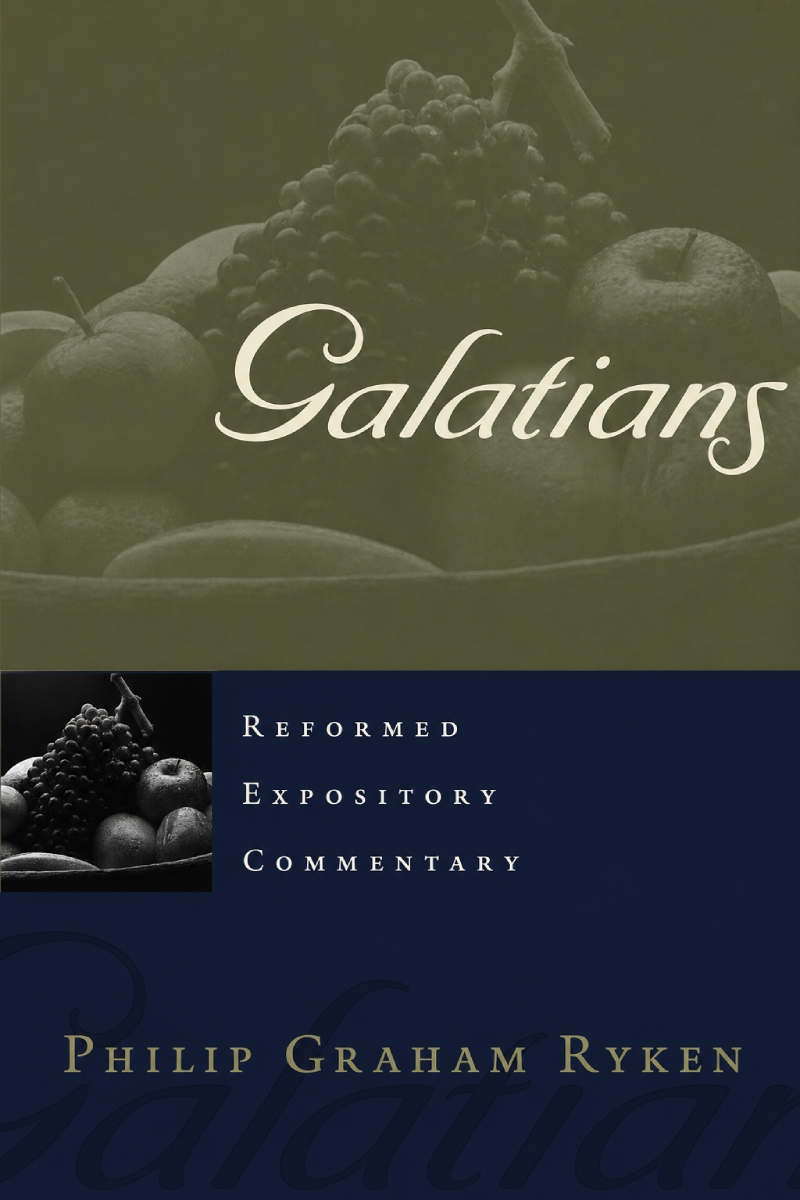
Galatians (Reformed Expository Commentary)
Philip Graham Ryken expounds Galatians as a gospel of grace for “recovering Pharisees.” He explains justification by faith apart from works, freedom from legalism without license, law and promise, adoption, union with Christ, and the Spirit-led life in which Christian freedom produces holiness, love, service, and spiritual fruit rather than self-righteous performance.
Available Instantly
About This Book
Philip Graham Ryken’s Galatians is an expository commentary on Paul’s letter written around the question of how sinners are made right with God and how those who have received the gospel are then meant to live. Ryken presents Galatians as a message for “recovering Pharisees”: people tempted to base their standing with God on religious performance. The governing claim is that justification comes through faith in Jesus Christ rather than works of the law, and that the same gospel of grace liberates Christians from legalism without turning freedom into moral license.
The opening chapters establish the authority and exclusivity of the gospel. Ryken explains Paul’s apostolic calling, his insistence that there is no other gospel, the divine origin of his message, his relationship with the Jerusalem apostles, and the confrontation with Peter at Antioch. Galatians 2:15–21 becomes a central statement of justification by faith and of the believer’s new life in relation to Christ. Ryken uses this section to address the practical religious question beneath the controversy: Can anything we do establish or improve our acceptance before God? His answer follows Paul’s argument that righteousness cannot come through law-keeping but only through Christ.
Galatians 3–4 develops the gospel of free grace through Abraham, promise, law, faith, sonship, and covenant. Ryken explains why the experience of the Spirit cannot be perfected by human effort, how Abraham becomes an example of justification by faith, how Christ bears the curse of the law, and why the promise precedes and governs the law’s role. The law leads to Christ rather than providing an alternate way of salvation. The movement from slavery to sonship in Galatians 4 gives substantial attention to redemption and adoption, while the Hagar and Sarah passage develops Paul’s contrast between slavery and freedom through the two women and two covenants.
Galatians 5–6 then asks what Christian freedom looks like in daily life. Ryken treats freedom from circumcision and legalism together with the warning that liberty is not license. Christian liberty becomes freedom to serve one another in love. The conflict between flesh and Spirit, the works of the flesh, and the fruit of the Spirit lead into explicit teaching on sanctification. Ryken describes the Christian life in terms of putting sinful desires to death and walking, living, and keeping in step with the Holy Spirit. The Spirit does not merely begin the Christian life; he directs its continuing growth in holiness and fruitfulness.
The final chapters apply this spiritual life to restoring a person caught in sin, bearing one another’s burdens, sharing good things, doing good, sowing and reaping, humility, and perseverance. The commentary closes where the letter repeatedly returns: boasting only in the cross of Christ rather than religious status or performance.
Ryken therefore connects major doctrines with the reader questions they answer. How can I know I am accepted by God? What is wrong with trying to earn spiritual standing through good works? What is the proper role of God’s law? What does it mean to be justified by faith? How does adoption change a believer’s identity? What is Christian freedom, and how can it avoid both legalism and self-indulgence? How does the Holy Spirit produce real holiness rather than mere rule-keeping? The exposition answers these questions through Galatians’ own movement from gospel defense, to the doctrine of grace, to life in the Spirit.
The commentary is strongly Christ-centered and pastoral while remaining tied to the structure of the letter. Its central subjects—justification by faith, salvation by grace, Christian freedom, the cross, law and promise, adoption, union with Christ, and Spirit-led sanctification—are presented as one coherent gospel: Christians begin by grace, stand by faith, and live out their freedom through the transforming work of the Holy Spirit.
Book Details

Reading Fit
STUDY LEVEL
Fundamental, Intermediate
STUDY SCOPE
Individual Book, New Testament
BOOKS INCLUDED

Edition & Format
PUBLISHED
November 17, 2017
AVAILABLE FORMATS
hardcover, kindle
LENGTH
303 pages

Topics Covered
You Might Also Like