
Expositions of Holy Scripture: Ephesians, Peter, and John
Alexander Maclaren expounds Ephesians, 1 and 2 Peter, and 1 John as a movement from God’s grace in Christ to a transformed Christian life. The sermons develop salvation by grace, union with Christ, the Church, prayer, spiritual maturity, holiness, suffering, the armor of God, divine light and love, and the believer’s hope, showing how apostolic doctrine becomes lived character.
Available Instantly
About This Book
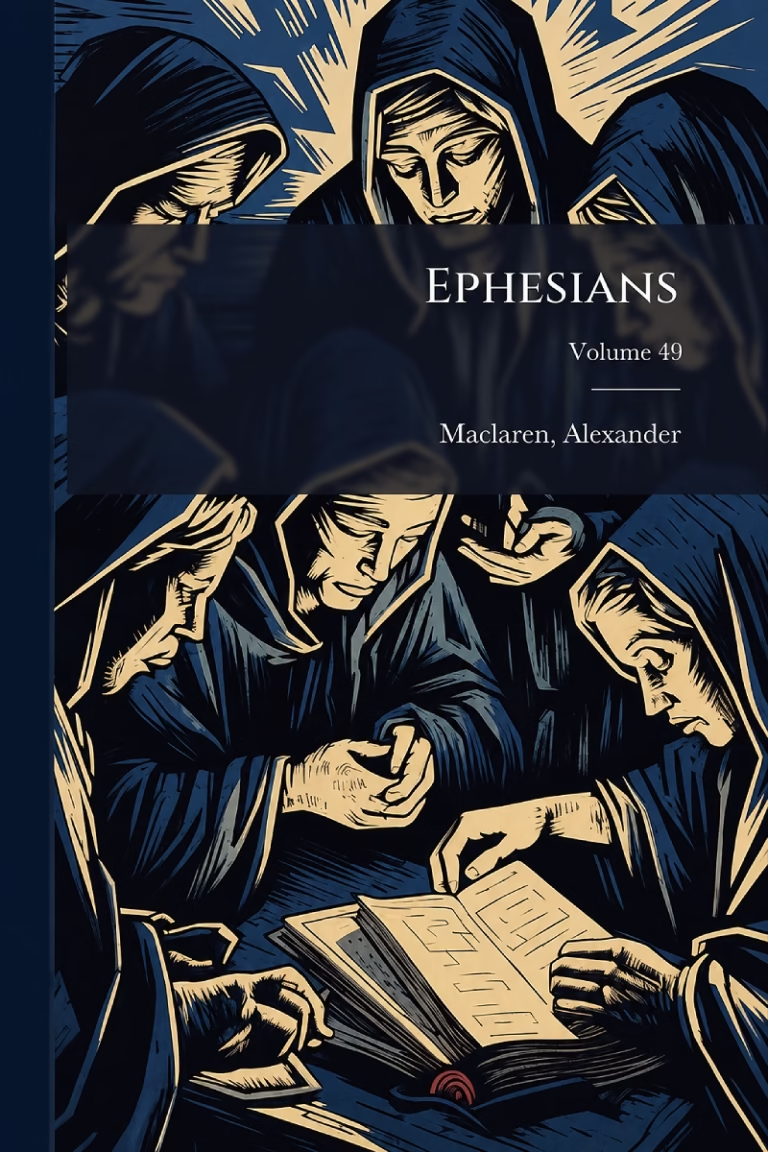
Expositions of Holy Scripture: Ephesians, Peter, and John collects Alexander Maclaren’s sermons from Ephesians, 1 Peter, 2 Peter, and 1 John. Ephesians receives the most extensive treatment, while the three other epistles receive substantial, separately developed exposition. Across the volume Maclaren repeatedly connects what God has given in Christ with the kind of life that should follow: faith, holiness, love, perseverance, spiritual growth, and visible Christian character.
Ephesians begins with the believer’s spiritual position and blessings in Christ. Maclaren develops sainthood, adoption, redemption, inheritance, hope, and divine power from Ephesians 1. In Ephesians 2:1–10 he moves from spiritual death to life and emphasizes salvation by grace through faith, insisting that good works are the fruit rather than the cause of God’s saving action. Christ as cornerstone then leads into the Church as God’s household and spiritual building, where former divisions are overcome by a shared relation to Christ.
Ephesians 3:14–21 receives concentrated treatment of prayer, inward strengthening by the Holy Spirit, Christ dwelling in the heart through faith, the love of Christ, and fullness in God. Union with Christ is not treated as a merely abstract position; Maclaren presents fellowship with the indwelling Christ as the source from which strength, love, holiness, and maturity grow. These sermons speak directly to readers asking how Christian doctrine becomes inward spiritual experience rather than remaining external belief.
Ephesians 4–5 develops spiritual growth and sanctification through the unity of believers, the distribution of grace, growth toward the measure of Christ, learning Christ, putting off the old way of life and putting on the new, refusing darkness, walking as children of light, and redeeming the time. The Holy Spirit is both the divine giver of life and the One whose presence makes unholy conduct grievous. Christian living therefore appears as a Spirit-enabled transformation of conduct, relationships, priorities, and use of time.
Ephesians 6:10–17 forms a substantial exposition of spiritual warfare. Maclaren treats the armor of God piece by piece: truth, righteousness, readiness of the gospel, faith, salvation, and the Word of God. The emphasis is not fascination with evil but steadfast resistance through resources God supplies. Prayer and dependence remain part of this practical posture.
First Peter shifts attention toward tested faith, Christian hope, holiness, suffering, and the Cross. Maclaren develops the trial of faith, joy in Christ, the prophetic witness to Christ’s sufferings, the call to holiness, living stones built upon Christ, spiritual sacrifices, humility, and Christ as the believer’s example under pressure. The letter answers how Christians are to endure suffering without allowing hardship to separate faith from holiness and hope.
Second Peter stresses God’s gift and the believer’s responsibility to grow. Participation in the divine nature, diligence in forming Christian character, accountability, the certainty of God’s rule, and growth in grace all reinforce Maclaren’s recurring conviction that spiritual life must advance rather than remain static.
First John concentrates on fellowship with God as light and love. Walking in the light, cleansing from sin, resisting the passing world, knowing the love that makes believers children of God, purifying hope, practical righteousness, and love revealed in Christ all become tests of lived fellowship. Maclaren’s concern throughout is that truth about God should become recognizable in conduct.
The volume therefore serves readers asking what grace produces after salvation, how Christ dwells within the believer, how Christians mature and become holy, what the Church is, how to stand in spiritual conflict, how to endure trials, and how faith, light, love, hope, and holiness become a coherent Christian life.
Book Details

Reading Fit
STUDY LEVEL
Intermediate
STUDY SCOPE
Individual Book, New Testament
BOOKS INCLUDED

Edition & Format
PUBLISHED
March 24, 2011
AVAILABLE FORMATS
paperback, hardcover, kindle
LENGTH
255 pages

Topics Covered
You Might Also Like