

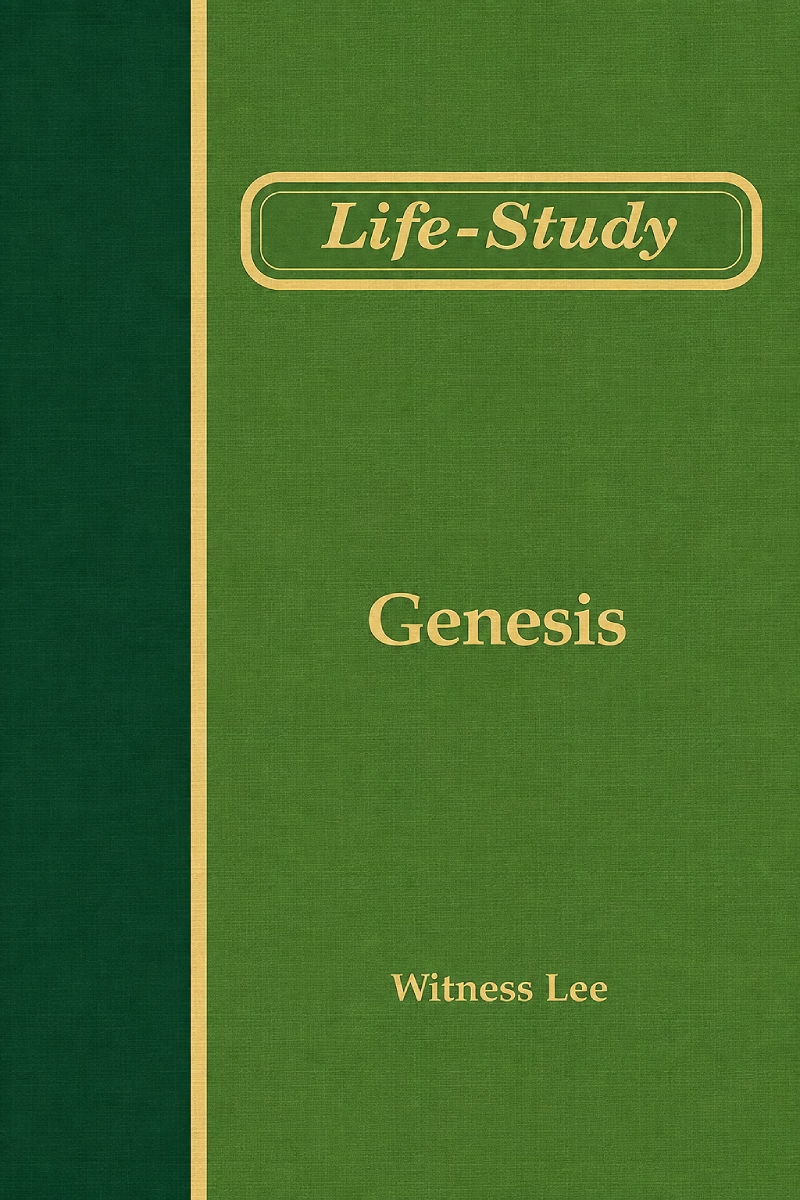
Life-study of Genesis
Witness Lee reads Genesis as a book of life: creation reveals God's purpose, the two trees disclose two opposing sources, and the lives of Adam, Noah, Abraham, Isaac, Jacob, and Joseph trace God's work from calling and grace through transformation, maturity, and reigning. The study follows Genesis's seeds of divine revelation forward to Christ, the church, and Revelation.
Available Instantly
Editorial Disclaimer
About This Book
Life-study of Genesis treats Genesis as the opening revelation of divine life and God's purpose rather than merely as a record of origins or a collection of biographies. Witness Lee's governing approach is that the major truths developed throughout Scripture are present in Genesis as seeds. He follows those seeds through later biblical revelation, especially their New Testament development and their consummation in Revelation, making the book a sustained study both of Genesis itself and of its place in the continuity of the Bible.
The opening chapters are read in terms of life, God's purpose, and God's building. Genesis 1 is developed not only as creation but as a picture of God's restorative work and His intention that humanity express Him in His image and represent Him with dominion. Genesis 2 becomes a major spiritual framework: the tree of life and the tree of the knowledge of good and evil disclose two sources and two lines running through Scripture. The river, gold, bdellium, and precious stone are connected with transformation and building, while the creation of the woman from Adam is treated as a picture pointing to Christ and the church. This section helps readers asking what God's purpose for humanity is, what it means to take God as life, and why the Bible repeatedly contrasts life with independent knowledge.
The study then follows the fall and God's promised salvation. Adam and Eve, Cain and Abel, Enoch, Noah, the ark, the flood, and Babel are developed as more than history: they disclose sin, Satan's corruption, God's judgment, grace, salvation, walking with God, resurrection, and the beginnings of human government and kingdom. Genesis 3:15 receives particular attention as the promise of the seed of the woman. Noah and the ark become a substantial picture of God's salvation from judgment and of a life that continues God's purpose.
A large part of the work traces the experiences of Abraham, Isaac, Jacob, and Joseph. Abraham's calling, faith, the promised seed and land, covenant, circumcision, fellowship with God, and intercession show the life of one called by God. Isaac emphasizes inheritance and the enjoyment of grace, and his marriage is treated as a type of Christ receiving the church as His bride. Jacob receives especially extensive treatment as a picture of God's transforming work. His natural strength is exposed and dealt with until the supplanter becomes Israel; Bethel, the pillar, breaking, transformation, and eventual maturity show how God works Himself into a person for His building. Genesis 35 and the later patriarchal narratives therefore answer practical questions about how a believer is changed by God, why divine discipline and breaking are needed, and what spiritual maturity looks like.
The closing portion develops Joseph as the reigning aspect of matured Israel. His dreams, purity, suffering, release, exaltation, wise administration, and dealings with his brothers are connected with a governing vision and a mature life capable of reigning. Genesis 37–50 is thus used to show that spiritual maturity is not merely inward growth but a life under God's vision that can represent Him and exercise authority.
Throughout, Lee interprets persons, events, objects, and relationships typologically. Christ, the church, God's house, covenant, grace, transformation, maturity, and kingdom are repeatedly related to the Genesis record. The result is a detailed individual-book study for readers seeking Genesis exposition, Christ in Genesis, biblical types, the spiritual significance of the patriarchs, the meaning of the two trees, the relation of life to God's building, and the process by which God brings His people from calling and grace to transformation, maturity, and reigning for the fulfillment of His eternal purpose.
Book Details

Reading Fit
STUDY LEVEL
Advanced, Intermediate
STUDY SCOPE
Individual Book, Old Testament
BOOKS INCLUDED

Edition & Format
PUBLISHED
January 21, 2026
AVAILABLE FORMATS
hardcover, kindle, audiobook
LENGTH
1796 pages
· 61h 40m audio

Topics Covered
You Might Also Like

Favorites
Editorial Disclaimer
TUBT includes this book because we believe it contains material that is worth reading, considering, and bringing into the wider Christian discussion. Its inclusion should not be understood as an endorsement of Witness Lee, Living Stream Ministry, the Local Church, or the “Lord’s Recovery” movement associated with his ministry.
TUBT does not recommend joining or identifying with that movement. We encourage readers to approach Lee’s writings with careful biblical discernment and to test his claims against Scripture.
Readers should also be aware that some of Lee’s writings contain strong criticisms of other Christian traditions and ministries and, at times, present distinctive claims concerning the church and the movement with which he was associated. TUBT does not share or endorse those claims.
We have chosen to include a limited number of Lee’s books because we believe portions of his work make a meaningful contribution to important theological and spiritual discussions. We recommend reading them critically, weighing what is valuable while carefully examining what should not be accepted.