
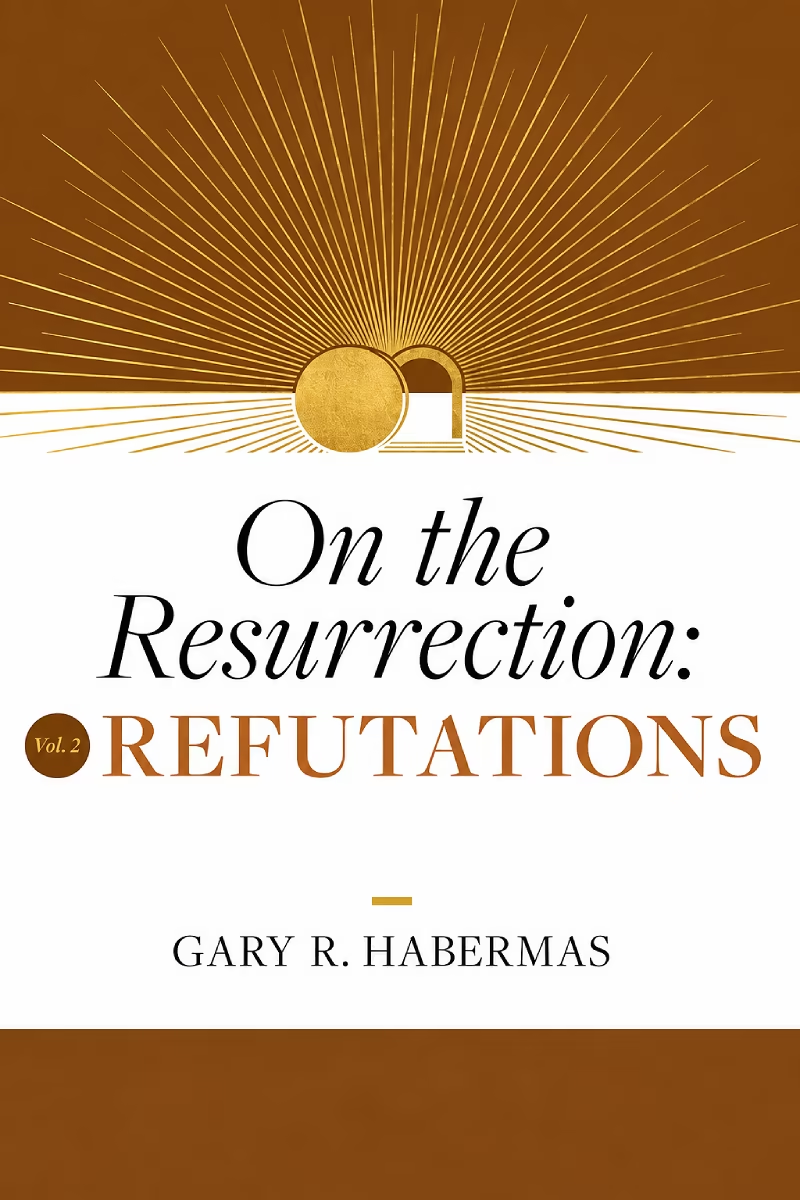
On the Resurrection: Refutations Vol 2
This extensive second volume of On the Resurrection examines and answers major objections and alternative explanations for Jesus’ resurrection, from second-century critics and Hume to stolen-body, swoon, legend, hallucination, and vision theories. Habermas also treats Gospel discrepancies, naturalism, the Talpiot tomb, and Islamic objections in a sustained historical refutation.
Available Instantly
About This Book
On the Resurrection, Volume 2: Refutations is Gary R. Habermas’s sustained examination of objections and alternative explanations offered against the resurrection of Jesus. Where the first volume of the series concentrates on positive evidence, this volume asks whether competing proposals can explain the historical data more successfully. Its governing purpose is therefore refutational: Habermas traces challenges from the early centuries of Christianity through modern critical scholarship and then evaluates fraud, apparent-death, legend, psychological, visionary, agnostic, and naturalistic approaches in detail.
The book begins historically with second-century challenges to Jesus’ death and resurrection. Early alternative traditions and critics provide examples of how objections appeared soon after the apostolic period. Habermas discusses sources and figures such as the Gospel of Thomas, Marcion, and Celsus as part of this background, distinguishing their historical setting from much later reconstructions. The treatment then turns to David Hume’s famous argument against miracles and later reformulations of Hume’s reasoning, asking whether historical testimony for an extraordinary event may be rejected in advance because the event is miraculous.
A long historical section follows the development of resurrection criticism through nineteenth- and twentieth-century theology. Liberal explanations are presented in their own intellectual settings rather than treated as one undifferentiated skeptical theory. Habermas considers how liberal scholars proposed natural or subjective alternatives, how other liberals criticized those proposals, how conservative scholars responded, and how later figures such as Karl Barth and Rudolf Bultmann reshaped the debate. This gives readers a history of resurrection objections as well as an argument against them.
The central portion then tests specific alternative theories. One chapter addresses apparent discrepancies in the Gospel resurrection narratives. Separate chapters investigate proposals that the disciples stole Jesus’ body or that someone else removed it. The swoon or apparent-death theory is treated as its own explanation. Two chapters examine legend proposals, including comparisons with dying-and-rising gods and claims about supposedly resurrected historical persons. Other chapters examine illumination and illusion hypotheses, hallucination theories, and objective-vision explanations. These approaches are compared with the historical facts concerning Jesus’ death, the disciples’ experiences, early proclamation, and the development of resurrection belief.
Habermas also considers the position of resurrection agnosticism: the view that the evidence may resist naturalistic explanations but still does not justify concluding that Jesus rose. He then gathers several reasons why naturalistic alternatives repeatedly fail as complete explanations. The issue of worldview is therefore important throughout the volume. Naturalism, miracle claims, historical method, and the legitimacy of supernatural explanation are not peripheral philosophical questions; they affect how proposed explanations are constructed and assessed.
Three appendices extend the refutation to prominent modern issues. The Talpiot tomb proposal is examined as a claim about the burial and family of Jesus. A separate discussion considers attempts to establish naturalism as the required framework for historical inquiry. Another appendix addresses Islamic objections to Jesus’ death and resurrection, making the book relevant to readers comparing Christian and Islamic claims about the crucifixion and resurrection.
Matthew, Mark, Luke, and John materially shape the volume because the death, burial, empty tomb, appearances, and alleged narrative discrepancies must be assessed from the Gospel evidence. First Corinthians 15 also provides early testimony to Jesus’ death, resurrection, and appearances and functions as an important control when later explanations are evaluated. The volume is not a Gospel commentary, but these New Testament sources recur because the alternative theories are attempts to explain claims preserved in them.
The book addresses readers asking whether the disciples stole the body, whether Jesus merely survived crucifixion, whether resurrection belief developed as legend, whether hallucinations or visions explain the appearances, whether the Gospel accounts contradict one another, whether Hume disproved rational belief in miracles, whether naturalism should control historical conclusions, and how proposals such as the Talpiot tomb or Islamic denial of the crucifixion compare with the historical evidence. Its distinctive search value is the breadth and depth with which it maps and refutes competing resurrection explanations.
Book Details

Reading Fit
STUDY LEVEL
Advanced
STUDY SCOPE
New Testament, Topical
BOOKS INCLUDED

Edition & Format
PUBLISHED
September 15, 2024
AVAILABLE FORMATS
hardcover, kindle
LENGTH
894 pages

Topics Covered
You Might Also Like