
Risen Indeed: A Historical Investigation
Gary R. Habermas asks whether Jesus’ resurrection can be investigated and established as history. Beginning with miracles, historical method, reason, and faith, he compares naturalistic and faith-centered alternatives with the case for a demonstrable resurrection, then relates his foundational research to later scholarship and the minimal-facts method.
Available Instantly
About This Book
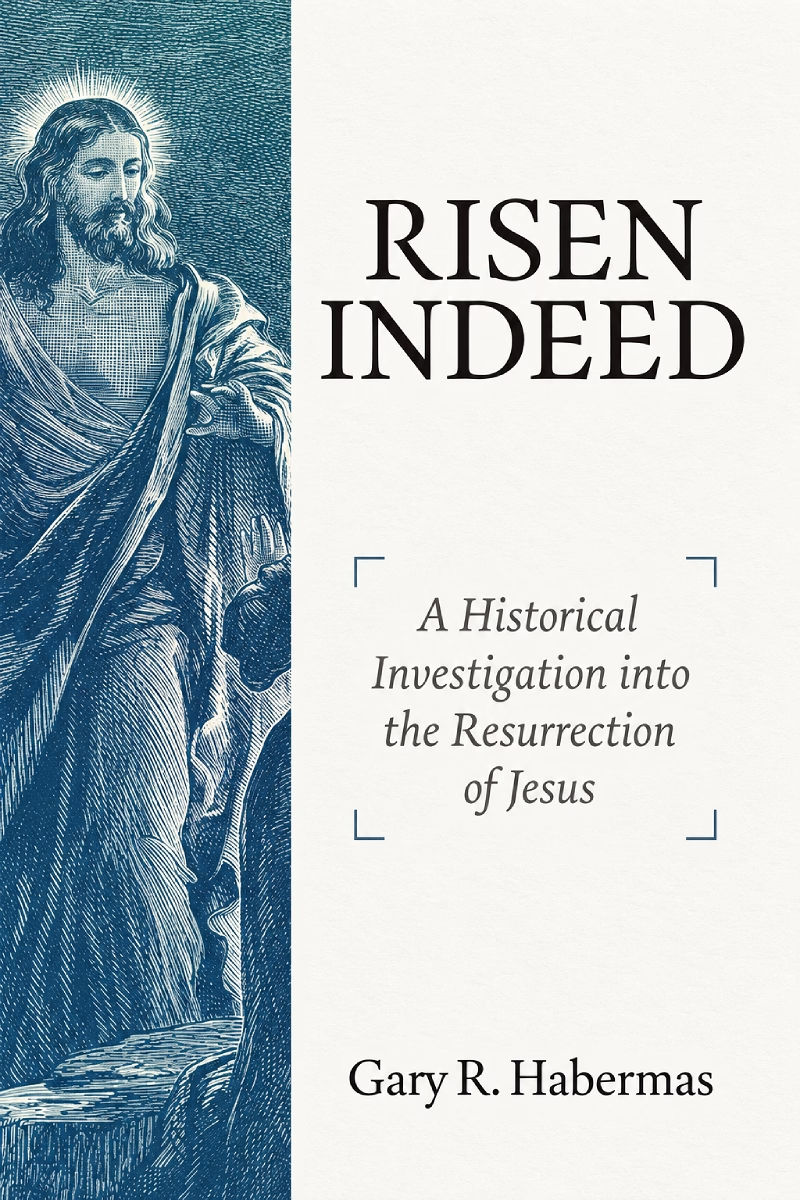
Risen Indeed: A Historical Investigation Into the Resurrection of Jesus presents Gary R. Habermas’s foundational historical and philosophical work on the resurrection together with a new introduction reflecting later decades of research. The central question is methodological as well as evidential: Can the claim that Jesus rose from the dead be investigated by historical reasoning, or must resurrection be accepted or rejected before the evidence is considered? Habermas argues that resurrection should be treated as a historical question and that competing explanations should be compared according to their ability to account for the known facts.
The first major part prepares the method of investigation. Habermas begins with the importance of resurrection in Christian theology and then examines the possibility of miracles. He distinguishes miracle from myth, considers whether modern science can rule out miraculous events in advance, and argues that claims should be examined in terms of historical probability rather than excluded by a closed view of reality. A chapter on history and miracles asks what historical investigation can establish, how historians reason from evidence, and whether a supernatural explanation may be considered when it best accounts for the data. The following treatment of reason and faith examines whether historical argument and Christian faith must be opponents.
The second part organizes major approaches to Jesus’ resurrection into three broad positions. The first says that the resurrection did not occur. David Hume serves as a major representative because of his argument concerning miracles, and Habermas also considers naturalistic approaches associated with figures such as Heinrich Paulus, David Strauss, and Otto Pfleiderer. These positions are important not merely as historical curiosities but because they expose the assumptions and explanatory burdens involved in non-resurrection accounts.
The second position holds that resurrection occurred but cannot be historically demonstrated. Søren Kierkegaard receives extended treatment as Habermas explores the relation between faith and objective historical proof; related theological approaches, including those associated with Karl Barth and Rudolf Bultmann, enter the comparison. The third position holds that resurrection occurred and can be supported historically. Wolfhart Pannenberg is a principal representative of this approach because he treats Jesus’ resurrection as a public event open to rational historical inquiry.
The final part evaluates the three positions and returns to the evidence and explanatory method. Habermas argues that the literal resurrection of Jesus provides the most adequate explanation of the relevant historical facts and that rival naturalistic theories fail to explain the data with equal force. The New Testament is important here not as a substitute for historical method but as a collection of early sources that must be assessed historically. First Corinthians 15 is especially significant because of its early resurrection tradition and testimony to appearances, while the Gospel accounts supply the narrative setting of Jesus’ death, burial, empty tomb, and post-resurrection appearances. Form criticism and redaction criticism are also considered in relation to the early place of resurrection proclamation in Christian history.
The 2021 edition adds an extensive introduction that looks back on the development of resurrection research after the original dissertation. Habermas discusses the Third Quest for the historical Jesus, trends in resurrection scholarship since the mid-1970s, and the emergence of his minimal-facts methodology. The minimal-facts approach concentrates on historical data that have strong evidential support and broad scholarly acceptance, then asks which explanation best accounts for them. In this edition it functions as an important bridge between the early dissertation and Habermas’s later work rather than replacing the dissertation’s larger philosophical and historiographical argument.
The book addresses readers asking: Can miracles be investigated historically? Is the resurrection of Jesus a matter of faith alone? What counts as historical evidence for resurrection? Why is Hume’s argument about miracles still influential? What do naturalistic resurrection theories have to explain? Why do Kierkegaard and Pannenberg differ about historical demonstration? How do 1 Corinthians 15, the Gospel traditions, and the resurrection appearances function as evidence? And how did the minimal-facts method emerge from wider resurrection research? Its strongest contribution is the integration of resurrection apologetics with the philosophy and method of historical inquiry.
Book Details

Reading Fit
STUDY LEVEL
Advanced, Intermediate
STUDY SCOPE
New Testament, Topical
BOOKS INCLUDED

Edition & Format
PUBLISHED
November 18, 2021
AVAILABLE FORMATS
paperback, kindle
LENGTH
313 pages

Topics Covered
You Might Also Like