
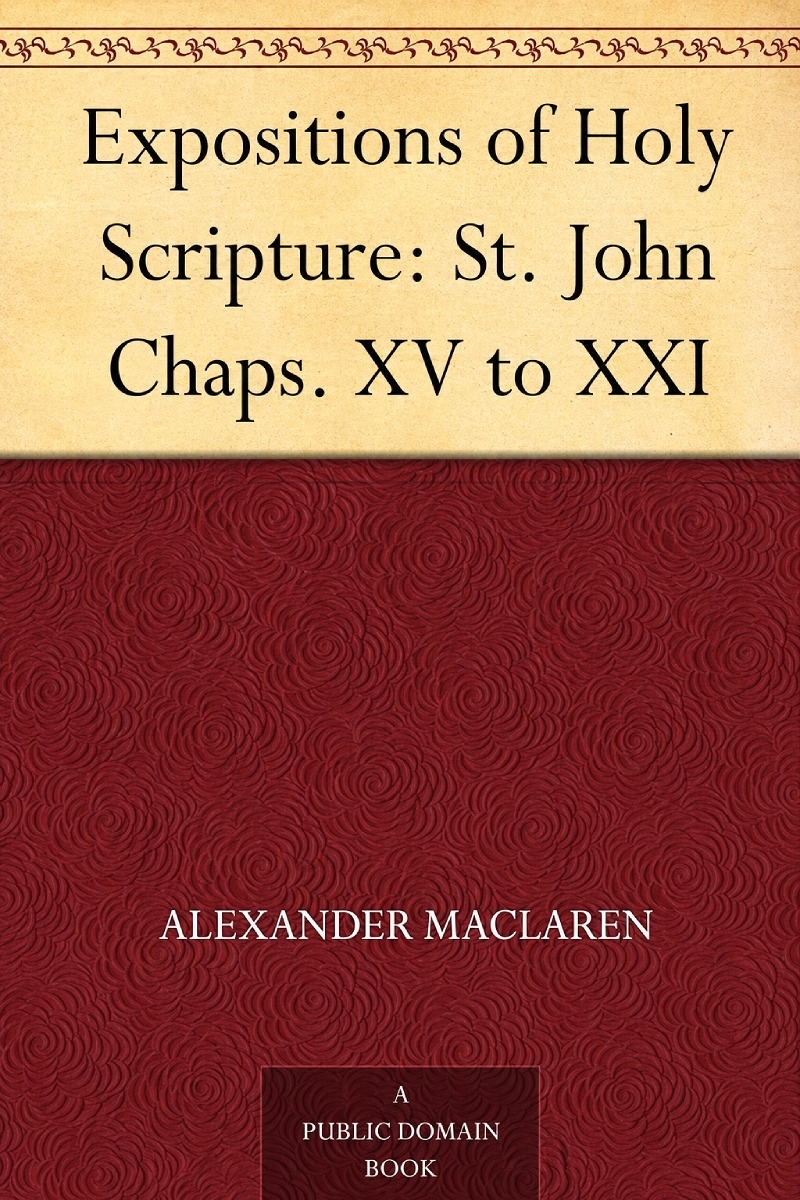
Expositions of Holy Scripture: John 15-21
Alexander Maclaren expounds John 15–21 from the vine and branches through the risen Christ’s final charge to Peter. The sermons develop abiding in Christ, love, Christian unity, persecution, the Holy Spirit, prayer, Christ’s intercession, His trial and crucifixion, resurrection, witness, restoration, and fruitful discipleship flowing from union with Him.
Available Instantly
About This Book
Expositions of Holy Scripture: John 15–21 covers the final major section of the Gospel of John, beginning with Jesus’ teaching on the vine and branches and ending with His risen appearance beside the Sea of Galilee. Alexander Maclaren follows the Farewell Discourse, Jesus’ prayer, arrest, trial, crucifixion, resurrection, and restoration of Peter, giving sustained attention to abiding in Christ, the Holy Spirit, love, prayer, the Cross, resurrection, witness, and fruitful discipleship.
John 15 opens with the true vine and the branches. Maclaren treats the image as a direct description of the living relation between Christ and believers: one life flows from the vine into the branches, and fruit depends upon continuing in that vital connection. Pruning, fruitfulness, answered prayer, obedience, and abiding in Christ’s love are all developed from this union. The chapter then broadens from the believer’s relation to Christ into love among disciples and the hostility they may face from the world.
John 16 turns to Christ’s departure and the coming of the Holy Spirit. Maclaren gives separate expositions to the Spirit’s work in relation to the world and to believers. Conviction of sin, righteousness, and judgment is connected with the facts about Christ, while the Spirit’s guidance into truth is presented as continuing illumination of what Jesus has revealed rather than an independent message detached from Him. The chapter also develops sorrow turned to joy, prayer in Christ’s name, the Father’s love, and peace in the midst of tribulation.
John 17 receives several sermons on Jesus as intercessor. Maclaren follows Christ’s prayer for His disciples, their preservation from the world’s evil, their sanctification, their unity, and their future presence with Him. Christian unity is therefore grounded not in organization alone but in shared relation to Christ and participation in the life given by God. The prayer also brings the glory, love, mission, and keeping power of God into view.
John 18 moves from the upper-room teaching into Christ’s arrest and trial. Maclaren considers Jesus’ self-possession before His captors, Peter’s denial, the religious proceedings, and the confrontation with Pilate. Christ’s kingship is shown as real but unlike ordinary political power, while the failure of His enemies and even His disciples exposes the contrast between human fear and His voluntary surrender.
John 19 receives sustained treatment of the crucifixion. Maclaren develops the eyewitness character of John’s account, the title placed on the Cross, Christ’s declaration that His work is finished, the Passover connection, and the burial by Joseph of Arimathea and Nicodemus. The Cross is treated as both completed saving work and the center from which Christ’s continuing work in His people proceeds.
John 20 turns to the resurrection morning, Mary Magdalene, the risen Lord’s commission, His gift to the disciples, Thomas’s confession, and the stated purpose of John’s Gospel. The resurrection confirms the identity of Jesus and becomes the ground of witness, faith, and mission. Maclaren’s exposition of Thomas emphasizes movement from doubt to direct confession of the risen Christ.
John 21 concludes with the disciples by the sea and especially with Peter. The recognition “It is the Lord,” Jesus’ repeated question “Lovest thou Me?”, the charge to feed His sheep, and the call to follow all become a study in restoration, love, service, and personal discipleship. Peter’s future suffering is placed beside the command to follow Christ without comparison with another disciple’s path.
The volume addresses readers asking what it means to abide in Christ, how the Holy Spirit guides believers, what Jesus prayed for His people, how Christian unity is formed, what the Cross accomplished, why the resurrection matters, how doubt becomes faith, and how restored believers are called into fruitful service.
Book Details

Reading Fit
STUDY LEVEL
Intermediate
STUDY SCOPE
Individual Book, New Testament
BOOKS INCLUDED

Edition & Format
PUBLISHED
May 12, 2012
AVAILABLE FORMATS
paperback, hardcover, kindle
LENGTH
292 pages

Topics Covered
You Might Also Like