

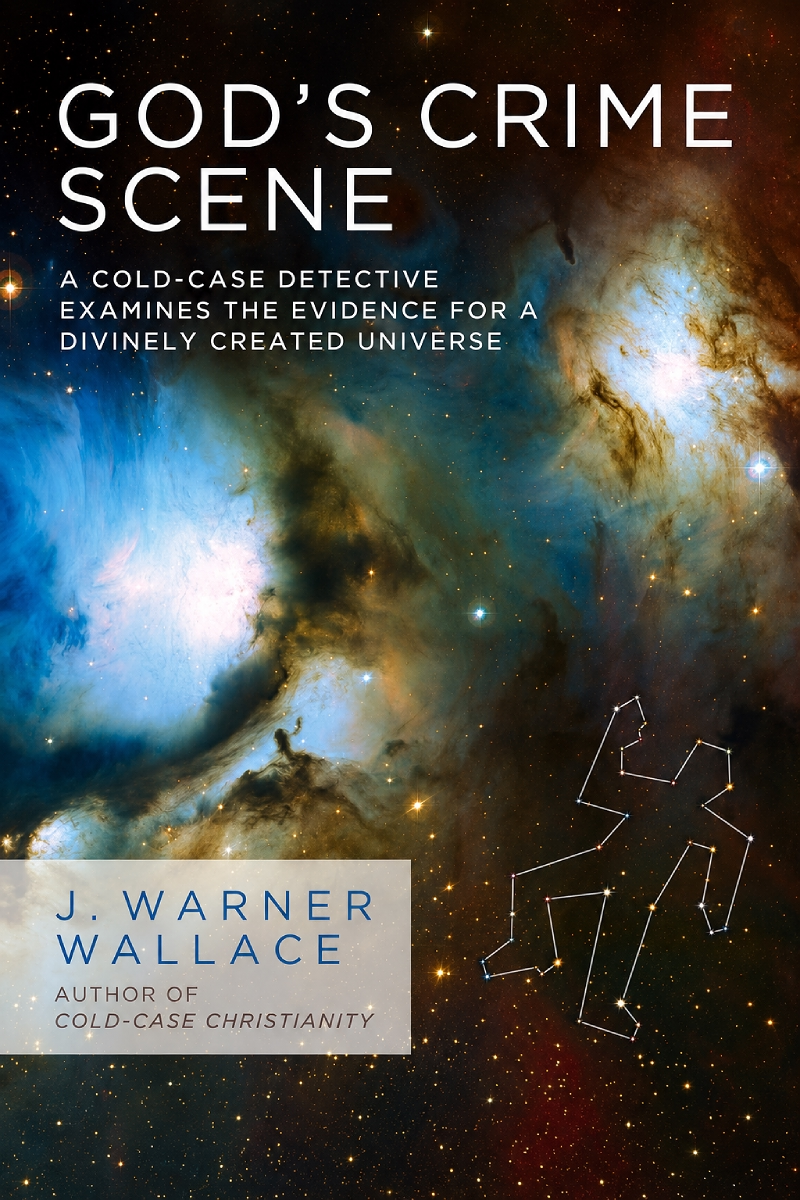
God’s Crime Scene
J. Warner Wallace investigates the universe as a cold-case crime scene and asks whether its features point beyond nature to a Creator. Eight major lines of evidence examine the universe’s beginning and fine-tuning, the origin and design of life, consciousness, free will, objective morality, and evil, building a cumulative case for God’s existence and attributes.
Available Instantly
About This Book
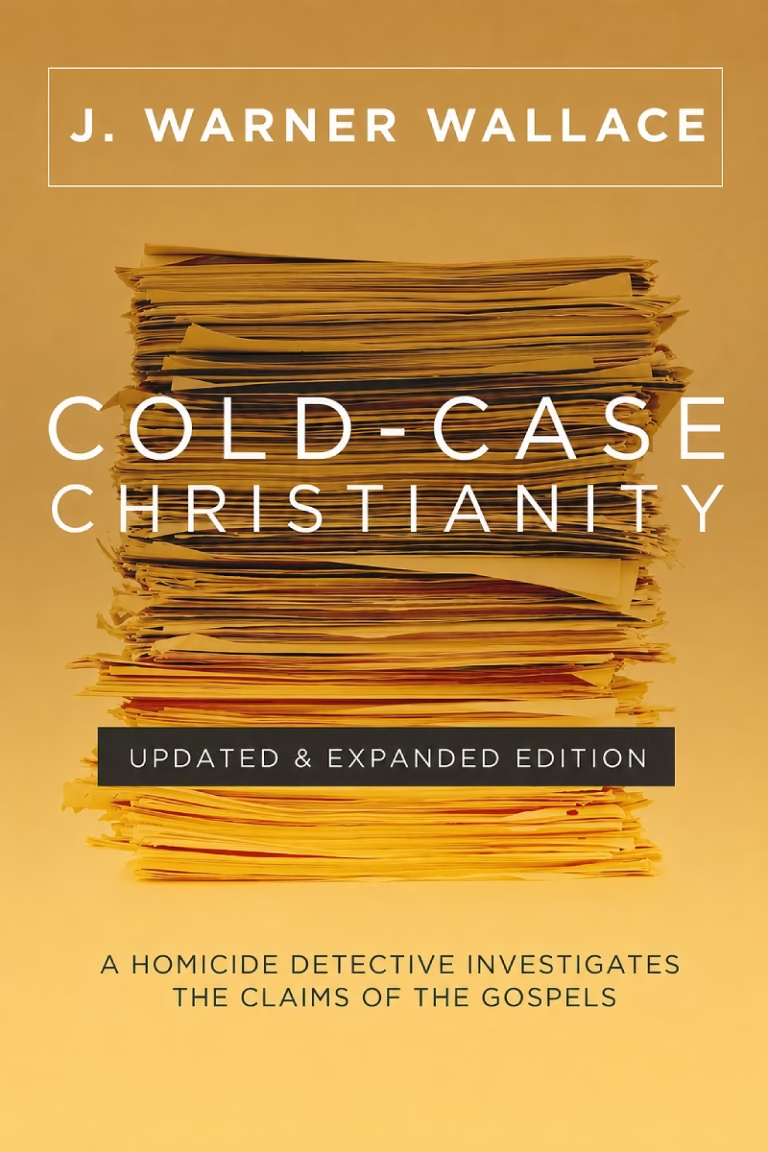
God’s Crime Scene: A Cold-Case Detective Examines the Evidence for a Divinely Created Universe applies J. Warner Wallace’s investigative method to the question of whether the natural universe can adequately explain itself. Wallace treats the universe as a metaphorical crime scene and asks whether all of the evidence found inside the natural world can be explained by causes that are themselves natural, or whether some features point beyond the universe to an external intelligent cause. The book develops a cumulative case through eight major investigations rather than relying upon one argument alone.
The first investigation concerns the beginning of the universe. Wallace examines whether space, time, and matter are eternal or whether the physical universe began to exist. If the universe had a beginning, he asks what kind of cause could account for it. The argument moves toward a cause that cannot itself be merely another physical object inside the same space-time system and therefore contributes to the book’s developing profile of a Creator beyond the natural universe.
Fine-tuning provides the second major line of evidence. Wallace considers physical constants, cosmic forces, initial conditions, and the narrow range within which a life-permitting universe can exist. Competing explanations such as necessity, chance, multiverse proposals, and design are compared using the investigative principle of explanatory power. The question is not merely why the universe exists, but why its conditions permit complex embodied life.
The next two investigations concern life. Wallace first asks how the earliest living systems could arise from nonliving chemistry and gives particular attention to DNA and functionally specific biological information. He then turns from the origin of life to the appearance of design in living systems. Coordinated biological structures, information, and purposeful organization are evaluated against competing naturalistic and intelligent-causation explanations.
Human consciousness provides a fifth line of evidence. Wallace asks whether subjective awareness, thought, intention, and first-person experience can be reduced completely to nonconscious matter. If consciousness is a real feature of human beings, he considers whether it is better explained by an ultimately mindless universe or by a cause that itself possesses mind.
Free will is treated as a distinct investigation. Wallace examines the common experience of agency, deliberate choice, and moral responsibility and asks whether these can be preserved if every human decision is determined entirely by prior physical causes. The existence of meaningful freedom is weighed alongside the cosmological and biological evidence as part of the cumulative case.
Objective morality forms the seventh investigation. Wallace distinguishes moral truths and obligations from personal preference, cultural custom, evolutionary advantage, and social convention. If some actions are objectively right or wrong regardless of human opinion, the book asks what kind of foundation can account for binding moral truth. This line of reasoning contributes to Wallace’s conclusion that the cause behind the universe is personal and morally significant rather than merely an impersonal force.
The final investigation addresses evil and injustice. Wallace treats evil as evidence that initially appears to count against God and asks whether suffering and wrongdoing are logically incompatible with the Creator profile developed from the earlier evidence. He also argues that identifying something as objectively evil presupposes a moral standard that itself requires explanation.
Across all eight investigations, Wallace uses cold-case concepts such as competing hypotheses, cumulative evidence, inference to the best explanation, explanatory scope, and the distinction between causes inside and outside a closed scene. The book addresses readers asking whether God exists, whether the universe requires a cause, whether fine-tuning and biological information indicate design, how consciousness and free will can be explained, why objective morality exists, whether evil disproves God, and whether naturalism can explain the full range of evidence found in the universe.
Book Details

Reading Fit
STUDY LEVEL
Fundamental, Intermediate
STUDY SCOPE
Topical
BOOKS INCLUDED

Edition & Format
PUBLISHED
August 1, 2015
AVAILABLE FORMATS
paperback, kindle, audiobook
LENGTH
322 pages
· 7h 43m audio

Topics Covered
You Might Also Like