
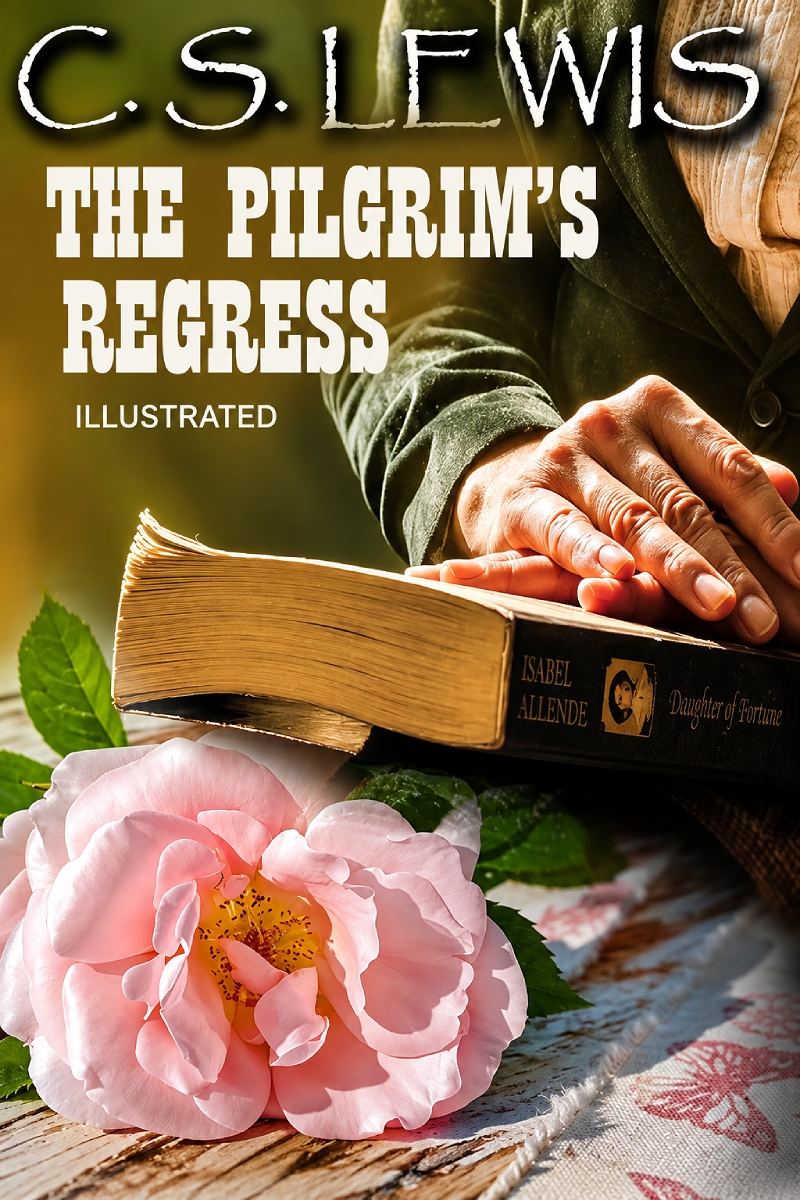
The Pilgrim’s Regress. Illustrated
C. S. Lewis turns his own road to Christianity into an allegorical search for the Island of “Sweet Desire.” John passes through sensuality, aestheticism, materialism, rationalism, and rival philosophies until Reason, Mother Kirk, the Grand Canyon of original sin, the Landlord’s Son, grace, and surrender reveal how Christianity answers both conscience and deep spiritual longing.
Available Instantly
About This Book
The Pilgrim’s Regress is C. S. Lewis’s allegorical apology for Christianity, reason, and Romanticism. Written soon after his conversion, the book turns a generalized version of his intellectual and spiritual journey into the travels of a pilgrim named John. John is drawn by an Island that awakens an intense “Sweet Desire,” but he must learn what that longing means, what cannot satisfy it, and why both conscience and desire ultimately point beyond the competing explanations he encounters.
John begins in Puritania beneath the distant authority of the Landlord and the Steward’s rules. His early experience combines moral law, guilt, fear, religious misunderstanding, and longing. He cannot live up to the demands placed upon him, yet neither can moral rules explain the Island that repeatedly attracts him. Lewis’s governing apologetic problem is therefore double: human beings face a moral claim they cannot simply erase, and they also experience desires that finite objects repeatedly fail to satisfy.
The first stages test false identifications of Sweet Desire. John confuses the Island with sensual pleasure, romantic feeling, aesthetic experience, cultural excitement, and intellectual fashion. Thrill and Eschropolis expose attempts to reduce the longing to emotion, art, sex, psychology, or social sophistication. Romanticism is not simply rejected; Lewis distinguishes the longing that can point beyond itself from the finite experiences that awaken or imitate it.
The Spirit of the Age gives the book one of its clearest confrontations between reason and reductionism. The giant tries to explain John as nothing more than visible physical processes. Reason, personified as a formidable woman, destroys the argument and becomes John’s guide. Lewis therefore presents reason as an ally of Christianity when it exposes explanations that deny dimensions of human experience merely because they cannot be reduced to matter.
At the Grand Canyon, Mother Kirk personifies the Church and explains the human predicament through the sin of Adam. Original sin is represented as a rupture no traveler can cross by choosing a better route. John and his companion Vertue initially resist her because each still hopes for a form of self-sufficiency. Vertue embodies moral seriousness and disciplined virtue, but virtue itself cannot bridge the canyon.
Their attempts to find another way carry them through the North and South, where Lewis satirizes opposing errors. The North represents systems that suppress desire, over-intellectualize life, or turn moral seriousness into abstraction. The South represents forms of irrationality, appetite, sensuality, and undisciplined experience. Along the way Lewis engages materialism, naturalism, humanism, philosophical idealism, pantheism, Freudian reductionism, rationalism, and other attempts to explain the world without accepting the Christian claim.
A hermit named History helps bring conscience and Sweet Desire together. The longings expressed in pagan imagination and the moral law given to the Shepherd People are shown as converging lines rather than unrelated phenomena. The Landlord’s Son, Jesus Christ within the allegory, becomes the answer toward which both have been pointing. The problem is not solved by intellectual discovery alone, however, because John must also relinquish self-preservation and self-rule.
Book Nine is the conversion center. John recognizes that he is in danger of becoming a Christian and confronts the necessity of surrender. Returning to Mother Kirk, he submits to a death-like passage through water, ceasing to save himself and receiving the way he could not create. Salvation by grace, faith in God, surrender, the end of moral self-sufficiency, and the role of the Church converge in this crossing.
The final “regress” revisits the landscape from the Christian side. Conversion does not abolish reason, desire, imagination, or moral experience; it reorders them. John can now see how distortions arose by severing truths from their proper center.
The Pilgrim’s Regress addresses readers asking whether deep longing for beauty or joy points beyond finite pleasures, whether reason and Christianity are enemies, why materialist and psychological reductions fail to explain the whole person, what original sin means, why moral effort cannot save, what role the Church plays in conversion, and why Christian faith requires both intellectual recognition and personal surrender.
Book Details

Reading Fit
STUDY LEVEL
Advanced, Intermediate
STUDY SCOPE
Topical
BOOKS INCLUDED

Edition & Format
PUBLISHED
October 21, 2024
AVAILABLE FORMATS
kindle
LENGTH
263 pages

Topics Covered
You Might Also Like