

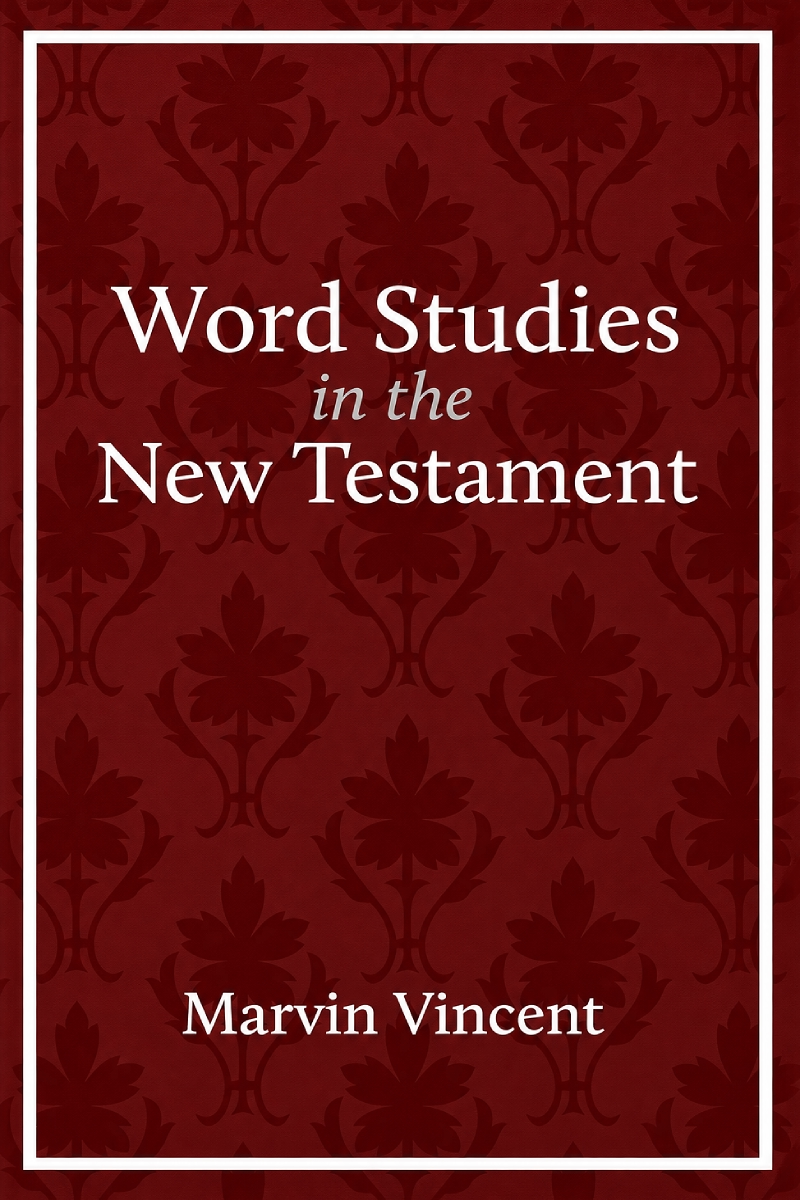
Word Studies in the New Testament
Marvin Vincent’s four-volume reference follows the entire New Testament verse by verse to explain the force of its Greek words for English readers. He traces lexical meaning, grammar, verb tenses, syntax, etymology, historical usage, Septuagint background, textual readings, and translation differences while comparing the distinctive language of the evangelists and apostles.
Available Instantly
About This Book
Word Studies in the New Testament is Marvin R. Vincent’s four-volume original-language reference covering the entire New Testament. Vincent describes the work as occupying a position between an exegetical commentary and a lexicon or grammar. Rather than arranging Greek words alphabetically, he follows the biblical text and explains significant words and constructions where they occur, aiming to bring readers of the English Bible nearer to the standpoint of the Greek reader.
The four-volume structure gives the work sustained coverage of all twenty-seven New Testament books. Volume One treats Matthew, Mark, Luke, Acts, James, First and Second Peter, and Jude. Volume Two covers the writings of John: the Gospel, First, Second, and Third John, and Revelation. Volume Three treats Romans, First and Second Corinthians, Ephesians, Philippians, Colossians, and Philemon. Volume Four covers First and Second Thessalonians, Galatians, the Pastoral Epistles—First and Second Timothy and Titus—and Hebrews.
Greek word study is the work’s central purpose. Vincent identifies important words behind English translations and explains their lexical sense, range of meaning, etymology, compounds, and historical development. He frequently distinguishes Greek words that may be represented by the same English term and shows how context narrows or changes the force of a word. The goal is not vocabulary collection for its own sake but clearer understanding of what a particular New Testament writer is saying.
Grammar is integrated throughout the commentary. Vincent discusses verb tenses, participles, articles, cases, prepositions, syntax, emphasis, and grammatical constructions whenever they materially affect interpretation. Aorist, imperfect, perfect, present, and other forms are treated in connection with the verses where they occur. The work therefore serves readers asking not only what a Greek word means but how the form and construction of a sentence shape its meaning.
Writer-specific usage receives sustained attention. Vincent regularly notes expressions peculiar or characteristic to Matthew, Mark, Luke, John, Paul, Peter, James, and other New Testament writers. The Synoptic Gospels are compared where parallel narratives use different wording, while Johannine and Pauline vocabulary is traced across related writings. This allows the reader to see both the common language of the New Testament and the distinctive habits of individual authors.
Translation is another recurring concern. Vincent compares the Authorized Version and Revised Version, points out places where English wording obscures distinctions in the Greek, and proposes more literal or precise renderings where necessary. Textual readings and variants are discussed when differences in the Greek text affect the word or construction under examination.
The historical background of Greek vocabulary is also important. Vincent draws from classical Greek authors, later Greek usage, and the Septuagint to show how words developed before and during the New Testament period. Septuagint usage is especially useful where the Greek Old Testament supplies the background for theological, religious, or scriptural language later used by New Testament writers.
Because the work proceeds verse by verse, lexical material remains connected to context. Words are explained within narratives, parables, discourses, apostolic arguments, pastoral instructions, epistles, and apocalyptic passages. The result is contextual exegesis rather than isolated dictionary definition. Major biblical concepts naturally appear throughout, but the work’s distinctive search purpose is linguistic: explaining the Greek through which those concepts are expressed.
Word Studies in the New Testament addresses readers asking what the Greek behind a particular verse means, why English translations differ, how verb tense or grammar affects interpretation, how a writer characteristically uses a word, how the Septuagint informs New Testament language, what textual readings underlie a translation, and where to find sustained Greek word-study help for any book of the New Testament.
Book Details

Reading Fit
STUDY LEVEL
Advanced, Intermediate
STUDY SCOPE
Individual Book, New Testament
BOOKS INCLUDED

Edition & Format
PUBLISHED
June 19, 2013
AVAILABLE FORMATS
paperback, hardcover, kindle
LENGTH
4214 pages

Topics Covered
You Might Also Like