

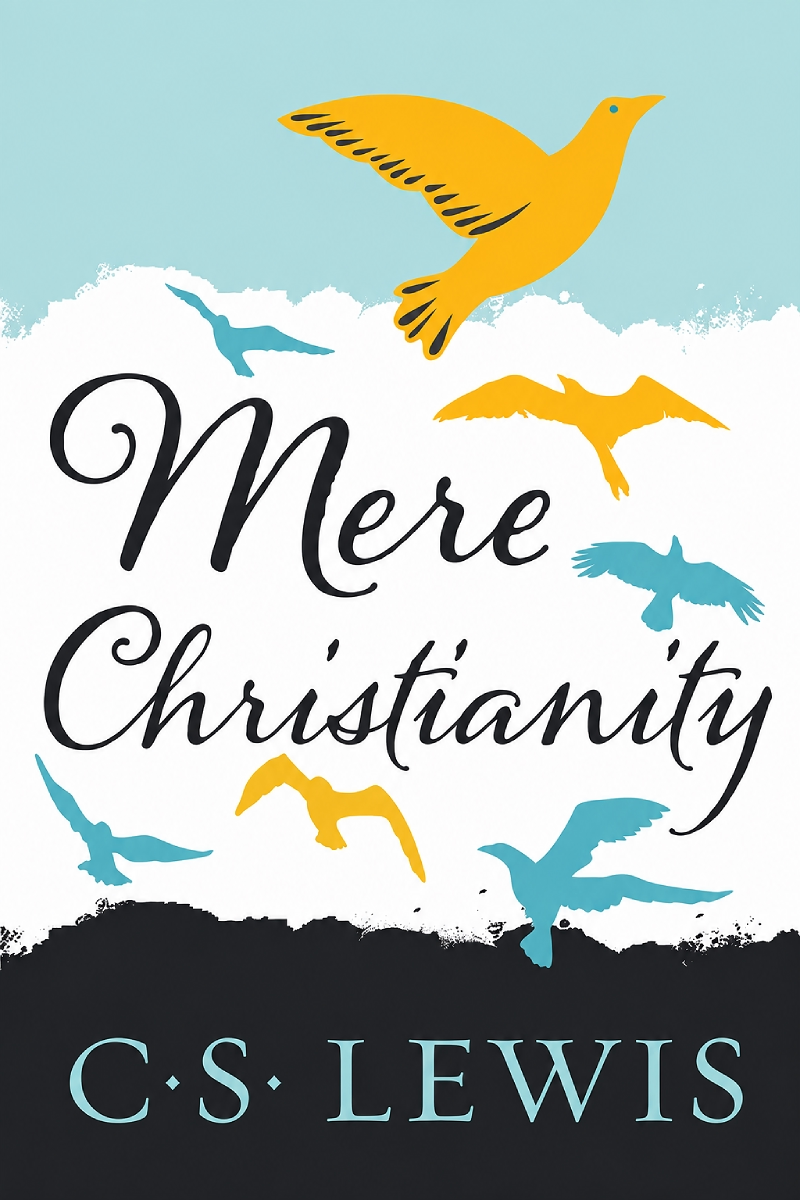
Mere Christianity
Beginning with humanity’s shared sense of right and wrong, C. S. Lewis builds a rational case for Christian belief and then asks what that belief means for life. He explores God, Christ, the Cross, faith, morality, pride, forgiveness, marriage, the Trinity, union with Christ, and God’s transforming work of making people new.
Available Instantly
About This Book
Mere Christianity is C. S. Lewis’s four-part presentation and defense of the common core of Christian belief, developed from his wartime radio talks. It begins with a question accessible even to readers outside Christianity—why human beings argue as though real standards of right and wrong exist—and moves toward what Christians believe about God and Jesus Christ, how Christians are to live, and how God ultimately changes human beings. The book is both apologetic and practical: Lewis argues for the reasonableness of Christian belief, but his governing destination is not mere intellectual assent. He wants the reader to see Christianity as entry into a new kind of life.
Book One, “Right and Wrong as a Clue to the Meaning of the Universe,” develops Lewis’s moral argument for God through what he calls the Law of Human Nature. People appeal to standards of fairness and obligation even while failing to keep them. Lewis distinguishes this moral law from instinct, social convention, and preference, then argues that it points beyond the material universe. Human moral failure also creates the problem that the Power behind the moral law is not simply comforting: guilty people need reconciliation, not merely information.
Book Two, “What Christians Believe,” moves from general theism to Christian claims. Lewis contrasts Christianity with materialism, pantheism, and dualism; considers the problem of evil and the role of free will; and describes evil as rebellion within a creation that is fundamentally God’s. Jesus Christ becomes decisive. Lewis presses the question of Christ’s identity, then treats repentance, atonement, Christ’s death and resurrection, forgiveness, and salvation. He deliberately presents the atonement through more than one explanatory picture, insisting that the saving reality is what Christ has done rather than any one human theory of how it works.
Book Three, “Christian Behaviour,” gives sustained attention to Christian morality and Christian living. Lewis distinguishes social morality, the ordering of the individual person, and humanity’s relation to God. He discusses prudence, temperance, justice, and fortitude; social ethics; sexuality; Christian marriage; forgiveness; pride; charity; hope; and faith. Pride receives especially concentrated treatment as the spiritual posture that puts the self in competition with God and others. Faith is not presented merely as a feeling. Lewis describes it first as holding to what reason has recognized when moods change, then as the surrender of self-reliance when a person discovers that moral effort cannot manufacture righteousness.
Book Four, “Beyond Personality,” develops the Trinity and the Christian’s participation in divine life. Lewis distinguishes created biological life from the life that belongs to God and explains Father, Son, and Holy Spirit as the three-personal life into which Christians are brought. His language of being united to God, attaching oneself to Christ, “putting on Christ,” Christ being formed in believers, and being drawn “into Christ” makes union with Christ a governing feature of this final section. Christianity is therefore more than copying a moral teacher: the living Christ works within the believer to replace the old natural self with a new kind of life.
That transformation is also a substantial treatment of what Christian theology commonly calls sanctification. Lewis uses Jesus’ command “Be ye perfect” in Matthew 5:48 as the framework for “Counting the Cost,” explaining that God intends not merely to improve a few faults but to remake the whole person. “Nice People or New Men” and “The New Men” continue the same theme: Christianity aims at a new creation, not simple respectability. Lewis also uses Philippians 2:12–13 to hold together human response and God’s inward working.
Mere Christianity therefore addresses readers asking whether objective morality points to God, why evil exists if God is good, who Jesus Christ is, what the Cross accomplishes, whether salvation can be achieved by moral effort, what faith means when feelings fluctuate, how Christians should live, why pride is spiritually destructive, how forgiveness works, what the Trinity means, and how a person can actually become different. Its deepest practical answer is that the Christian life is not self-improvement carried out at a distance from God, but a life received through Christ and progressively transformed by Him.
Book Details

Reading Fit
STUDY LEVEL
Fundamental, Intermediate
STUDY SCOPE
Topical
BOOKS INCLUDED

Edition & Format
PUBLISHED
May 13, 2014
AVAILABLE FORMATS
paperback, hardcover, kindle, audiobook
LENGTH
250 pages
· 7h 6m audio

Topics Covered
You Might Also Like