

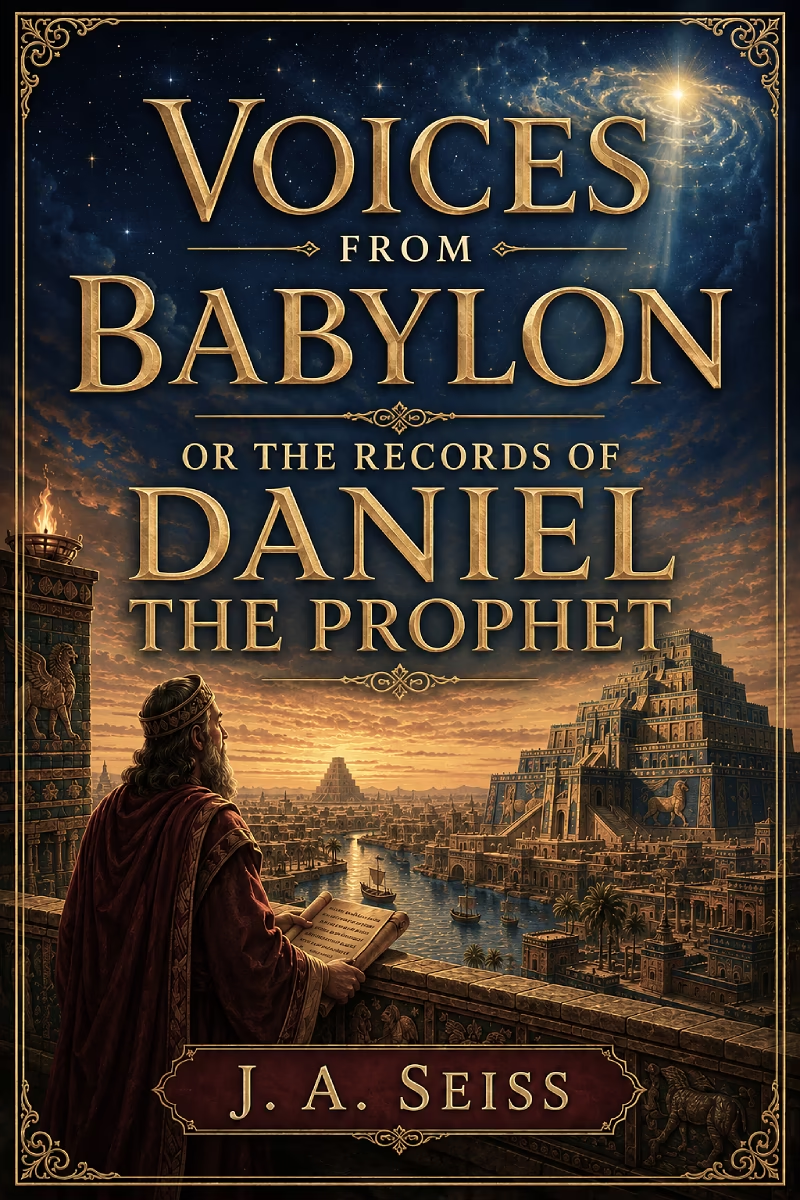
Voices from Babylon or Records of Daniel the Prophet
J. A. Seiss expounds Daniel chapter by chapter as a prophetic panorama of world empires, Israel’s future, Antichrist, Christ’s kingdom, judgment, resurrection, and final deliverance. Alongside the visions, he draws practical lessons from Daniel and his companions on faithfulness, prayer, courage, providence, and confidence in God during hostile times.
Available Instantly
About This Book
J. A. Seiss’s Voices from Babylon; or, Records of Daniel the Prophet is a series of fourteen substantial lectures expounding the book of Daniel from chapter 1 through chapter 12. Seiss treats Daniel as a divinely given prophetic panorama reaching from the Babylonian exile through the succession of world empires to the final conflict, the defeat of Antichrist, the kingdom of Christ, Israel’s future deliverance, resurrection, and everlasting reward. At the same time, the narratives of Daniel and his companions supply practical instruction about faithfulness, prayer, courage, worship, and trust in God under hostile political and spiritual conditions.
The first part of the book establishes Daniel’s character and the supernatural character of the biblical record. Daniel 1 is used to examine principled faithfulness in Babylon, while the opening lectures also defend the authenticity, inspiration, and unity of Daniel. Seiss approaches the book grammatically and historically but insists that its parts belong to one coherent revelation. He repeatedly compares Daniel with later Scripture because he sees the same prophetic subjects developed across the canon.
Daniel 2 receives extended treatment. Nebuchadnezzar’s dream is interpreted as an outline of successive Gentile world powers beginning with Babylon and continuing through Medo-Persia, Greece, and Rome. The stone cut without hands becomes the climactic kingdom established by God, with Christ as its head. Seiss therefore uses Daniel 2 to answer questions about the course of human political dominion, the limits God places upon earthly empires, and the final replacement of human rule by the kingdom of God.
The narratives of Daniel 3–6 show divine sovereignty and preservation in concrete crises. The fiery furnace, Nebuchadnezzar’s humiliation, Belshazzar’s feast, and Daniel in the lions’ den illustrate God’s judgment of pride and sacrilege, His providential rule over kings, His miraculous preservation of faithful servants, and the cost of refusing idolatrous compromise. These chapters give the work a practical dimension alongside its prophecy: believers facing pressure, intimidation, or hostile authority are encouraged to remain faithful to God.
From Daniel 7 onward, prophecy becomes the dominant focus. The four beasts, the little horn, the heavenly judgment, and the Son of Man are related to the final form of human dominion, the appearing of Christ, and His everlasting kingdom. Daniel 8 is treated in relation to the world powers and Israel, with Antiochus presented as a historical figure who also foreshadows a later Antichrist. Seiss repeatedly develops the Antichrist as a future personal ruler whose rebellion reaches its climax immediately before divine judgment and the revelation of Jesus Christ.
Daniel 9 receives detailed treatment of Daniel’s prayer and the prophecy of the seventy weeks. Seiss applies the seventy sevens specifically to Israel and Jerusalem, traces the coming of Messiah the Prince, and interprets the final week in relation to the latter-day Antichrist. Daniel 10–11 expands the discussion of angelic and spiritual powers, Persia and Greece, conflict surrounding Israel, and the future willful king. These chapters are read in close connection with New Testament passages concerning the man of sin, the Beast, and the final opposition to Christ.
The concluding exposition of Daniel 12 concentrates on the great tribulation, Israel’s final purification and restoration, the activity of Michael, bodily resurrection, everlasting life, judgment, and reward. Seiss links Daniel closely with Ezekiel, the Olivet discourse, 2 Thessalonians, and especially Revelation to construct a continuous prophetic picture of the latter days. Israel in Bible prophecy is therefore not a peripheral subject but one of the book’s governing concerns.
Readers searching for an exposition of Daniel, the prophetic meaning of the four kingdoms, Daniel’s seventy weeks, Antichrist, the future of Israel, the great tribulation, the second coming and kingdom of Christ, or the resurrection in Daniel will find sustained treatment. Readers concerned with how to remain faithful in an ungodly environment also find repeated application in the lives of Daniel and his companions. The book’s strongest identity is a detailed, futurist exposition of Daniel in which world history, Israel, Christ’s return and kingdom, judgment, and practical faithfulness are woven into one prophetic framework.
Book Details

Reading Fit
STUDY LEVEL
Advanced, Intermediate
STUDY SCOPE
Individual Book, Old Testament
BOOKS INCLUDED

Edition & Format
PUBLISHED
AVAILABLE FORMATS
paperback
LENGTH
399 pages

Topics Covered
You Might Also Like