


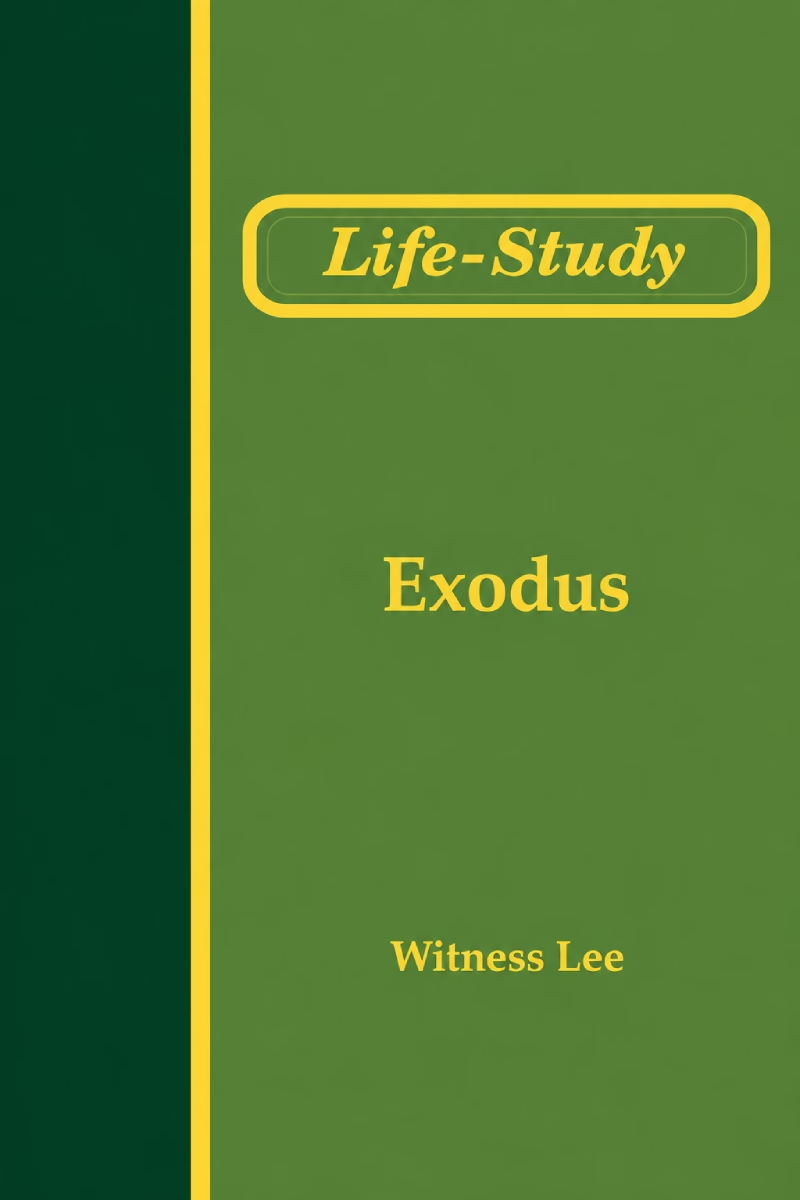
Life-Study of Exodus
Witness Lee reads Exodus as a detailed picture of the believer's corporate experience of Christ: redemption in the Passover, deliverance through the sea, spiritual food and water in the wilderness, God's living word at Sinai, and finally the tabernacle and priesthood. The journey leads from bondage to God's goal—a people built together as His dwelling place.
Available Instantly
Editorial Disclaimer
About This Book
Life-study of Exodus presents Exodus as a book of types portraying the corporate experience of God's salvation and the experience of Christ for the church life. Witness Lee follows the historical sequence from Israel's bondage in Egypt to the completion of the tabernacle, but treats that journey as a spiritual progression: God's people are redeemed and delivered, supplied with Christ, brought to God and His living word, constituted for worship and service, and built together as God's dwelling place.
The early chapters develop Moses' calling and God's purpose in bringing His people out of Egypt. The conflict with Pharaoh portrays the resistance of the world and its ruler to God's claim upon His people. Exodus 12 receives sustained treatment as the Passover, with the lamb and its blood pointing to Christ and redemption. Israel's departure from Egypt and passage through the Red Sea are developed as a picture of complete salvation and separation from the old realm. These portions address questions about what redemption accomplishes, how God's people are delivered from bondage, and why salvation in Exodus is corporate and purposeful rather than merely an escape from judgment.
The wilderness experiences show Christ as the continuing supply of the redeemed people. Marah and Elim, the manna of Exodus 16, and the living water from the smitten rock in Exodus 17 are interpreted in relation to the believer's nourishment, drinking, resurrection life, and dependence upon Christ. The conflict with Amalek is used to expose the flesh and the need for continual spiritual conflict. The study therefore connects salvation with the practical question of how redeemed people are sustained, nourished, and dealt with as they follow God.
A major middle section is devoted to Exodus 20–24. The law is not treated merely as an external code. Lee develops it as God's living word, revealing God Himself and infusing His substance into loving seekers. He also examines its negative function when separated from the living God, its ordinances, and the covenant enacted in Exodus 24, including the blood of the covenant. This extensive treatment helps readers understand the relation between God's commandments, His speaking, loving God, covenant, and fellowship with Him.
The largest concentration of teaching concerns the tabernacle, its furniture, the priesthood, and the building work in Exodus 25–40. The ark, expiation cover, table of the bread of the Presence, lampstand, coverings, boards, veil, entrance, altars, court, priestly garments, consecration, incense, anointing, workers, and erection of the tabernacle are developed as detailed types of Christ, the believers' experience of Christ, priestly service, and the church as God's dwelling place. The tabernacle is understood as a type of the union and mutual dwelling of God and man—first realized in Christ and then expressed corporately in the church. The priesthood shows how God's redeemed people approach Him, bear His testimony, serve Him, and participate in His dwelling.
Throughout the book, Christ is presented as the reality of Exodus: the Passover, the spiritual food, the smitten rock, and the content and reality of the tabernacle types. First Corinthians 5 and 10, John 1 and 6, and Ephesians 2 supply important New Testament connections for this interpretation. The study's governing movement is therefore from redemption and salvation to supply, revelation, worship, service, priesthood, and building.
This work is especially relevant to readers seeking a deep study of Exodus, Christ in Exodus, the Passover, manna and living water, the law and God's word, the tabernacle and its furniture, the priesthood, or the spiritual meaning of Israel's journey. It also answers the broader Christian-life question of what God is saving His people for: not simply release from bondage, but the enjoyment of Christ and the building together of a people in whom God can meet with humanity, communicate with them, and dwell.
Book Details

Reading Fit
STUDY LEVEL
Advanced, Intermediate
STUDY SCOPE
Individual Book, Old Testament
BOOKS INCLUDED

Edition & Format
PUBLISHED
December 1, 1987
AVAILABLE FORMATS
hardcover, kindle, audiobook
LENGTH
2208 pages
· 88h 27m audio

Topics Covered
You Might Also Like
Favorites
Editorial Disclaimer
TUBT includes this book because we believe it contains material that is worth reading, considering, and bringing into the wider Christian discussion. Its inclusion should not be understood as an endorsement of Witness Lee, Living Stream Ministry, the Local Church, or the “Lord’s Recovery” movement associated with his ministry.
TUBT does not recommend joining or identifying with that movement. We encourage readers to approach Lee’s writings with careful biblical discernment and to test his claims against Scripture.
Readers should also be aware that some of Lee’s writings contain strong criticisms of other Christian traditions and ministries and, at times, present distinctive claims concerning the church and the movement with which he was associated. TUBT does not share or endorse those claims.
We have chosen to include a limited number of Lee’s books because we believe portions of his work make a meaningful contribution to important theological and spiritual discussions. We recommend reading them critically, weighing what is valuable while carefully examining what should not be accepted.