
Ephesians
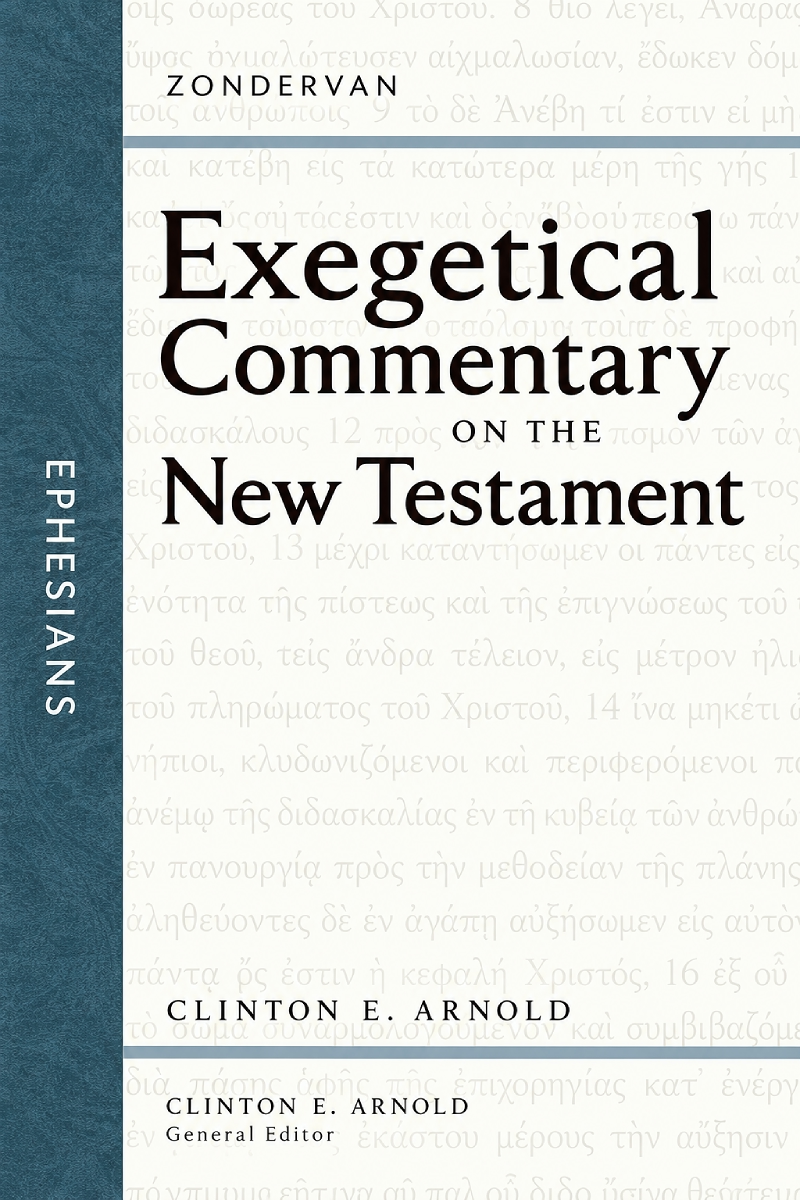
Arnold’s exegetical commentary on Ephesians follows the letter passage by passage with special attention to identity in Christ, the unity of Jews and Gentiles, holy living, and God’s supremacy over hostile spiritual powers. Detailed exegesis connects Paul’s theology with the church’s worship, transformation, prayer, and spiritual warfare.
Available Instantly
About This Book
Clinton E. Arnold’s Ephesians in the Zondervan Exegetical Commentary on the New Testament is a detailed, passage-by-passage study of Paul’s letter that combines literary structure, Greek exegesis, theological synthesis, and application. Arnold identifies four major purposes running through Ephesians: strengthening believers in their new identity in Christ, demonstrating God’s superior power over hostile spiritual powers, promoting the unity of Jews and Gentiles in the church, and calling believers to increasing purity and holiness. These themes give the commentary a distinctive shape and make it especially useful for readers seeking to connect Ephesians’ theology with Christian identity, church life, spiritual conflict, and transformed conduct.
Ephesians 1 establishes the believer’s new location and identity “in Christ.” Arnold treats the repeated language of being in Christ as a key to the letter. Election, adoption, redemption, inheritance, and the sealing of the Holy Spirit in Ephesians 1:3–14 are interpreted within God’s purpose to unite all things in Christ and to produce praise to his glory. Paul’s prayer in Ephesians 1:15–23 then introduces the theme of divine power, culminating in Christ’s exaltation above every rule, authority, power, and dominion.
That power theme continues through Ephesians 2. Arnold explains salvation from death to life in Ephesians 2:1–10 as an act of grace that transfers believers from bondage under the ruler of the power of the air into a new life created for good works. Ephesians 2:11–22 addresses another central concern: the reconciliation of Jews and Gentiles through Christ. The breaking down of hostility and the creation of one new humanity are treated as defining realities of the church, which is also described as God’s household and holy temple.
Ephesians 3 develops God’s eternal purpose in making this multiethnic people known as part of his wisdom, even in relation to the rulers and authorities in the heavenly realms. Arnold gives sustained attention to Paul’s prayers because they show that Christian maturity requires spiritual understanding, inner strengthening through the Spirit, knowledge of Christ’s love, and fullness in God.
In Ephesians 4–5 the commentary turns to the lifestyle appropriate to this calling. Unity, gifted service, maturity, truthful speech, forgiveness, sexual purity, love, wisdom, and Spirit-filled worship are presented as practical expressions of a new identity. Arnold treats holiness not as an isolated moral program but as transformation that flows from what God has already done in Christ. Ephesians 5:21–6:9 applies this new life to households, marriage, parenting, service, and authority.
Ephesians 6:10–20 is especially important to Arnold’s treatment of spiritual warfare. The armor of God is set within the letter’s larger teaching about Christ’s supremacy over the powers and the believer’s need to stand firm in God’s strength. Spiritual conflict is therefore neither sensationalized nor minimized: it is connected with truth, righteousness, the gospel of peace, faith, salvation, the word of God, and persistent prayer.
The commentary concludes by drawing together Ephesians’ theology of God, Christ, the Holy Spirit, the church, salvation, holiness, spiritual powers, and worship. It answers questions such as: What does a believer’s identity in Christ mean? How does the gospel create unity across deep divisions? How should Christians understand spiritual powers and the armor of God? Why must salvation by grace produce a holy way of life? How do prayer and worship participate in spiritual formation and resistance? Arnold’s detailed exegesis makes the volume especially valuable for readers who want both technical depth and a coherent theological reading of the whole letter.
Book Details

Reading Fit
STUDY LEVEL
Advanced, Intermediate
STUDY SCOPE
Individual Book, New Testament
BOOKS INCLUDED

Edition & Format
PUBLISHED
January 4, 2011
AVAILABLE FORMATS
hardcover, kindle
LENGTH
996 pages

Topics Covered
You Might Also Like