

A History Of The Textual Criticism Of The New Testament
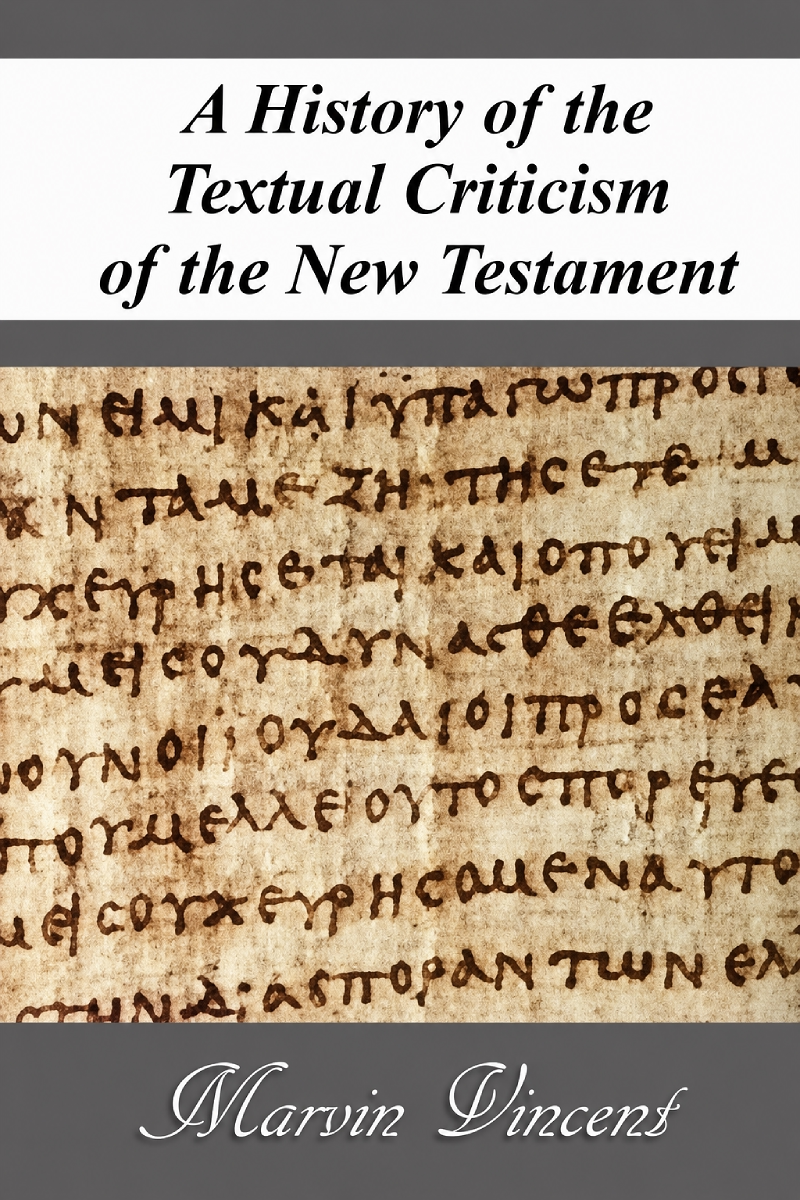
Marvin Vincent traces the development of New Testament textual criticism from manuscripts, ancient versions, and patristic quotations through Erasmus, the Textus Receptus, Bengel, Griesbach, Lachmann, Tischendorf, Tregelles, Westcott and Hort, and Codex Bezae, explaining how scholars sought the earliest attainable Greek text and developed modern critical methods.
Available Instantly
About This Book
A History Of The Textual Criticism Of The New Testament is Marvin R. Vincent’s historical introduction to the discipline that compares surviving witnesses in order to recover the earliest attainable New Testament text. Written for students who had not specialized in textual criticism, the book first explains why the discipline is necessary and what evidence it uses, then traces the development of critical method from the earliest printed Greek New Testaments through the major nineteenth-century editors and theories.
The opening chapters define the need and office of textual criticism. Because the original New Testament manuscripts no longer survive and handwritten copies differ from one another, the critic must compare the surviving evidence and evaluate variant readings. Vincent discusses the kinds of accidental and intentional changes that can enter texts during transmission and distinguishes the work of recovering the text from questions of interpretation or authorship.
Greek manuscripts form the first major class of evidence. Vincent explains uncials, cursives, lectionaries, palimpsests, manuscript divisions, systems of designation, and the importance of the great ancient codices. Codex Sinaiticus, Codex Vaticanus, Codex Alexandrinus, Codex Bezae, and other major witnesses are considered in relation to age, character, and textual value. Manuscripts are not simply counted; their relationships and the quality of their readings must be weighed.
Ancient versions provide a second major class of witnesses. Vincent surveys Old Latin, Vulgate, Syriac, Egyptian, Ethiopic, Armenian, Gothic, and other translations and explains how versions can preserve evidence for readings older than many surviving Greek manuscripts. Patristic quotations provide a third source. Church fathers often preserve early textual forms, although their value must be assessed carefully because quotations may be loose, remembered rather than copied, or altered during later transmission.
The historical narrative then turns to the first printed Greek New Testaments. The Complutensian Polyglot and Erasmus introduce the printed-text period, followed by Stephanus, Beza, and the Elzevir editions. Vincent explains how this stream eventually produced the form commonly called the Textus Receptus and how dependence upon that received printed text gradually gave way as scholars collated more manuscripts, versions, and patristic evidence.
Bengel represents a major advance because he recognizes that witnesses must be grouped and related rather than merely counted. Griesbach develops manuscript families and critical canons more fully. Lachmann then attempts to reconstruct a text directly from ancient evidence rather than beginning with the Textus Receptus. Tischendorf greatly expands the manuscript base and is treated especially in connection with the discovery and publication of Codex Sinaiticus. Tregelles advances independent comparative criticism through sustained attention to early authorities.
Vincent also traces resistance to the emerging critical text. Scrivener and Burgon receive attention for their defense of more traditional readings and their objections to the preference given to the oldest witnesses. Westcott and Hort form one of the book’s largest later subjects because their 1881 Greek New Testament, classification of text types, and genealogical method represented a culmination of nineteenth-century criticism and strongly influenced the Revised Version.
The closing chapters examine later contributions available in Vincent’s period, including B. Weiss and especially Codex Bezae. The distinctive readings of Bezae generate competing theories involving Latin influence, Syriac influence, Jewish-Christian origins, the Western text, and the possibility of differing editions of Luke and Acts. This discussion shows textual criticism moving beyond the collection of variants toward reconstruction of the historical relationships among textual forms.
The book addresses readers asking why New Testament manuscripts differ, what evidence textual critics use, how the Textus Receptus arose, why major codices matter, how manuscript families and genealogical reasoning developed, what Bengel, Griesbach, Lachmann, Tischendorf, Tregelles, Westcott and Hort contributed, and why Codex Bezae became a central problem in the history of New Testament textual study.
Book Details

Reading Fit
STUDY LEVEL
Advanced, Intermediate
STUDY SCOPE
New Testament, Topical
BOOKS INCLUDED

Edition & Format
PUBLISHED
April 3, 2011
AVAILABLE FORMATS
paperback, hardcover, kindle
LENGTH
222 pages

Topics Covered
You Might Also Like