
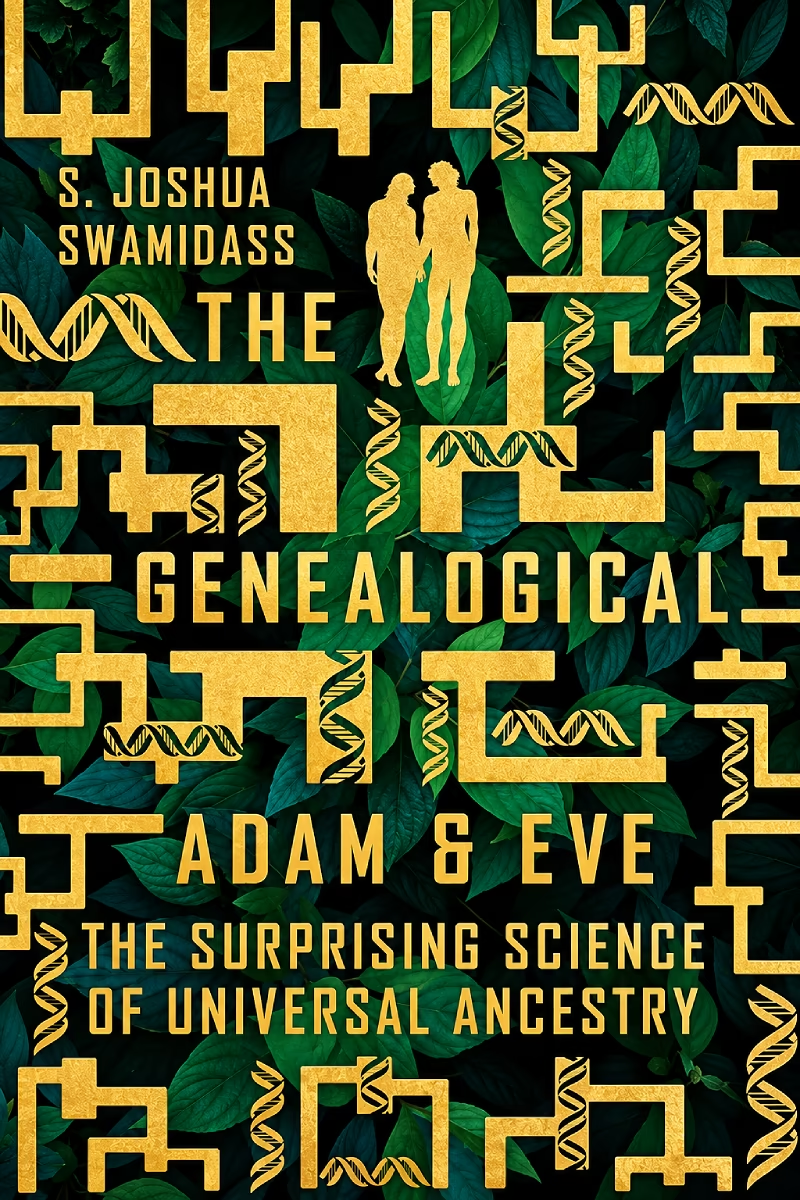
The Genealogical Adam and Eve: The Surprising Science of Universal Ancestry
Can evolutionary science and a recent, specially created Adam and Eve both be true? S. Joshua Swamidass distinguishes genealogy from genetics to show how Adam and Eve could become universal ancestors within a larger human population, opening a careful conversation about Genesis, human origins, theology, and what it means to be human.
Available Instantly
About This Book
The Genealogical Adam and Eve examines whether a historical, recently created Adam and Eve can be placed alongside the scientific account of human evolution without requiring either claim to be dismissed at the outset. S. Joshua Swamidass approaches the problem through the distinction between genealogical ancestry and genetic ancestry. His governing argument is that population genetics addresses the DNA inherited from ancestors, while genealogy describes the much larger web of biological parentage. Because people inherit no identifiable DNA from many genuine ancestors sufficiently far back in time, genetic evidence cannot by itself rule out the possibility of a recent couple who became universal genealogical ancestors.
The book develops a specific “genealogical hypothesis.” Adam and Eve may have lived in the Middle East only several thousand years ago, may have been created directly by God without biological parents, and may have had descendants who intermarried with an already existing population of biologically human beings produced through evolutionary history. On this model, Adam and Eve could become ancestors of everyone living today even though the human population never passed through a genetic bottleneck of only two individuals. The book therefore treats universal ancestry, population genetics, genealogical models, human evolution, and direct creation as related but distinct questions.
A major purpose is to clarify what science can and cannot say about the traditional Christian discussion of Adam and Eve. Swamidass repeatedly distinguishes questions about biological ancestry from theological questions about humanity, the image of God, the fall, sin, exile, and human relationship to God. He also explores the difficult question of who should be called “human” when scientific, theological, and biblical uses of that word do not necessarily operate with the same definition. The people outside the Garden become important to this discussion because the proposal allows Adam and Eve’s descendants to join a wider population while still preserving universal genealogical descent in later generations.
Genesis 2–3 forms the principal biblical setting for the proposed Adam-and-Eve scenario, while New Testament teaching about Adam also enters the theological discussion. Romans 5 and 1 Corinthians 15 are especially relevant to questions about Adam, sin, death, and Christ, although the book’s primary contribution is not a verse-by-verse exegesis of these passages. Instead, it asks whether scientific evidence actually excludes a historical Adam and Eve of the kind many Christians have assumed Scripture requires.
The book also addresses a reader-intent problem that often appears as a forced choice: Must a Christian choose between evolutionary science and a real Adam and Eve? Swamidass argues that genealogy creates additional conceptual space. His proposal does not claim that science proves Adam and Eve existed; rather, it argues that accepted science leaves room for a recent universal genealogical couple, even one directly created, provided other humans existed outside the Garden and their populations subsequently mixed.
The later chapters widen the discussion beyond ancestry mechanics. They consider the fragmentation of Christian traditions over origins, the possibility of recovering multiple theological traditions within a shared conversation, and the implications of ancestry for justice, mercy, exile, and human solidarity. The result is an interdisciplinary treatment of human origins designed for readers wrestling with the relationship between Genesis, historical Adam and Eve, evolution, genetics, and Christian theology. It is especially relevant to searches asking whether Adam and Eve can be historical, whether genetics disproves universal descent from Adam and Eve, how genealogy differs from genetics, and how evolutionary human origins might be discussed without automatically abandoning traditional theological claims.
Book Details

Reading Fit
STUDY LEVEL
Advanced, Intermediate
STUDY SCOPE
Topical
BOOKS INCLUDED

Edition & Format
PUBLISHED
December 10, 2019
AVAILABLE FORMATS
paperback, hardcover, kindle, audiobook
LENGTH
237 pages
· 8h 25m audio

Topics Covered
You Might Also Like