

In This Article

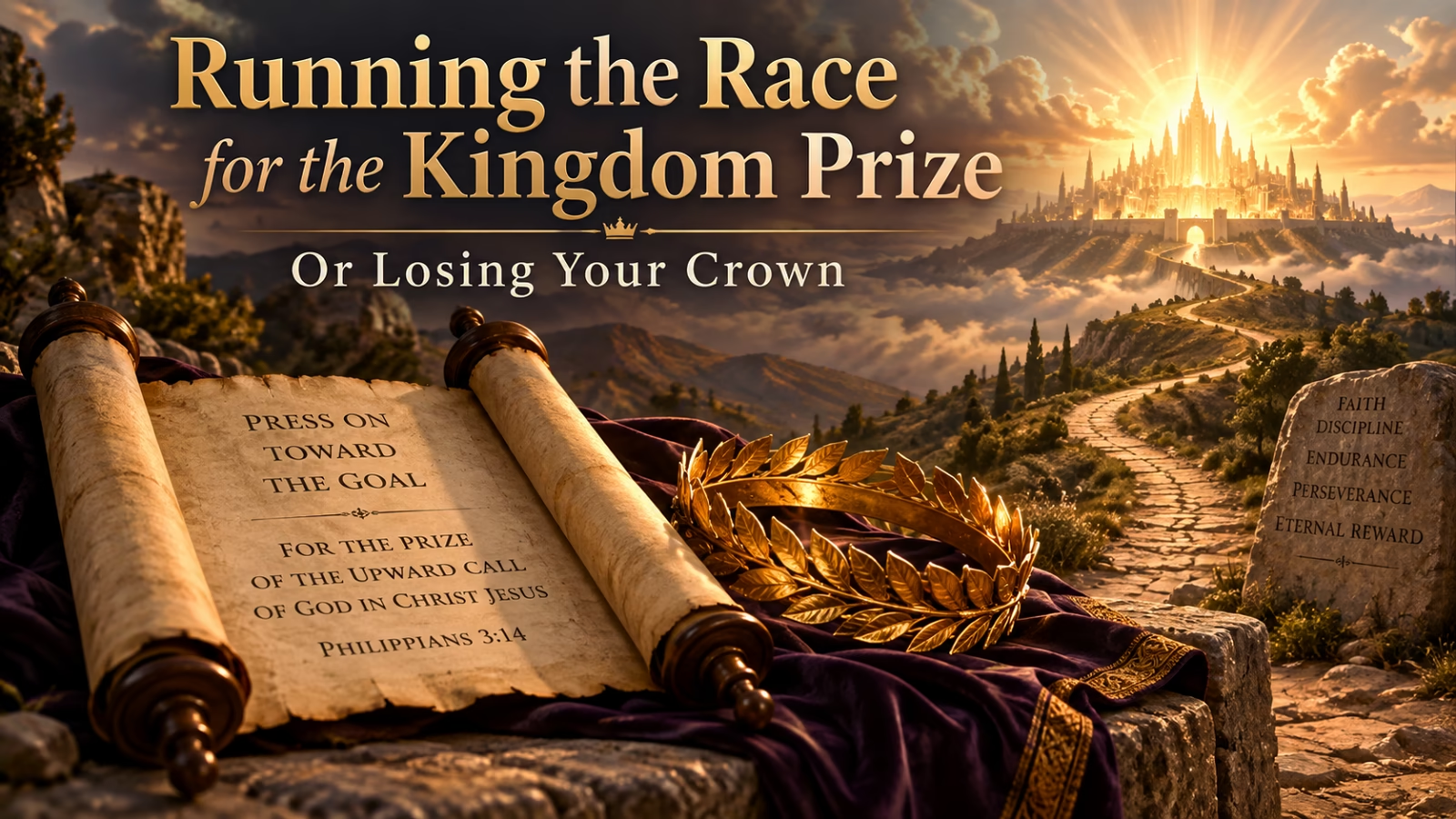
Running the Race for the Prize: Or Losing the Crown
In 1 Corinthians, Paul makes a statement that should capture every believer's attention. He describes the Christian life as a race, urging Christians to run to obtain a prize. He then directly applies this to himself, demonstrating its universal applicability and the very real possibility of disqualification:
Do you not know that in a race all the runners run, but only one receives the prize? So run that you may obtain it. Every athlete exercises self-control in all things. They do it to receive a perishable crown, but we an imperishable crown. So I do not run aimlessly; I do not shadow box as one beating the air. But I discipline my body and keep it under control, lest after preaching to others I myself should be disqualified.
— 1 Corinthians 9:24–27
These are sobering words, especially coming from an Apostle chosen directly by Jesus Christ. Yet, Paul still believed he could be disqualified.
Disqualified from what?
That question opens one of the most important, yet often overlooked, threads running through the New Testament: the Prize.
Paul was not striving to become a child of God; he already was, and that can never be lost.
Rather, he was running because there is something more—what he called "the prize"—that every child of God will either obtain or lose. Like Paul, we are all in this race for the prize, and each of us will either gain or lose it. There is no middle ground here.
Understanding The Prize
To understand the prize, we must allow several passages, often treated separately, to speak together: Paul's race, the judgment seat of Christ, the promises to the overcomers in Revelation 2 and 3, the first resurrection of Revelation 20, the wedding garment, the priestly pattern of the Tabernacle, the thousand-year Kingdom, and finally, the New Jerusalem.
When those passages are allowed to survive together without patching, the message becomes clear without weakening either God's salvation or Christ's warnings.
Salvation Is A Gift
Salvation is a gift that, once received, cannot be lost. All believers will be included in the New Jerusalem, expressing God's perfect glory.
At the same time, we are in a race, and our crowns are on the line. Whether we realize it or not, Paul's and Jesus' words stand. This is why Paul said, "run that you may obtain it."
Question: What stands between the Age of Grace and New Jerusalem? The Kingdom. Keep that in mind as we continue.
A Gift and a Prize Are Not the Same Thing
If salvation and the prize are identical, as some teach, Paul's words become impossible to interpret without breaking Scripture. It would mean he is instructing individuals, already saved by grace, to strive for the very salvation they already possess.
Identifying the prize with salvation also implies that Christ's finished work on the cross is insufficient to secure salvation.
That position is not only inconsistent with Paul's teaching on salvation by grace and Jesus' teaching concerning the eternal life He freely gives, but it also makes Paul's words about a race fundamentally contradict the gospel he preached.
Paul resolves this dilemma with his own words when he said:
Anyone who builds on that foundation may use a variety of materials—gold, silver, jewels, wood, hay, or straw. But on the judgment day, fire will reveal what kind of work each builder has done. The fire will show if a person's work has any value. If the work survives, that builder will receive a reward. But if the work is burned up, the builder will suffer great loss. The builder will be saved, but like someone barely escaping through a wall of flames.
— 1 Corinthians 3:12-15
Paul makes it clear in this verse that a believer can be saved yet still experience significant loss. This loss cannot be a loss of salvation, as Paul explicitly states that the person "himself will be saved."
However, the loss also cannot be imaginary, as Paul just as explicitly declares that he "will suffer great loss."
For Scripture to survive without breaking and requiring patching, both must be true at the same time: salvation cannot be lost, yet a saved believer can still suffer great loss through disqualification. That disqualification comes from a failed race for the prize.
This perfectly aligns with 1 Corinthians 9, where Paul, though already belonging to Christ, still fears disqualification.
The Judgment Seat of Christ
The race has a finish line, and after the course is complete, every believer must appear before the Judgment Seat of Christ, where the race will be evaluated and the prize either won or lost, as Paul made clear when he said:
For we must all appear before the judgment seat of Christ, so that each of us may receive what is due us for the things done while in the body, whether good or bad.
— 2 Corinthians 5:10
Paul includes himself: "we must all appear." No one is immune to this Judgment Seat of Christ. Each of us will stand alone before Christ before the Kingdom age begins.
This is not the Great White Throne of Revelation 20:11–15, which occurs after the millennial Kingdom age. That judgment is not for the children of God.
The Judgment Seat of Christ concerns only those who belong to Him.
No one's sin debt or salvation is questioned at the Judgment Seat, because to question either would be to question the finished work Christ accomplished on the cross. Jesus paid the sin debt in full, He purchased us, and He has already declared that He will not lose even one of those who belong to Him; and only those who belong to Him are qualified to stand before Him at His Judgment Seat.
The Judgement Seat, Crown and Prize
The Judgment Seat of Christ is about the crown and the prize—who will receive them and who will not. This must be settled before the Kingdom Age begins, as where someone will live during the Kingdom Age is decided at this time.
For this reason, and because not everyone will receive the crown and prize, Christ leaves the third heaven, gathers His children to Himself in the clouds in the air, and there the Judgment Seat takes place.
Once reward and loss have been determined, Christ continues His descent to the earth with the victorious saints, defeats the remaining opposition at Armageddon, and takes possession of the earth for His Kingdom.
As stated earlier, 1 Corinthians 3 demonstrates that this examination can result in either reward or loss, though the believer himself remains saved.
Religion, The Crown, The Prize
This explains Paul's seriousness: religious practice is not synonymous with gaining the crown and the prize. Instead, it is about loving one another, listening to the Spirit, and preserving the unity in the Body of Christ for which Jesus prayed before His crucifixion.
Even a well-known, well-loved leader—even an apostle chosen directly by Jesus—can preach to others, accomplish great things in His name, and still be disqualified from the crown and the prize. This reality should be sobering for every Christian.
Maturity Isn't Magical Or Instantaneous
The Judgment Seat also reveals another important truth: judgment does not magically transform an immature believer into maturity.
A believer who resisted the Spirit’s transforming work throughout the Age of Grace, whether knowingly or unknowingly, does not become a finished, living stone simply by standing before Christ. Quite the opposite: the Judgment Seat will bring into the open what that believer has actually become.
A verdict can expose a condition, but it does not, by itself, complete the transforming work required in that living stone. If the stone is unfinished, it will require further work—not magic.
Being deceived does not change the condition of the stone: an incomplete stone is still an incomplete stone. Jesus and the apostles repeatedly warned believers against deception precisely because deception carries real consequences.
The Prize Is Not the New Jerusalem
The Prize is not the New Jerusalem. If it were, how could God declare the New Jerusalem complete when some of His redeemed children had failed to attain the Prize?
There is no night there. There is no more death, mourning, crying, or pain.
God’s habitation is complete. His redeemed people are no longer divided between those who won the Prize and those who lost it. The Bride is ready, the city comes down out of heaven, and God makes His home there.
Therefore, the Prize cannot be entrance into the New Jerusalem. All the saints must ultimately be perfected and present for the city to be complete and the Bride to be ready.
What the overcomers receive is an early participation during the Kingdom age in the realities that will eventually characterize God’s completed city, the New Jerusalem. That is why Revelation 2 and 3 are so important and must not be taken lightly.
The Seven Churches
Revelation 2 and 3 contain messages from the risen Christ to seven churches, and the significance of the number seven deserves careful consideration.
Throughout Scripture, the number seven signifies completion, beginning with God's seven-day work of creation.
This pattern recurs in Israel's Sabbaths, the sevenfold cycles leading to Jubilee, and most notably in the seven-branched lampstand of the Tabernacle.
This connection becomes particularly significant in Revelation.
Christ is depicted walking among seven golden lampstands, and He explicitly tells John, "the seven lampstands are the seven churches" (Revelation 1:20).
Just as the seven lamps formed one complete lampstand before God, these seven churches collectively represent the complete testimony of the Church before Christ.
Jesus did not choose to use seven churches randomly.
He used these seven actual churches to present a complete picture of the spiritual conditions that can exist among His churches.
And because the One speaking is the Alpha and the Omega, the First and the Last—a title that reveals the position from which He is speaking—His words transcend any single moment in time. Their themes of faithfulness, failure, deception, endurance, love, compromise, repentance, victory, and loss apply to all churches that have existed and continue to exist throughout the Age of Grace.
Any teaching that confines these messages either to those seven first-century churches or separates them into dispensational periods treats the words of Christ as though they were spoken by a temporal being rather than by the Alpha and the Omega, the First and the Last.
The messages to the seven churches are not merely ancient letters, nor do they address specific periods of time.
They constitute Christ's complete message to His Church—including His churches today—because the One speaking is the Alpha and the Omega, the First and the Last. He is not speaking from within the limitations of human time.
The Overcomer Promises of Revelation 2&3
Again and again throughout the letters to the seven churches, Jesus says, "To him who overcomes..." This condition makes clear that overcoming is a choice, not something automatically given to every believer, regardless of church affiliation. What matters is whether one has an ear to hear what the Spirit is saying to the churches.
If every believer automatically receives everything Christ specifically promises to overcomers, then those promises no longer distinguish victory from defeat.
The question is not whether Christ will ultimately perfect His redeemed children; He will. The question is who will and who will not receive the overcomer's Kingdom prize.
This is why the Judgment Seat of Christ takes place immediately before the Kingdom age begins, and the seven churches give us a clear picture of how Jesus will evaluate each saint.
Wining the Prize or Losing Your Crown
Access to the Tree of Life
To the one who is victorious, I will give the right to eat from the tree of life, which is in the paradise of God.
— Revelation 2:7
This promise points to an early enjoyment of what will eventually be available to all in the New Jerusalem.
During the Kingdom age, the victorious overcomers will have access to the Tree of Life in the Paradise of God, while the defeated will not. They will be locked out of the Paradise of God and forbidden access to the Tree of Life, just as Adam and Eve were driven out of Eden and barred from the Tree of Life which was in the Paradise of God.
Escape from the Second Death
The one who overcomes will not be hurt by the second death.'
— Revelation 2:11
This is one of the most serious warnings Christ gives the churches.
The promise is not merely that the overcomer receives something extra; it is that they escape something horrible—an experience of the second death.
For Scripture to survive without breaking and requiring patches, the opposite must also be true: the defeated believer can and will experience something of the second death.
This explains why Christ uses the word "harmed" or "hurt."
Salvation cannot be lost, so the second death experienced by the defeated cannot be permanent. It is not final destruction, but it is something the defeated will endure.
Revelation 20 later repeats the same protection in connection with the first resurrection: the second death has no power over those who share in it.
That does not require eternal loss of salvation. First Corinthians 3 has already given us another category: saved, yet suffering loss. However, eternal security cannot be used to empty Christ's warning of its force.
The Hidden Manna and the White Stone
To the one who is victorious I will give some of the hidden manna, and I will give him a white stone, with a new name written on the stone that no one knows except the one who receives it.
— Revelation 2:17
This overcomer's promise includes three parts, as described by Jesus: the hidden manna, the white stone, and the new name. Taken together, these elements reveal the depth of a singular experience: a personal and intimate nearness to God.
The hidden manna points to a hidden portion experienced only by the victorious, a nearness to God as seen in its connection with the Ark in the Holy of Holies of the Tabernacle.
The white stone and new name point to a deeply personal and close connection with Christ, experienced only by the one who receives them.
Together, these promises reveal a special intimacy and nearness to Christ that belongs exclusively to the victorious as part of their prize, something the defeated won't experience until 1000 years later in New Jerusalem.
Authority Over the Nations
To the one who is victorious and does my will to the end, I will give authority over the nations—that one 'will rule them with an iron scepter and will dash them to pieces like pottery'—just as I have received authority from my Father. I will also give that one the morning star.
— Revelation 2:26–28
This promise is unmistakably governmental: the victorious believer receives authority over the nations and shares in Christ's rule during the Kingdom Age.
Paul says the same thing from another direction:
If we endure, we will also reign with him.
— 2 Timothy 2:12
But Christ does not stop with governmental authority. He also promises the victorious believer the Morning Star. Revelation later tells us exactly who the Morning Star is:
"I am the Root and the Offspring of David, and the bright Morning Star."
— Revelation 22:16
The Morning Star is Christ Himself.
Christ is promising the victorious Overcomers something more than participation in His government. In addition to reigning with Him, they will experience Him as the Morning Star—an early experience of Christ in His Kingdom that will ultimately reach its full expression in the New Jerusalem. They will receive a foretaste of the reality of the New Jerusalem while reigning with Him in the Kingdom.
if we endure, we will also reign with him. If we disown him, he will also disown us;
— 2 Timothy 2:12
Endurance—continuing to trust Christ and stand with Him no matter what happens, even if we are hit with the tragedies of Job—is a requirement for reigning with Him during the Kingdom Age.
If we cannot endure now, we are not ready to reign with Christ then. He Himself endured every manner of suffering.
The believer who does not overcome by standing with Christ and keeping His word to the end, no matter what happens, cannot simply be given the same governmental position as if Christ had placed no condition on attaining it.
White Garments and the Book of Life
All who are victorious will be clothed in white. I will never erase their names from the Book of Life, but I will announce before my Father and his angels that they are mine.
— Revelation 3:5
Here, the warning becomes more severe: the blotting out—the erasing—of names from the Book of Life.
How does a person's name get into the Book of Life?
They are born of the Spirit and become a child of God, which also makes them a citizen of His Kingdom during the Age of Grace, as Paul makes clear in Philippians 3:20, Ephesians 2:19, and Colossians 1:13.
Let's be explicit, Jesus is saying that those who are not victorious will not be clothed in white garments, and their names will be removed from the Book of Life.
Inclusion in the Book of Life identifies us with Kingdom citizenship during the Age of Grace. The Book of Life is a registry of Kingdom citizenship.
During the Kingdom Age, the Book of Life will still function as a registry of Kingdom citizens. However, the defeated saints' names will not be found in the Book of Life, and their Kingdom citizenship will be revoked for that age.
In other words, the defeated saints will not be permitted to enter the Kingdom as citizens during the Kingdom Age because their names will not be found in the Book of Life, nor will they be clothed in the white garments required to stand in the King's presence.
This cannot, however, imply that Christ eternally forsakes a true believer, for to do so would hand Satan a victory and make it impossible for the New Jerusalem to be completed with the perfection required of the Bride of Christ.
Jesus made this clear when He declared that His sheep would never perish and that He would lose nothing the Father had given Him (John 10:28–29; John 6:39).
Therefore, "blotting out" cannot mean eternal loss that extends into the New Jerusalem; it can only fall within the context of Kingdom Age reward and loss, when the victorious experience Christ as the Morning Star.
The thousand-year Kingdom allows both truths to coexist: Christ's warning retains its full meaning, while Christ does not ultimately lose those who belong to Him.
Those defeated during the Age of Grace can suffer real Kingdom loss and yet ultimately be brought to perfection for the New Jerusalem. The Bride of Christ suffers no final loss. She is perfect.
Hold Fast So No One Takes Your Crown
To the Church in Philadelphia, Christ says:
I am coming soon. Hold on to what you have, so that no one will take your crown. The one who is victorious I will make a pillar in the temple of my God. Never again will they leave it. I will write on them the name of my God and the name of the city of my God, the new Jerusalem, which is coming down out of heaven from my God; and I will also write on them my new name.
— Revelation 3:11–12
Here, the Lord is speaking to a church against which He had no complaint. These saints were on the right path, and His instruction was simple: hold on to what you have.
What does it mean to hold on, and what did they have?
To hold on means to keep doing what you are doing and avoid the errors of Ephesus, Pergamum, Thyatira, Sardis, and Laodicea.
Philadelphia is the Lord showing us the path the race is run on that leads to the crown and the prize.
That said, we need to understand how Philadelphia lived the Christian life. Without a deep understanding of that, avoiding the errors of the other churches—as proven by those that loved the Lord yet still fell short—will be difficult.
Philadelphia, in Greek, means "brotherly love," and that is no accident. God does nothing randomly, and the meaning of this church's name should not be ignored as we consider why Philadelphia receives no rebuke from Christ.
Philadelphia is, first and foremost, the church of brotherly love. Jesus expresses brotherly love, and where His love governs the Body, unity thrives.
Philadelphia stands as the answer to Jesus' prayer before the cross—that His people would be one. Had unity been absent, Christ would have had something to correct. Instead, He gives Philadelphia no rebuke and sets before them an open door that no one can shut.
Philadelphia kept the Lord's word—the truth of Christ revealed throughout the New Testament, including the gospel and teaching entrusted to His apostles.
Philadelphia did not deny His name, which has more to do with what comes from the heart than from the mouth.
Philadelphia kept the word of His perseverance, meaning they remained faithful to Christ regardless of circumstances or their own strength.
Lastly, Philadelphia was not repeating the failures of the other churches.
A side note on the consequences the other churches would endure if they did not change direction: Those consequences cannot exist in the New Jerusalem, because that would mean the New Jerusalem had not reached perfection and the Bride was not prepared. Nor can they be the final outcome of the present Age of Grace, because the Judgment Seat of Christ takes place after the Age of Grace has ended. There is only one age in which these consequences can be experienced: the Kingdom Age.
Sit With Me on My Throne
"Those whom I love I rebuke and discipline. So be earnest and repent. Here I am! I stand at the door and knock. If anyone hears my voice and opens the door, I will come in and eat with that person, and they with me. To the one who is victorious, I will give the right to sit with me on my throne, just as I was victorious and sat down with my Father on his throne."
— Revelation 3:19–21
Christ concludes His messages to the seven churches with a matter of utmost importance. He has exposed serious failures, warned of real consequences, and revealed what awaits the victorious.
At the same time, He does not abandon His people, leaving them to figure out how to overcome on their own. It's not all doom and gloom although for the defeated it will be.
With Laodicea, He clarifies what they must do. From there, He shifts the conversation from Laodicea to "those"—all those whom He loves.
"Those whom I love I rebuke and discipline." This means you and me too.
Then He declares, I stand at the door and knock, let me in. This is the way to victory.
Believers do not need to comprehend every detail of how to overcome before they begin. Christ stands at the door, effectively saying, "Let Me in and I'll show you how."
During His ministry, Jesus explained how He would come to His people when He promised to send the Helper, the Holy Spirit, and immediately followed with, "I will come to you" (John 14:16–18). The Helper, the Holy Spirit, Jesus Christ Himself, will teach you, remind you of His words, and guide you into truth (John 14:26; 16:13).
So when Christ stands at the door and knocks, open the door. Let Him—the Spirit, the head of the body—in. Listen to the Helper, and allow Him to lead you to victory.
Human Strength Cannot Win the Race
Romans 7 demonstrates that we cannot achieve the victorious Christian life through our own strength. Christ, in His perfection, would not command His saints to accomplish something impossible for them and then leave them without the necessary help.
Instead, He comes to the door Himself, knocks, and says, "Let Me in." Those who open the door, listen to Him, and persevere can finish the race, be crowned victorious, and receive the prize.
Hear What the Spirit is Saying to the Churches—Even Yours
The condition of the five rebuked churches provides a serious cautionary illustration. Simply labeling a church “Christian” does not mean it is on the path to victory.
These churches exhibited aspects of Christ, but they had not opened the door to Him, as they were allowing things in that the Lord will not dwell with. They were examples of what heading for defeat looks like, and the only escape is to hear what the Spirit is saying to the churches and follow Christ, the Head of the Body.
Like Philadelphia, which had only "a little power"—in my view, a picture of a church that was not relying proudly on its own strength—we must open the door to Christ and let Him in.
That is the answer: Let Him in. Sit with Him. Dwell with Him. Eat with Him. Listen to Him. Learn from Him, and follow Him to victory.
Mary did exactly that. She sat at Jesus' feet and listened while Martha became frustrated because Mary was not helping with all the work. But what did Jesus say?
“Martha, Martha, you are worried and troubled about many things. But one thing is needed, and Mary has chosen the good part, which will not be taken away from her” (Luke 10:41–42).
Mary understood what Philadelphia understood: before doing things for Christ comes listening to Christ.
No defeated believer will be able to claim that Christ demanded victory but provided no means to attain it. He was there, knocking. The Helper had been sent. His help was available. The door simply had to be opened.
And Christ concludes the entire sequence with the prize: "To the one who is victorious, I will give the right to sit with me on my throne."
The message is remarkably simple: open the door to Christ, let the Helper in, the Holy Spirit, the Head of the Body, listen to Him, and He will lead you to victory. Victory is not man-made religion, nor does it come from human effort alone.
The law of the Spirit of Life, the Head of the Body, is knocking on all our doors: Christ is knocking. Let Him in, listen to the Helper, and let Him lead you to your crown, your prize, and into the Kingdom!