


In This Article


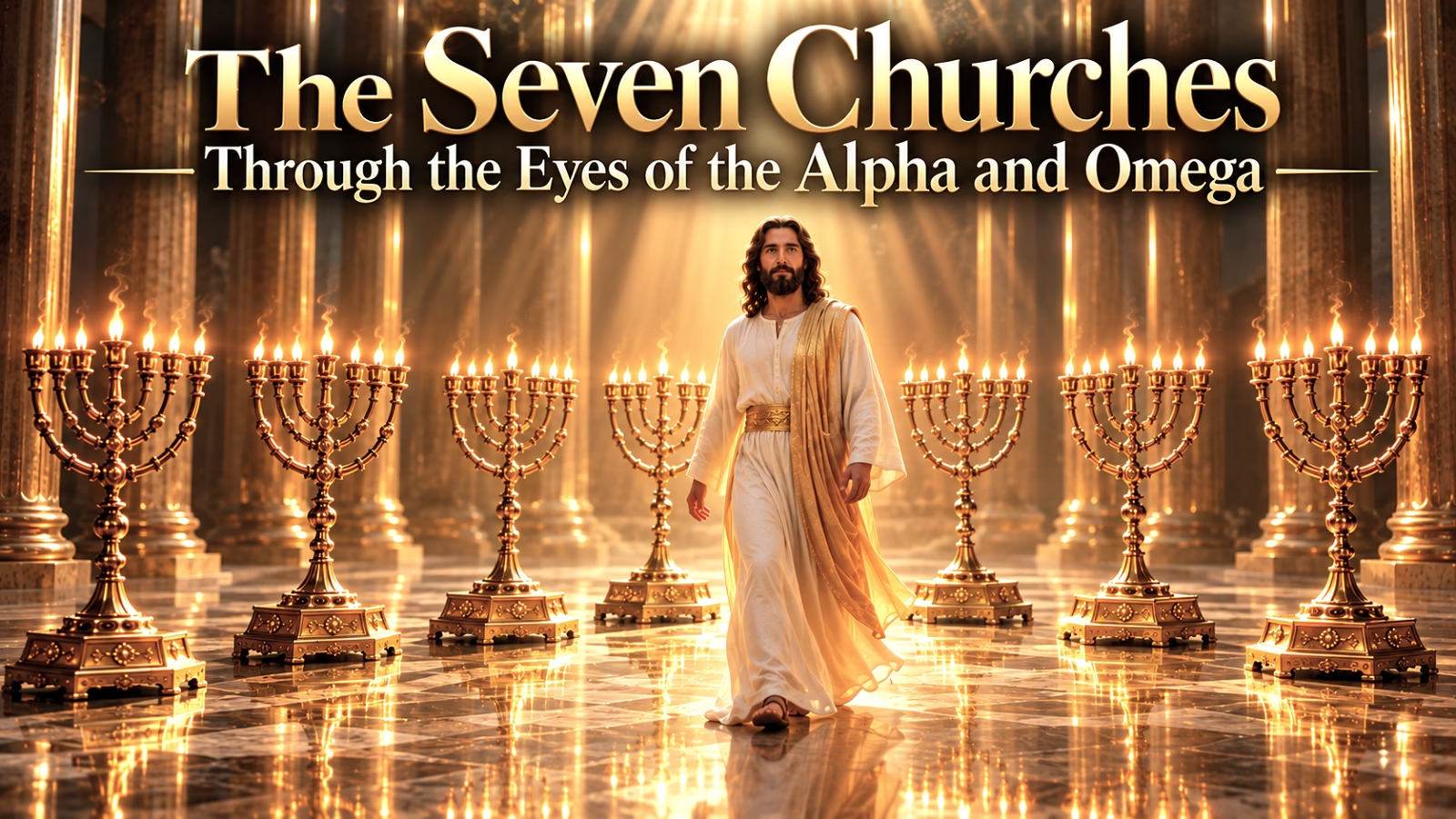
The Seven Churches Through the Eyes of the Alpha and Omega
When most people read Revelation 2 and 3, they naturally read the seven churches one after another: Ephesus, Smyrna, Pergamos, Thyatira, Sardis, Philadelphia, and Laodicea.
That is how temporal human beings read. We move from one thing to the next. We experience yesterday, then today, then tomorrow. We cannot see the whole span of history at once.
But the One speaking to the churches introduces Himself differently.
I am Alpha and Omega, the beginning and the ending...
— Revelation 1:8
That statement should affect the way we hear everything that follows.
Christ as the Alpha and Omega
Christ is not merely another participant moving through history alongside us. He is the One through whom all things were created, the One by whom all things consist, and the One who declares Himself both the beginning and the end.
John receives the Revelation within time.
Christ gives it from the perspective of the Alpha and Omega.
That distinction opens an important way of understanding the seven churches.
Seven Real Churches, More Than Local Situations
The seven churches were real churches in Asia.
Revelation does not erase their historical reality.
Ephesus was Ephesus. Smyrna was Smyrna. Philadelphia was Philadelphia.
But Christ repeatedly says something remarkable at the end of each message:
"He that hath an ear, let him hear what the Spirit saith unto the churches."
Notice the plural. He does not merely say, "Hear what the Spirit said to Ephesus."
He says: Hear what the Spirit says to the churches.
The message to one becomes a message for all. This happens seven times. That immediately tells us that Christ intended these letters to reach beyond their original recipients.
Why Seven Churches
Seven dominates the structure of Revelation. There are seven churches. Seven lampstands. Seven seals. Seven trumpets.
Seven bowls.
Again and again, seven is used to communicate completeness. That gives us a powerful clue concerning the churches.
Christ did not need to write letters to every congregation that existed in the first century. Nor did He need to individually address every congregation that would exist afterward.
Instead, He selected seven.
Symptoms within the Churches
The seven churches together form one complete picture. They present the conditions Christ sees within His churches.
Not merely in Asia. Not merely in the first century.
And not as seven successive historical periods through which the Church must pass.
Rather, the seven letters give us a complete spiritual diagnosis of the churches from beginning to end.
Not Seven Church Ages
One common interpretation attempts to turn the seven churches into seven consecutive periods of Church history.
Under that approach, Ephesus represents one historical era, Smyrna another, Pergamos another, and so forth until Laodicea supposedly represents the final condition of the Church.
But nothing in the letters requires that structure.
Christ never says:
"This church represents the next period of history."
Instead, every letter contains conditions that can appear wherever churches exist.
A congregation today can lose its first love.
Another can remain faithful under persecution.
Another can tolerate destructive teaching.
Another can appear alive while being spiritually dead.
Another can faithfully keep Christ's word.
Another can become lukewarm.
And several of those conditions can exist at the same time.
That is exactly what we would expect if the seven churches form a complete diagnostic picture rather than a chronological timeline.
The Seven Letters as a Spiritual Diagnostic
Think of the seven letters as a physician's diagnostic chart.
A physician may have a list of symptoms associated with a condition. One patient may exhibit three of them. Another may exhibit five. Another may show entirely different symptoms.
The symptoms do not have to appear in a predetermined historical sequence.
The same is true of the churches.
Christ identifies spiritual conditions—some healthy, some dangerous—that can appear in different combinations wherever His people gather.
Ephesus: Truth Without First Love
Ephesus had much that Christ commended.
They labored.
They persevered.
They rejected evil.
They tested false apostles.
Yet something foundational had deteriorated.
"Nevertheless I have somewhat against thee, because thou hast left thy first love.
A church can therefore be doctrinally alert, hardworking, and morally serious while still suffering a deep inward loss.
That symptom can appear anywhere.
Smyrna: Faithfulness Under Suffering
Smyrna receives no rebuke.
Christ sees their tribulation, poverty, and suffering, yet calls them spiritually rich.
"Fear none of those things which thou shalt suffer..."
Their condition reveals another possibility within the churches: A congregation may appear weak outwardly while being extraordinarily healthy before Christ.
Persecution is not proof of spiritual failure. Sometimes faithfulness is revealed precisely through suffering.
Pergamos: Faithfulness Mixed With Compromise
Pergamos held fast Christ's name. They had not denied the faith even where persecution had become deadly. Yet compromise had entered.
Christ identifies teachings and practices that were being tolerated within the church.
Here we find another diagnostic pattern: Strength and weakness can coexist.
A church may courageously confess Christ in one area while tolerating corruption in another.
That alone shows why these letters should not be reduced to seven neat historical eras. Real churches are more complicated than that.
Thyatira: Growth Alongside Corruption
Christ acknowledges Thyatira's works, charity, service, faith, and patience.
He even says:
"the last to be more than the first."
There was growth. Yet serious corruption was also being tolerated.
Again we see overlapping symptoms.
Spiritual activity does not automatically mean everything within a church is healthy.
A congregation can grow in some areas while simultaneously becoming dangerously compromised in another.
Sardis: Reputation Without Life
Sardis presents perhaps the most sobering diagnosis:
"you have a reputation of being alive, but you are dead."
Human reputation and Christ's diagnosis were completely different.
Others saw life. Christ saw death.
Yet even there, the situation was not absolute.
"Yet you have still a few names in Sardis, people who have not soiled their garments..."
So even within a deeply unhealthy church, faithful believers could remain.
The condition of the congregation did not automatically describe every individual inside it.
Philadelphia: Faithfulness With Little Strength
Philadelphia receives no rebuke.
Christ says:
"I know that you have but little power, and yet you have kept my word and have not denied my name."
This is one of the healthy patterns presented within the sevenfold picture.
Notice what Christ values. Not worldly size. Not institutional power. Not reputation.
They had "little strength". Yet they kept His word and did not deny His name.
Philadelphia demonstrates that spiritual health can exist where outward strength appears small.
Laodicea: Self-Satisfaction Without Spiritual Reality
Laodicea believed itself rich and in need of nothing. Christ saw something entirely different.
"For you say, I am rich, I have prospered, and I need nothing, not realizing that you are wretched, pitiable, poor, blind, and naked"
Their great problem was not merely weakness. It was misdiagnosis.
They believed they were healthy. Christ knew they were not. That condition can appear in any century.
A church can possess wealth, organization, influence, activity, and confidence while failing to recognize its true spiritual condition before the Lord.
Diagnosing the Churches
Any Church Can Contain Several of These Conditions
This is where the sevenfold picture becomes extremely practical.
A modern congregation does not have to be "an Ephesus church" or "a Laodicean church."
It may exhibit characteristics of several.
A church might have:
- the doctrinal discernment of Ephesus,
- the endurance of Smyrna,
- some of the compromise of Pergamos,
- the service of Thyatira,
- the reputation problem of Sardis,
- the faithfulness of Philadelphia,
- and traces of Laodicean self-satisfaction.
All at the same time.
Another congregation may exhibit an entirely different combination.
The seven letters therefore become far more useful when they are allowed to function as Christ's complete spiritual diagnostic of His churches.
Instead of asking: Which historical church age are we living in?
The better question becomes: Which of these conditions does Christ see in us?
Christ's Examination
Christ Examines What Men Cannot See
One theme runs through every letter.
Christ knows.
"I know thy works..."
Again and again He says it.
Churches judge themselves by attendance, reputation, finances, activity, influence, history, programs, doctrine, or visible success.
Christ sees something deeper. He sees:
- Love
- Faithfulness
- Compromise
- Endurance
- Hidden corruption
- Spiritual death
- Obedience
- Self-deception
He sees the actual condition of His house. And because the seven letters form a complete picture, no church escapes that examination.
From the First Church to the Last
John received these words at a particular moment in history. But the One speaking is the Alpha and Omega.
The sevenfold message therefore enters time through John while reaching throughout the entire existence of the churches.
The first churches needed these words. The churches existing today need them, and the final churches before Christ's return will need them.
The conditions may appear in different proportions and combinations, but the diagnostic remains complete.
That is why each letter ends by reaching beyond its immediate recipient:
"He that has an ear, let him hear what the Spirit saying to the churches."
The Spirit is still speaking. The question is whether the churches are still listening.
Seven Churches — One Complete Examination
Seen this way, Revelation 2 and 3 become extraordinarily clear.
The seven churches are not seven isolated ancient congregations with little relevance to us. Neither must they be forced into seven consecutive periods of Church history.
They are seven real churches chosen by the Alpha and Omega to present one complete picture of the spiritual conditions that can exist throughout all His churches.
Seven brings the picture to completion. Some conditions are healthy. Some are dangerous. Some churches contain mixtures of both.
And every congregation, in every place and every generation, can hold these seven letters before itself and ask: What does Christ see when He walks among us?
That is the perspective that matters. Not merely how a church sees itself. Not how other churches see it. Not how history remembers it.
But how it appears before the eyes of the One who says:
"I am Alpha and Omega, the beginning and the ending."
The One who sees the whole is the One examining His churches.