


In This Article


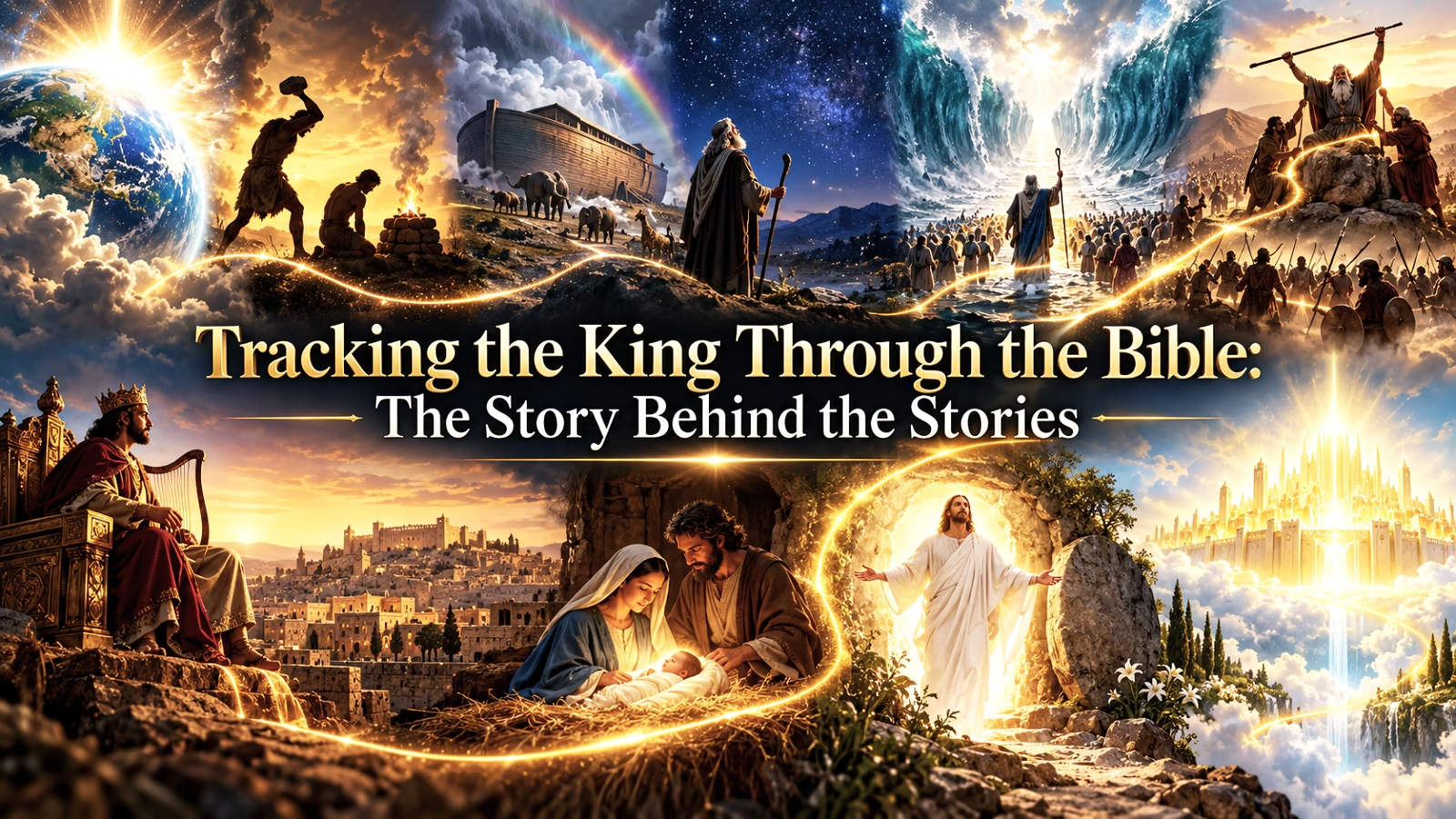
Tracking the King Through the Bible: The Story Behind the Stories
The Bible can appear to be a collection of separate stories. Creation, Cain and Abel, Noah, Abraham, Egypt, Israel, wars, judges, kings, prophets, exile, Christ, the Church, Revelation—each account can seem to stand on its own.
But Scripture itself reveals something very different. From Genesis to Revelation, God is telling one continuous story: the movement of the King through history and the war surrounding His coming, His victory, His people, and His Kingdom.
Once that thread becomes visible, the Old Testament changes. Events that seemed disconnected begin to occupy their proper places inside one unfolding conflict, and even many of its most severe judgments can be seen in the larger war God declared near the beginning.
The King Enters the Biblical Story as Light
The first great movement appears almost immediately. Genesis begins with darkness covering the deep, and then God speaks.
“And God said, Let there be light: and there was light.” — Genesis 1:3, ASV
This is not the creation of Christ. The Son is eternal. But the rest of Scripture teaches us how to understand the significance of Light entering darkness.
John says that in the Word “was life; and the life was the light of men,” and Jesus later declares, “I am the light of the world.” Paul deliberately reaches back to Genesis when he compares God shining light out of darkness with the light of the knowledge of God in the face of Jesus Christ.
The Bible ends with the same Light. New Jerusalem has no need of sun or moon to illuminate it, because the glory of God gives it light and the Lamb is its lamp.
So from the beginning to the end, Scripture is tracking the One who enters darkness as Light and ultimately fills God's completed city with that Light.
Genesis 3:15 Declares the War
The conflict becomes explicit after the fall. God addresses the serpent and declares an enmity that will govern the biblical story from that point forward.
“And I will put enmity between thee and the woman, and between thy seed and her seed: he shall bruise thy head, and thou shalt bruise his heel.” — Genesis 3:15, ASV
This is far more than a prediction that one descendant will someday defeat a snake. God identifies two opposing seeds and announces hostility between them, with the conflict ultimately centering upon the Seed of the woman who will crush the serpent's head.
The promised Seed is the coming King. From this point onward, Scripture begins tracking the line through which He will enter human history.
The serpent's side is also present. Fallen human kind now carries the law of sin and death, and that fallen nature provides the ground through which the serpent's hostility can operate.
The war has begun.
Cain: The War Becomes Human History
The first historical manifestation appears immediately in Cain and Abel. Cain murders his brother, and the New Testament later tells us exactly what spiritual side Cain had joined.
“Not as Cain was of the evil one, and slew his brother. And wherefore slew he him? Because his works were evil, and his brother's righteous.” — 1 John 3:12, ASV
Cain's murder therefore cannot be reduced to an isolated family tragedy. Genesis 3:15 has just declared the conflict, and Cain becomes the first man Scripture explicitly identifies as “of the evil one.”
Abel dies without carrying the line forward, but God immediately preserves the Seed-line.
“God hath appointed me another seed instead of Abel; for Cain slew him.” — Genesis 4:25, ASV
Seth is raised up in Abel's place. The attack does not stop God's purpose.
The Mark That Changed Cain's Position
Cain then reveals something remarkable. After being driven out, he fears that anyone who encounters him will kill him.
God does not dismiss that fear. Instead, He places a mark upon Cain specifically so that those who find him will not strike him.
“And Jehovah appointed a sign for Cain, lest any finding him should smite him.” — Genesis 4:15, ASV
The mark necessarily had to be recognizable. Otherwise it could not perform the function God gave it.
The effect upon Cain's experience is dramatic. Without the mark, Cain expects death. With the mark, he is able to live openly among the nations, take a wife, have a son, and build the first recorded city.
“And Cain knew his wife; and she conceived, and bare Enoch: and he builded a city, and called the name of the city, after the name of his son, Enoch.” — Genesis 4:17, ASV
Building a city requires far more than being tolerated. It requires organization, cooperation, authority, and people willing to gather around the builder.
The nations had not experienced God as their enemy. They knew enough to recognize and revere what came from Him, and God's mark transformed Cain's standing among them.
Yet Cain himself was “of the evil one.” God gave the mark as righteous protection against murder, but Satan could exploit the authority and reverence attached to that mark through the man who carried it.
Cain therefore becomes more than the first murderer. He becomes the first man aligned with the evil one to organize human society into a city outside the presence of God.
The conflict of Genesis 3:15 has now become organized human history.
Two Currents Begin Moving Through Genesis
From Cain onward, Scripture increasingly reveals two currents. One moves through humanity organized independently of God; the other carries the line through which the woman's Seed will come.
Cain's line develops civilization, but violence grows with it. Lamech eventually boasts of killing and magnifies vengeance beyond Cain's own protection.
Meanwhile, Scripture turns to Seth and begins following the line that leads toward Noah. The biblical camera repeatedly narrows because God is tracking the pathway of the coming King.
The Flood does not end that purpose. Noah's household carries the line through judgment, and after the Flood Scripture again begins narrowing the genealogy toward the man God will call out from the nations.
Human rebellion also reorganizes after the Flood. Babel becomes another great expression of humanity gathered into an organized system apart from God's government.
But God answers by calling one man.
Abraham: God Narrows the Line
God calls Abram while he is one and begins a covenant through which the promised Seed will continue. From this point forward, the biblical record becomes increasingly selective.
The line moves through Abraham, not merely through humanity generally. Then through Isaac rather than Ishmael, Jacob rather than Esau, and eventually Judah among the sons of Jacob.
This is not favoritism without purpose. Scripture is tracking the King.
“The sceptre shall not depart from Judah, Nor the ruler's staff from between his feet, Until Shiloh come; And unto him shall the obedience of the peoples be.” — Genesis 49:10, ASV
Now the Seed has become explicitly royal. The coming One will not merely be a descendant; He will bear the sceptre.
The Woman Becomes Visible in Israel
Joseph's dream gives us one of Scripture's great identifying pictures. He sees the sun, moon, and eleven stars bowing before him, and his own family understands the imagery.
That picture reappears in Revelation 12, where a woman is clothed with the sun, has the moon beneath her feet, and wears a crown of twelve stars. Revelation is deliberately reaching back into Genesis.
Israel is therefore not merely another ancient nation in the story. Israel becomes the Old Testament corporate expression of the woman through whom the promised King is being carried toward His birth.
This explains why the history of Israel occupies so much of Scripture. The Bible is not primarily tracking world empires, technological development, or the rise and fall of every civilization.
It is tracking the woman because the woman is carrying the King.
Egypt Tries to Destroy the Carrier of the Seed
Egypt illustrates the conflict clearly. Israel enters Egypt during Joseph's generation under protection and peace, but a later Pharaoh turns against them.
The attack escalates beyond slavery. Pharaoh orders the Hebrew male children killed.
Seen politically, Pharaoh is a ruler pursuing control over a people he has come to fear, and he remains fully responsible for those choices. Seen within Genesis 3:15, those same historical events also belong to the larger spiritual conflict: the people carrying the promised Seed are being systematically attacked.
God intervenes and brings Israel out. Pharaoh then pursues them militarily, but his army is destroyed at the Red Sea.
The external enslaving power has been broken. Then, almost immediately, another enemy appears.
Amalek: The Flesh Attacks the Newly Delivered People
Amalek attacks Israel in the wilderness without any recorded provocation from Israel. Deuteronomy later emphasizes the nature of that attack.
“Remember what Amalek did unto thee by the way as ye came forth out of Egypt; how he met thee by the way, and smote the hindmost of thee, all that were feeble behind thee, when thou wast faint and weary; and he feared not God.” — Deuteronomy 25:17–18, ASV
Amalek attacks the weak, tired, and vulnerable parts of the newly delivered people. Scripture's typology makes Amalek a powerful picture of the flesh.
Paul later describes that flesh in Romans 7. Sin dwells within it, operates as a law, wars against the law of the mind, and brings man into captivity.
“But I see a different law in my members, warring against the law of my mind, and bringing me into captivity under the law of sin which is in my members.” — Romans 7:23, ASV
The correspondence is remarkable. Israel has been outwardly delivered from Pharaoh, yet immediately Amalek attacks; a believer may be delivered from outward bondage to the world and still discover the flesh actively warring within.
That is also why Amalek cannot simply be improved. God eventually commands Saul to deal with Amalek completely.
Saul refuses. He preserves Agag and the best of what God had commanded him to destroy.
And Amalek does not disappear from the biblical story.
Agag Reaches Esther
Centuries later, Esther introduces Haman as an Agagite. Agag had been king of Amalek.
Haman does not merely dislike Mordecai. He seeks the extermination of the entire Jewish people throughout the Persian Empire.
The hostility that attacked Israel's weak in the wilderness has now matured into a plan to annihilate the entire people carrying the royal Seed.
Christ has not yet reached Mary. If the Jews disappear, the historical pathway through which the King must come disappears with them.
Once again God intervenes, and the line survives.
The Amalek story therefore stretches far beyond one desert battle. It belongs to the Genesis 3:15 war.
Israel Could Also Threaten the King's Progress
The enemy was not always outside Israel. At times the people carrying the Seed became so corrupted that God had to judge, cleanse, and redirect them.
Foreign gods were welcomed. Children were sacrificed. Kings became corrupt. Prophets were persecuted and killed.
If Israel had simply been allowed to dissolve into the surrounding rebellion, the vessel carrying the King would have been swallowed by the very world from which God had separated it.
This helps explain some of the severity readers encounter in the Old Testament. God's judgments are not random explosions of anger.
He is governing righteously in the middle of a war, judging entrenched evil while preserving and redirecting the people through whom the King must come.
The Judgments Against the Nations Were Not Arbitrary
The same principle applies when Israel encounters deeply corrupted nations. Scripture gives both sides of the reason for God's judgments.
Deuteronomy says those nations were being judged because of their wickedness. It also warns Israel that intermarriage and religious assimilation would turn their children away from God.
So God's severe actions cannot properly be reduced to ethnic destruction, arbitrary violence, or mere protection of a bloodline. Scripture presents them as righteous judgment upon real wickedness and the preservation of God's righteous government, while within the larger Genesis 3:15 conflict they also protect the people carrying the promised Seed from being spiritually absorbed and destroyed.
God's righteousness matters especially because the conflict includes an accuser. The God who judges Satan cannot become unrighteous in order to defeat him.
Every intervention therefore has to remain consistent with God's own holiness, justice, and revealed purpose.
David: The Royal Line Comes Into Full View
The royal nature of the Seed becomes unmistakable with David. God establishes a covenant concerning David's house and throne, and from that point Scripture carefully tracks the royal line.
That line repeatedly comes under attack.
One of the starkest examples comes through Athaliah, who attempts to destroy the entire royal family.
“Now when Athaliah the mother of Ahaziah saw that her son was dead, she arose and destroyed all the seed royal.” — 2 Kings 11:1, ASV
But one child, Joash, is hidden and preserved. The royal line survives again.
Read as an isolated palace coup, the story is dramatic. Read within Genesis 3:15, its significance is much greater: the historical line carrying the King comes frighteningly close to disappearing, and God preserves it.
Even Exile Does Not Stop the King
Israel's rebellion eventually brings judgment and exile. Jerusalem falls, the temple is destroyed, and the Davidic kingdom appears outwardly finished.
But the King has not stopped moving.
God preserves a remnant, restores the people to the land, and continues carrying the royal line toward the appointed generation. Even the apparent collapse of the kingdom cannot cancel the promise.
The exile therefore is not a detour from the story. It is part of God's righteous correction of the woman so that the Seed can continue toward His appointed birth.
Mary and Joseph: The King Reaches His Appointed Entrance
By the opening of the New Testament, centuries of conflict have narrowed to a young woman named Mary and a man named Joseph.
Jesus must truly be David's Seed according to the flesh, yet the royal line through Jeconiah carries a judgment concerning the throne. God resolves both requirements perfectly.
Mary supplies the physical Davidic descent. Joseph supplies the legal royal right through the house of David without becoming Jesus' biological father.
The King is therefore genuinely David's Seed according to the flesh while receiving the legal right to David's throne without inheriting the disqualified bloodline through Joseph.
Then something occurs that Genesis 3:15 had already anticipated: the promised One is uniquely the Seed of the woman.
Jesus is conceived by the Holy Spirit.
After thousands of years of preservation, judgment, warfare, correction, genealogy, covenant, and divine intervention, the King has reached Mary and entered human history.
The War Does Not Stop When the King Is Born
Herod immediately demonstrates that the conflict continues. When he learns that the King of the Jews has been born, he attempts to kill Him.
Children in Bethlehem are slaughtered in the attempt.
The serpent could not prevent the Seed from reaching His birth, so the attack turns directly upon the King Himself.
But again God intervenes. Jesus is preserved and continues toward the purpose for which He came.
The King Defeats the Serpent
Jesus passes through human living, crucifixion, resurrection, and ascension. What Genesis 3:15 announced begins reaching its decisive fulfillment.
The serpent bruises His heel, but the King accomplishes the victory that will ultimately crush the serpent's head.
After His resurrection and ascension, Revelation shows the Lamb as the only One worthy to take the scroll from God's hand and open its seals. The King has completed the work necessary to move God's purpose into its next stage.
The King's Victory Moves Into His Body
When the first seal is opened, a rider goes forth upon a white horse, crowned and “conquering, and to conquer.” This is the Holy Spirit carrying the accomplished victory of Christ forward into the spiritual realm and into God's people.
The King has won the victory as the Head. That victory must now be worked into His Body.
This is where Revelation 12 expands the woman first pictured in Joseph's dream. The woman still carries the sun, moon, and twelve-star imagery, but now something new is brought forth from her.
The man-child appears.
The Man-Child Could Not Appear Before the King
The man-child is not simply a replay of Jesus' historical birth and ascension. Christ had already ascended long before John received the Revelation.
Christ is the Head of the man-child, but the corporate overcoming company cannot be produced until the Head has passed through incarnation, human living, crucifixion, resurrection, ascension, and victory.
Only then can that victorious life be worked into God's children.
The woman therefore reaches a new stage. The people who once carried the King toward His birth now produce the overcoming company in whom the King's victory has been brought to maturity.
When the man-child is caught up, war breaks out in heaven. Satan and his angels are cast down.
The conflict God announced in Genesis 3:15 has now reached open heavenly warfare.
Revelation 19 Brings the King's Victory Into the Open
The war still has an earthly expression to be completed. Revelation 19 shows Christ returning openly as King of kings and Lord of lords.
The victory established at the cross, carried forward through the Spirit, and expressed through the saints now enters the visible physical realm.
The Beast and the organized earthly rebellion are destroyed. Satan is then bound, and the Kingdom age begins.
The War Finally Ends
After the thousand years, Satan is released briefly and again deceives the nations. His nature has not changed.
The final rebellion is immediately ended, and Satan is cast into the lake of fire.
Only then is the ancient war completely finished.
The serpent who appeared near the beginning of Genesis can no longer oppose the King, accuse God's people, deceive the nations, or interfere with God's purpose.
New Jerusalem Reveals What the Whole Story Was Moving Toward
But defeating Satan was never God's entire purpose. God was not merely trying to win a war.
The war existed because an enemy opposed something God intended to obtain.
Revelation 21 and 22 show us that purpose completed: the King, His Bride, God's dwelling with humanity, the nations in their proper place, and creation made new.
“Behold, I make all things new.” — Revelation 21:5, ASV
New Jerusalem is therefore not an appendix added after the main story. It reveals where the entire story was going.
The Bible begins with God, man, life, a garden, a tree, a woman, and an enemy. It ends with God dwelling with humanity, the Bride, the Tree of Life, the nations, the throne of God and of the Lamb, and the enemy permanently removed.
The end interprets the beginning.
The Bible Is One Story
Once the King becomes the controlling thread, the Bible no longer appears fragmented.
- Genesis 1 introduces the Light.
- Genesis 3 announces the Seed and declares the war.
- Cain becomes the first organized human expression of the evil side.
- Seth continues the Seed-line.
- Noah carries it through judgment.
- Abraham receives the covenant.
- Isaac and Jacob continue the line.
- Judah receives the sceptre.
- Israel becomes the woman carrying the King.
- Egypt attempts to destroy her.
- Amalek attacks her weakness.
- Haman attempts to annihilate her.
- God repeatedly disciplines and preserves her.
- David receives the royal covenant.
- The royal Seed survives repeated attempts at destruction.
- Mary finally carries the King into the world.
- Herod attempts to kill Him.
- Christ completes His victory through death and resurrection.
- The Spirit carries that victory into His Body.
- The overcoming man-child is produced.
- Satan is cast down.
- The King returns openly.
- The enemy is finally removed.
- New Jerusalem reveals God's completed purpose.
These are not separate stories accidentally bound into one book. They are movements in one story.
The laws, genealogies, wars, judgments, covenants, kings, prophets, captivities, restorations, Gospel accounts, apostolic writings, and Revelation all belong to the same unfolding revelation.
The Story Behind Every Story
The Bible is the story of the King.
It records His movement through history before His incarnation, the war surrounding the Seed through whom He would come, His entrance into humanity, His victory over the enemy, the building of His Body and Bride, His coming Kingdom, and the final accomplishment of God's eternal purpose.
That is why Scripture cannot ultimately be understood as isolated moral stories. Abraham is connected to David, David to Mary, Mary to Christ, Christ to His Body, and His Body to the Kingdom and New Jerusalem.
The Old Testament is not merely preparation for the New Testament. It is the King already moving through history toward His appointed entrance.
Genesis tells us where the war began. Revelation tells us where it ends.
And everything between them is the story of the King.