

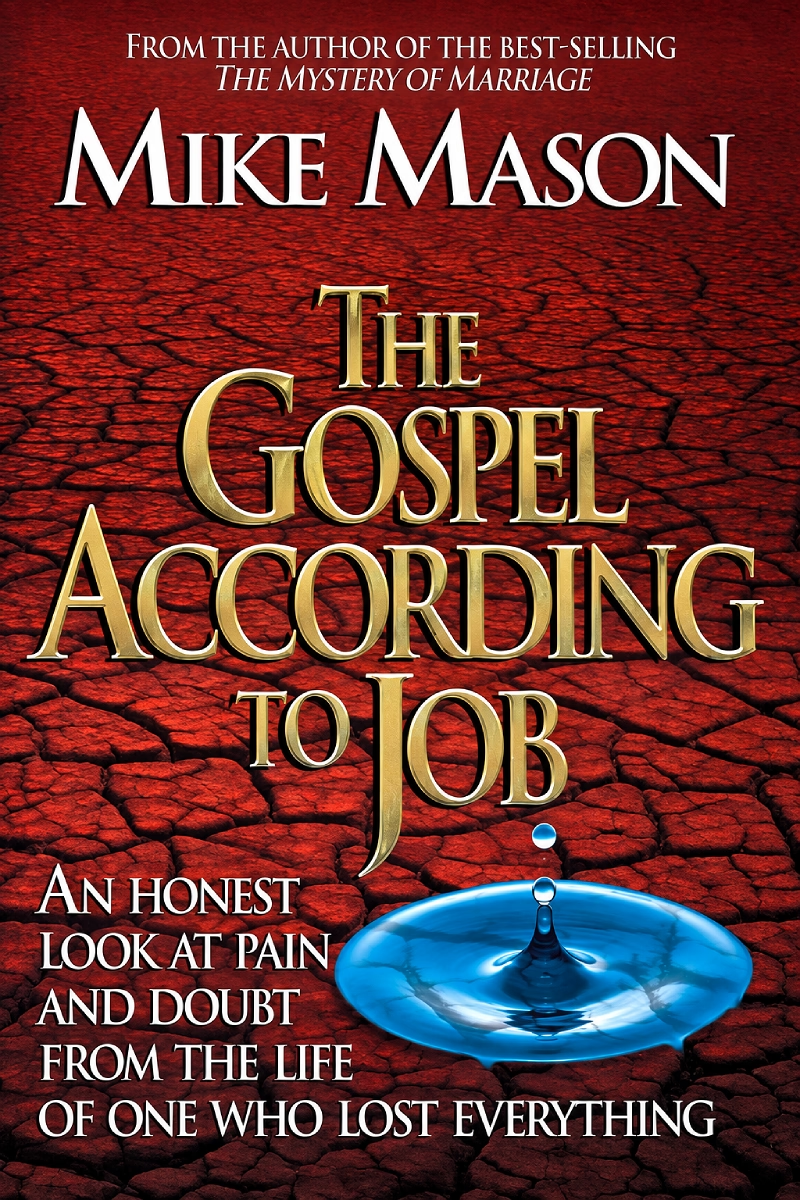
The Gospel According to Job
Mike Mason’s devotional journey through Job faces suffering and doubt without easy answers. Moving through the whole book, he explores honest anguish, faith, guilt, vindication, the cross, and the longing for a mediator, showing how Job’s deepest answer is not an explanation of pain but a transforming encounter with the living God that can sustain faith in spiritual crisis.
Available Instantly
About This Book
Mike Mason’s The Gospel According to Job is a devotional commentary that moves through the whole book of Job in short meditations while asking what Job reveals about suffering, doubt, faith, guilt, and the gospel. Mason writes especially for Christians who feel overwhelmed by pain, confusion, spiritual darkness, or a sense of separation from God. Rather than offering a formula for escaping suffering, he treats Job as a book that strips away easy explanations and brings a person to the point where only God himself can finally answer.
The commentary follows Job’s canonical movement from the prologue in Job 1–2 through the three rounds of dialogue, Elihu’s speeches in Job 32–37, the divine theophany in Job 38–42:6, and the epilogue in Job 42:7–17. Because Mason works consecutively through these sections, readers encounter Job’s losses, the accusations and arguments of his friends, Job’s protests and questions, his insistence on integrity, his longing for vindication, and the moment when God answers from the whirlwind. The result is not merely a topical book about pain; it is a sustained Christian meditation on the spiritual experience contained in Job.
Suffering is the dominant human problem. Mason rejects the idea that severe pain can always be mastered through a technique, a positive attitude, or sufficiently strong religious effort. Job’s story forces the reader to confront helplessness and the limits of human explanation. The friends repeatedly try to fit Job’s suffering into a moral system in which pain must be the direct result of wrongdoing, while Job refuses both false self-condemnation and easy self-justification. Mason uses that conflict to explore what happens when familiar explanations about God no longer seem adequate to lived experience.
Doubt, anger, fear, confusion, and lament are treated as realities that faith may have to carry rather than emotions that must be hidden before a person can approach God. Mason sees Job’s honesty as part of his faithfulness. The book therefore speaks to readers who wonder whether questioning God is compatible with faith, whether spiritual crisis means that faith has failed, or how a believer can continue to seek God when prayer does not produce an immediate change in circumstances.
At the same time, Mason reads Job through the gospel. Job’s longing for someone who can stand between God and humanity becomes a way of considering mediation, guilt, reconciliation, and Christ. Mason repeatedly brings the cross into the experience of suffering, not as a simple explanation for pain but as the place where guilt is borne and where the Christian learns what it means to entrust oneself to God without controlling the outcome. In this sense, the “gospel according to Job” is the discovery that salvation cannot be reduced to self-rescue, moral performance, or correct explanations.
Faith in this book is therefore not equated with constant happiness or emotional certainty. Mason describes faith as remaining engaged with the enormity and reality of God even when the believer does not understand what God is doing. Job’s hope that God himself will vindicate him becomes a pattern of trusting beyond visible evidence. The final theophany is decisive: God does not give Job a comprehensive explanation for his suffering. He gives Job himself. Mason treats that encounter as the answer toward which the entire book moves—a direct encounter with the living God that changes the sufferer even when many intellectual questions remain unresolved.
The book can help readers asking why suffering happens without an obvious cause, whether it is permissible to doubt or be angry with God, how to respond to condemning religious explanations, what Job’s longing for a mediator means for Christians, how the cross speaks into suffering and guilt, and what faith looks like when God does not explain himself. Its central Christian-life application is endurance through honest relationship with God: refusing both denial and despair while discovering that God’s mercy leaves room for real human weakness, emotion, and dependence.
Book Details

Reading Fit
STUDY LEVEL
Fundamental, Intermediate
STUDY SCOPE
Individual Book, Old Testament
BOOKS INCLUDED

Edition & Format
PUBLISHED
September 3, 2002
AVAILABLE FORMATS
paperback, hardcover, kindle
LENGTH
451 pages

Topics Covered
You Might Also Like