Deuteronomy, Joshua, Judges, Ruth, 1st Samuel, 2nd Samuel, 1st Kings, and 2nd Kings 1-7
Alexander Maclaren
4.6(46)


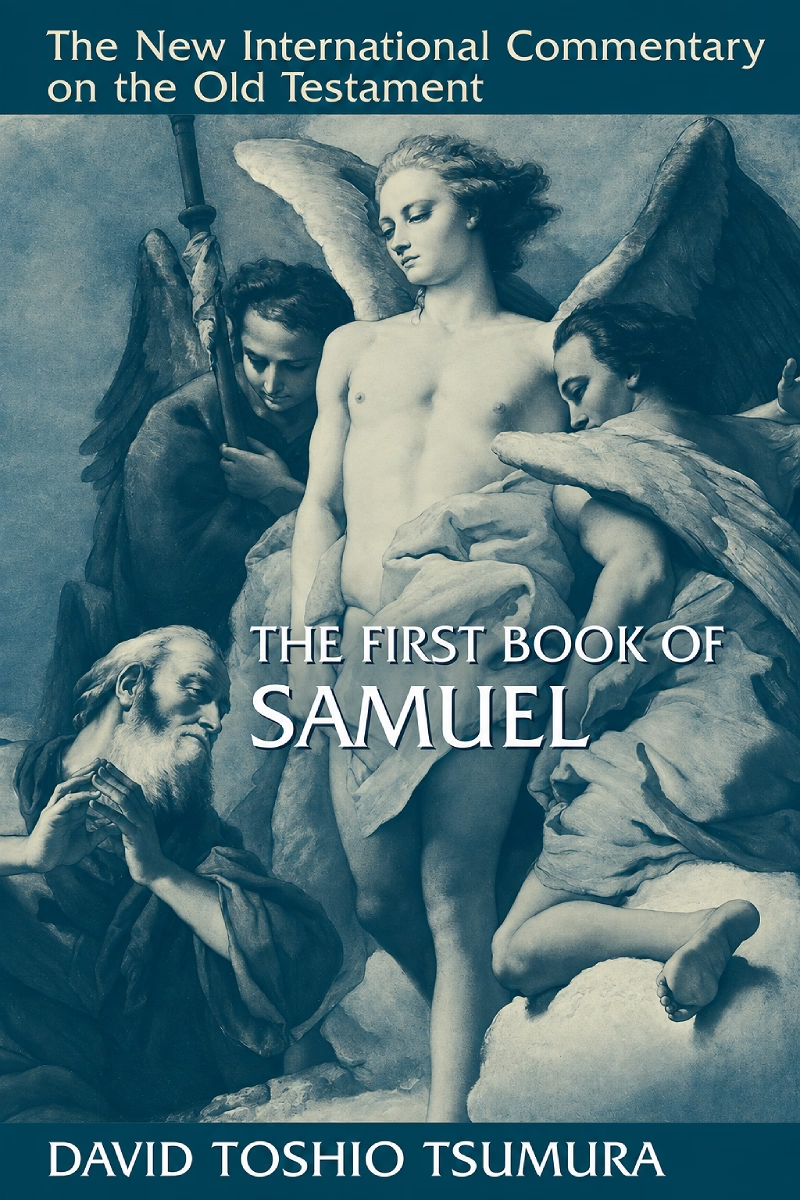
David Toshio Tsumura offers a rigorous exposition of 1 Samuel that combines close Hebrew analysis with literary, historical, cultural, and theological interpretation. He follows Samuel, the ark, Saul, and David through Israel’s transition to monarchy, showing why obedience to God’s word is essential for a king acceptable to the God of Israel and how the narrative fits together.
Available Instantly
David Toshio Tsumura’s The First Book of Samuel is a full-scale commentary on 1 Samuel that combines close attention to the Hebrew text with literary, historical, cultural, and theological interpretation. Because 1 Samuel contains many difficult textual and linguistic problems, Tsumura devotes unusual care to Hebrew grammar, syntax, discourse analysis, prose and poetry, and the coherence of the Masoretic Text. The commentary is therefore especially useful for readers trying to understand difficult verses, apparent textual problems, narrative transitions, and the literary structure of 1 Samuel rather than merely retelling its familiar stories.
Tsumura organizes the narrative around the major movements of the book. The first section follows the rise of Samuel in 1 Samuel 1–7, including Hannah, Eli and his sons, Samuel’s call as a prophet, the capture and return of the ark of God, and Samuel’s judgeship. These chapters show the transition from failed priestly leadership to Samuel as the man through whom the word of the Lord again comes to Israel. The ark narrative receives substantial attention, including Israel’s defeat, the Philistine capture of the ark, the humiliation of Dagon, the plagues in Philistine territory, and the ark’s return.
The transition to monarchy in 1 Samuel 8 introduces one of the commentary’s governing theological concerns: what kind of king can rightly rule Israel under the God of Israel. Tsumura identifies the purpose of 1 Samuel as demonstrating that obedience to the word of God is the necessary condition for an acceptable king. That theme shapes the rise and rejection of Saul. The commentary follows Saul’s selection and public confirmation, Samuel’s address to Israel, Saul’s military leadership, and the decisive episodes in which Saul fails to obey the divine command. Saul’s rejection in 1 Samuel 13–15 is therefore not simply a character flaw or political reversal; it becomes a theological judgment on kingship that will not submit to God’s word.
From 1 Samuel 16 onward the commentary follows the intertwined story of Saul and David. Tsumura examines David’s anointing, his entrance into Saul’s service, the David and Goliath narrative in 1 Samuel 17, Jonathan’s relationship with David, Saul’s growing hostility, David’s repeated escapes, and the long conflict in which David is preserved while Saul’s kingship deteriorates. The commentary also gives careful treatment to David’s life among the Philistines and to Saul’s final crisis, including his consultation with the medium of Endor in 1 Samuel 28 and his death with Jonathan in chapter 31.
Historical and cultural background is a significant part of Tsumura’s work. He pays close attention to Philistine and Canaanite settings, social and religious customs, geography, warfare, material culture, and the ancient Near Eastern environment that helps explain the narrative. This background serves the interpretation of the text rather than replacing it. His treatment of the Philistines is especially important because they form the recurring external threat from the ark narrative through Saul’s death and provide the setting for some of David’s most famous episodes.
The commentary also examines 1 Samuel as literature. Narrative structure, repeated words, dialogue, shifts in viewpoint, poetic material, and discourse features help show how the book develops Samuel, Saul, and David and how its individual scenes contribute to the larger movement from judgeship to monarchy. Tsumura’s close reading is particularly valuable for questions about how the stories fit together and why the Hebrew narrative is arranged as it is.
For readers, the book addresses both technical and theological questions: What does the Hebrew text of a difficult passage actually say? How should the rise of Israel’s monarchy be understood? Why was Saul rejected? What distinguishes Saul’s kingship from the emerging role of David? What is the theological significance of the ark, Samuel’s prophetic ministry, David and Goliath, and the medium of Endor? Across these questions, Tsumura keeps the narrative’s central issue in view: human leadership in Israel remains accountable to the word and rule of God.

STUDY LEVEL
Advanced
STUDY SCOPE
Individual Book, Old Testament
BOOKS INCLUDED

PUBLISHED
March 15, 2007
AVAILABLE FORMATS
hardcover, kindle
LENGTH
720 pages