
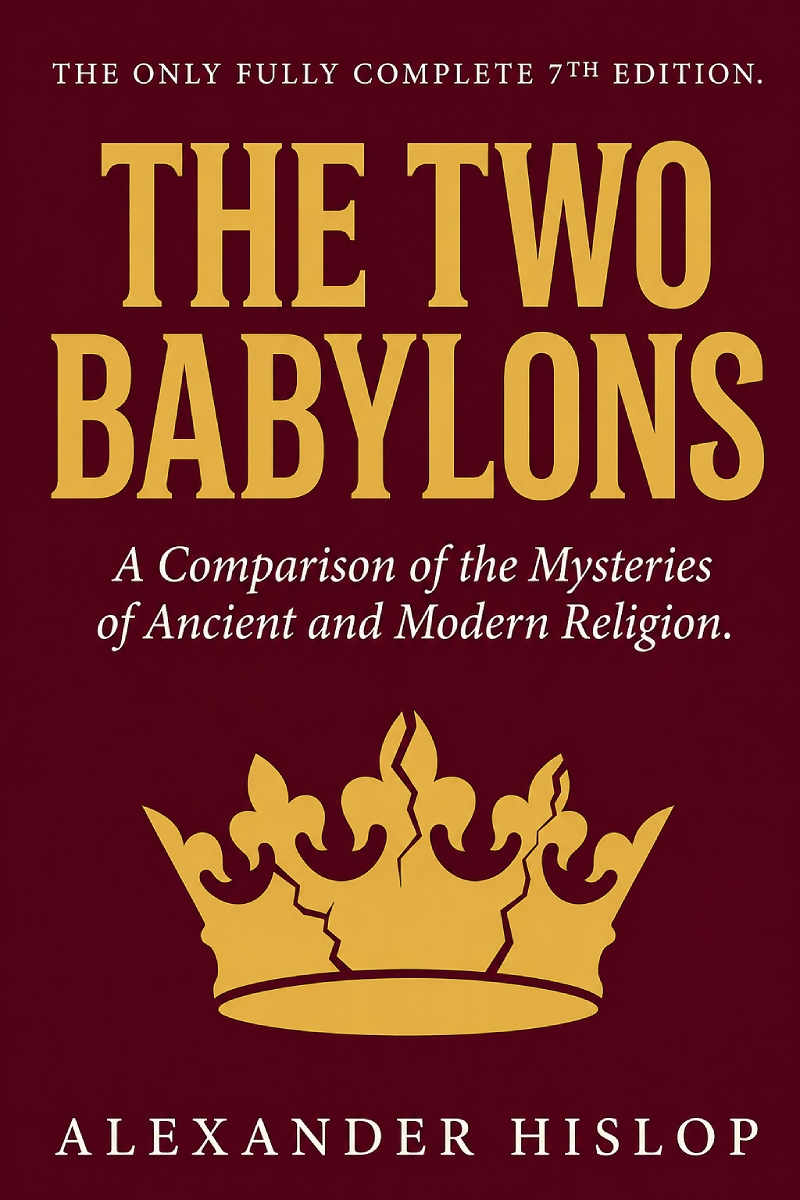
The Two Babylons 7th Edition
Alexander Hislop argues that the religious system of papal Rome preserves ancient Babylonian mystery religion under later names and forms. From Nimrod and mother-and-child worship to festivals, doctrines, rites, priesthood, and prophetic symbols, the book compares pagan traditions with Revelation’s Babylon and traces the continuity Hislop sees between the two systems.
Available Instantly
About This Book
The Two Babylons is Alexander Hislop’s extended comparative argument that the religious system represented by papal Rome reproduces essential features of the ancient mystery religion of Babylon. The book ranges across Babylonian, Assyrian, Egyptian, Greek, Roman, Phoenician, and other ancient traditions, comparing objects of worship, festivals, doctrines, rites, symbols, and religious offices. Its biblical framework is established by Revelation’s “Babylon the Great,” which Hislop interprets as a later religious system standing in a type-and-antitype relationship with historical Babylon.
Revelation 17 supplies the governing prophetic image. Hislop begins with the woman bearing the name “Mystery, Babylon the Great” and compares her golden cup with Jeremiah’s description of ancient Babylon as a golden cup that intoxicated the nations. From that parallel he develops the thesis that the Babylon of the Apocalypse inherits the character of the earlier Babylonian mysteries. The relationship is not merely one of shared immorality or idolatry; Hislop argues for historical and religious continuity between the ancient and later systems.
Genesis 10 is central to his reconstruction of the beginning of that system. Nimrod becomes the principal early figure, and Hislop repeatedly connects him with later names and forms found in ancient mythology. The book traces the figures associated with Nimrod, his wife, and their deified child through different cultures, treating changes of name and symbol as variations of one underlying religious pattern. Mother-and-child worship therefore becomes one of the book’s major comparative subjects, with Egyptian, Greek, Roman, and other forms set beside Roman Catholic devotion to Mary and the child Jesus.
The book’s largest sections examine the practical forms in which this alleged continuity appears. Festivals such as Christmas, Lady Day, Easter, the Nativity of St. John, and the Feast of the Assumption are compared with older seasonal rites, fertility customs, sun worship, and ancient calendars. Doctrinal and disciplinary comparisons include baptismal regeneration, justification by works, the sacrifice of the Mass, extreme unction, purgatory, and prayers for the dead. Hislop’s purpose throughout is to distinguish biblical Christianity from practices he believes entered ecclesiastical religion from the ancient mysteries.
Rites and ceremonies receive equally detailed treatment. Processions, relics, images, the clothing and crowning of images, the rosary, Sacred Heart devotion, lamps, wax candles, and the sign of the cross are interpreted through comparative religious history. Hislop makes extensive use of ancient writers, mythological parallels, monuments, linguistic arguments, symbols, and historical customs. The book therefore has strong search relevance for pagan religious symbolism, idolatry, ancient mystery religion, and the origin of later religious customs as Hislop understands them.
Religious offices form another substantial line of comparison. The sovereign pontiff or Pontifex Maximus, priests, monks, and nuns are related to ancient systems of hierarchy and dedicated religious orders. These institutional parallels are part of Hislop’s larger claim that the Babylonian system survived not merely in isolated customs but as an organized religious structure.
The final major chapter returns explicitly to prophecy. Revelation 12–13 is read through the book’s historical framework of paganism and Rome. The great red dragon, the beast from the sea, the beast from the earth, and the image of the beast are compared with ancient symbols and with stages in the development of Roman religious-political power. This section reinforces the book’s use of biblical types and pictures: ancient Babylon is treated as a type whose characteristics reappear in apocalyptic Babylon.
The Two Babylons addresses readers asking what Hislop means by Babylonian mystery religion, how he connects Nimrod with later pagan deities, why mother-and-child worship occupies such a large place in his argument, where he traces the origins of Christmas and Easter customs, how he relates Roman doctrines and rites to pagan precedents, what he believes Revelation’s Babylon represents, and how ancient religious symbolism is used to interpret Revelation 12, 13, and 17.
Book Details

Reading Fit
STUDY LEVEL
Advanced, Intermediate
STUDY SCOPE
Topical
BOOKS INCLUDED

Edition & Format
PUBLISHED
May 21, 2024
AVAILABLE FORMATS
paperback, hardcover, kindle
LENGTH
207 pages

Topics Covered
You Might Also Like