

In This Article

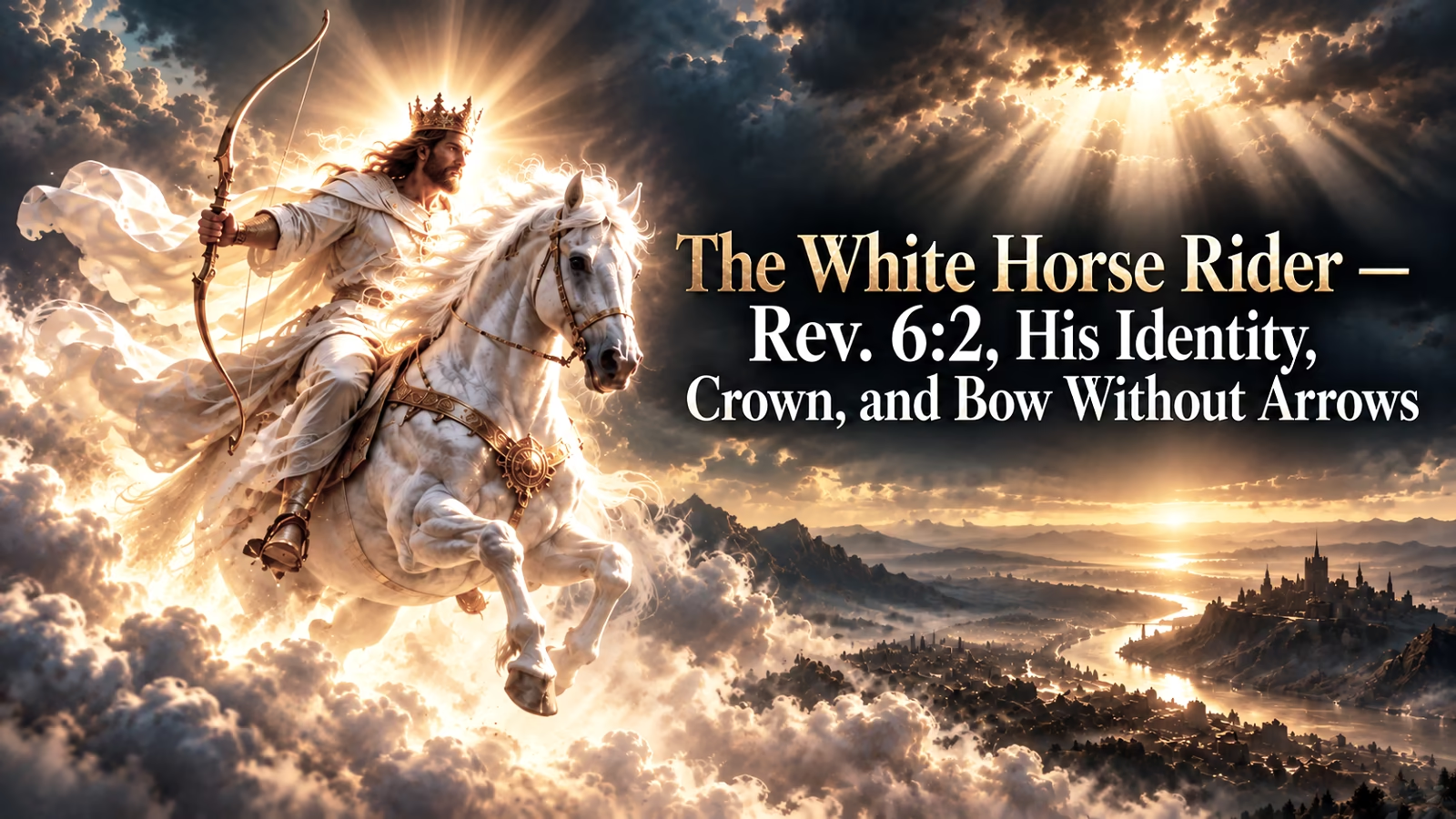
The White Horse Rider — Rev. 6:2, His Identity, Crown, and Bow Without Arrows
Few passages in the Book of Revelation have generated as much cinematic terror—or theological confusion—as the opening of the First Seal:
"And I looked, and behold, a white horse. He who sat on it had a bow; and a crown was given to him, and he went out conquering and to conquer." — Revelation 6:2
For the last century, modern pop-eschatology has overwhelmingly insisted that this rider is the Antichrist. We are told he is a charismatic, deceptive world leader who arrives on a white horse to counterfeit Jesus Christ, using an arrowless bow to broker a fake global peace treaty before plunging the world into the Great Tribulation.
But when we pressure-test this popular theory against the strict definitions of Scripture, the narrative fractures. It requires massive interpretive leaps, arbitrary "patches," and theological gymnastics.
When you strip away human tradition and allow Scripture to interpret Scripture, a beautiful, airtight framework emerges.
The Rider on the White Horse is not a demonic counterfeit; He is the Word of God moving out in Spirit form—the Holy Spirit—enforcing the absolute, uncontested legal victory won at the Cross.
Here is a comprehensive defense of this view and a demonstration of how it maintains the unbroken continuity of God's Word.
1. The Definitional Crisis: Does the Antichrist Deceive or Deny?
The foundational flaw of the "Antichrist on a white horse" theory is that it directly violates the biblical definition of the Antichrist. Popular teaching claims the Antichrist will pose as Jesus to trick humanity.
But what does the Apostle John actually say?
In the only New Testament books where the word "antichrist" explicitly appears, John defines this spirit not by subtle imitation, but by blunt, aggressive theological denial:
1 John 2:22:
"Who is a liar but he who denies that Jesus is the Christ? He is antichrist who denies the Father and the Son."
1 John 4:3:
"And every spirit that does not confess that Jesus Christ has come in the flesh is not of God. And this is the spirit of the Antichrist..."
2 John 1:7:
"...who do not confess Jesus Christ as coming in the flesh. This is a deceiver and an antichrist."
Scripture does not break.
The Antichrist does not sneak into the world saying, "I am Jesus, your Savior." He declares, "Jesus is not the Christ, and the Son of God does not exist."
By forcing the rider of Revelation 6:2 to be a deceptive, pseudo-Christ figure, modern interpretations create a scriptural contradiction.
The Rider on the White Horse must be understood as an entirely divine, righteous force, leaving John’s definition of the antichrist spirit perfectly intact.
2. The Grammatical Reality of "Conquering and to Conquer"
Many historicist and military interpretations argue that the white horse represents human geopolitical conquest—such as the expansion of the Roman Empire. However, the precise Greek grammar of the text exposes a fatal flaw in this view.
The text states that the rider went out "conquering and to conquer" (nikōn kai hina nikēsē).
In physical warfare, conquest is a finite, earthly event. An army invades, a battle is fought, territory is seized, and the conquering stops so that political administration can begin.
To conquer is the end of the matter; the war concludes, and the authority takes control.
But the Greek structure here combines a present participle with a continuous purpose clause:
- "Conquering" (nikōn): Continuous, active, ongoing progression.
- "And to conquer" (kai hina nikēsē): Moving forward with a guaranteed, unyielding momentum toward an ultimate, cosmic conclusion.
Human empires rise, peak, and decay; they do not possess an unbounded, relentless spiritual momentum.
Only a divine, supernatural reality can move continuously through history to finish a specified final work.
3. The Bow Without Arrows: A Symbol of Finished Legal Victory
For decades, commentators have stumbled over the rider's weapon: a bow with no mention of arrows. Proponents of the Antichrist theory claim this signifies a "bluff" or "bloodless diplomacy."
But when viewed through the lens of the finished work of Jesus, the empty bow is the ultimate symbol of triumph.
The bow is empty because the arrows have already been shot, and they perfectly hit their target at the Cross.
The Spent Arrows
At the Cross, the full weight of divine judgment against sin was discharged. Jesus absorbed the structural arrows of death, sin, and the law into Himself, exhausting their power forever.
Simultaneously, as the Messianic prophecy of Psalm 45:5 states, the King's arrows are "sharp in the heart of the King’s enemies."
At Calvary, the ultimate enemy was legally, structurally, and decisively defeated.
The Disarming of the Enemy
As Paul writes in Colossians 2:15:
"Having disarmed principalities and powers, He made a public spectacle of them, triumphing over them in it."
The Greek word for "disarmed" (apekdysis) literally means to strip an enemy of their legal weapons and rights.
Because the enemy was legally bankrupted at the Cross, he has absolutely no legal ground left to resist. Therefore, the Rider on the White Horse does not need a fresh supply of arrows to fight a new war.
The arrowless bow is carried as a symbol of an undeniable, pre-existing legal victory.
The Rider is the divine Enforcer—the cosmic Bailiff—sent out to execute a verdict that has already been handed down by the Judge of all the earth.
4. The Word in Spirit Form: Giving Life to the Letter
It is common for some to interpret the white horse as simply "the preaching of the Gospel." While closer to the truth, words alone can become "killing letters" without the Holy Spirit (2 Corinthians 3:6).
The letter kills, but the Spirit gives life.
The Rider, therefore, is not a static text or a human sermon; He is the Word of God moving out in Spirit form as the Holy Spirit.
Before Jesus went to the Cross, He told His disciples that He must leave so that the Helper could come (John 16:7).
What started as a finished physical victory at the Cross must be enforced, applied, and manifested within the spiritual realm—the very realm where the true enemies of God exist.
Like an invisible arrow piercing the heart from a distance, the Holy Spirit convicts, subdues internal rebellion, and removes demonic resistance (Acts 2:37).
This is why a crown (stephanos) is given to the rider immediately. He is the representative of the New King.
The old prince of this world has been legally cast out (John 12:31), and the Spirit is aggressively clearing the territory to manifest the Kingdom.
5. The Sovereign Head Start: The Timeline of the Seals
This framework brings flawless chronological harmony to the book of Revelation.
The rider on the white horse goes out immediately upon the opening of the first seal.
Conversely, the global devastation described under the next three horsemen—mass physical warfare (red), global hyper-inflation and famine (black), and the death of a quarter of the earth (pale)—has not yet occurred on the scale described in Revelation.
Those horsemen belong to the Great Tribulation.
By sending the White Horse out first, God establishes a sovereign ground plan:
- Spiritual Purging: Before the physical systems of the earth collapse into chaos, the Holy Spirit is given an immediate head start to clear the spiritual realm, protect the elect, and gather the global harvest.
- Uncontested Authority: Because of the Cross, the spiritual forces of darkness have no legal baseline to interfere with or stop the advance of the Spirit.
6. The Perfect Symmetry of Revelation 19
The spiritual mission that begins in Revelation 6 reaches its physical climax in Revelation 19.
The continuity is breathtaking:
- [ THE PHYSICAL CRUCIFIXION ] Jesus fires His arrows → Disarms principalities → Legal victory secured
- [ REVELATION 6: THE SPIRITUAL REALM ] The Holy Spirit rides out (White Horse / Arrowless Bow) → Invisible enforcement & purging
- [ REVELATION 19: THE PHYSICAL RETURN ] The spiritual purging is complete → Jesus returns physically → The Kingdom manifests on Earth
When the invisible, spiritual purging of the realm is complete, Jesus is seen physically returning in Revelation 19.
He is called the Word of God—the Word that became flesh.
And notice the order of His army:
"And the armies in heaven, clothed in fine linen, white and clean, followed Him on white horses" (Revelation 19:14).
They do not ride alongside Him as equals; they ride behind Him.
Jesus is the absolute Head of the Body. He rides first because He alone won the legal victory.
The overcoming saints, now fully transformed into His image by the long-term work of the Holy Spirit, follow in perfect submission.
Conclusion: Scripture Does Not Break
When we stop trying to "patch" Revelation with convoluted theories about a counterfeit Christ, the Bible sings in perfect harmony.
The Rider on the White Horse is the unstoppable, life-giving movement of the Holy Spirit, executing the finished, legal triumph of the Cross in the spiritual realm.
He goes out immediately, clearing out the spiritual forces of darkness, so that when the Head finally returns with His Body following close behind, the physical Kingdom of Christ can be ushered in with absolute, uncontested majesty.