

In This Article

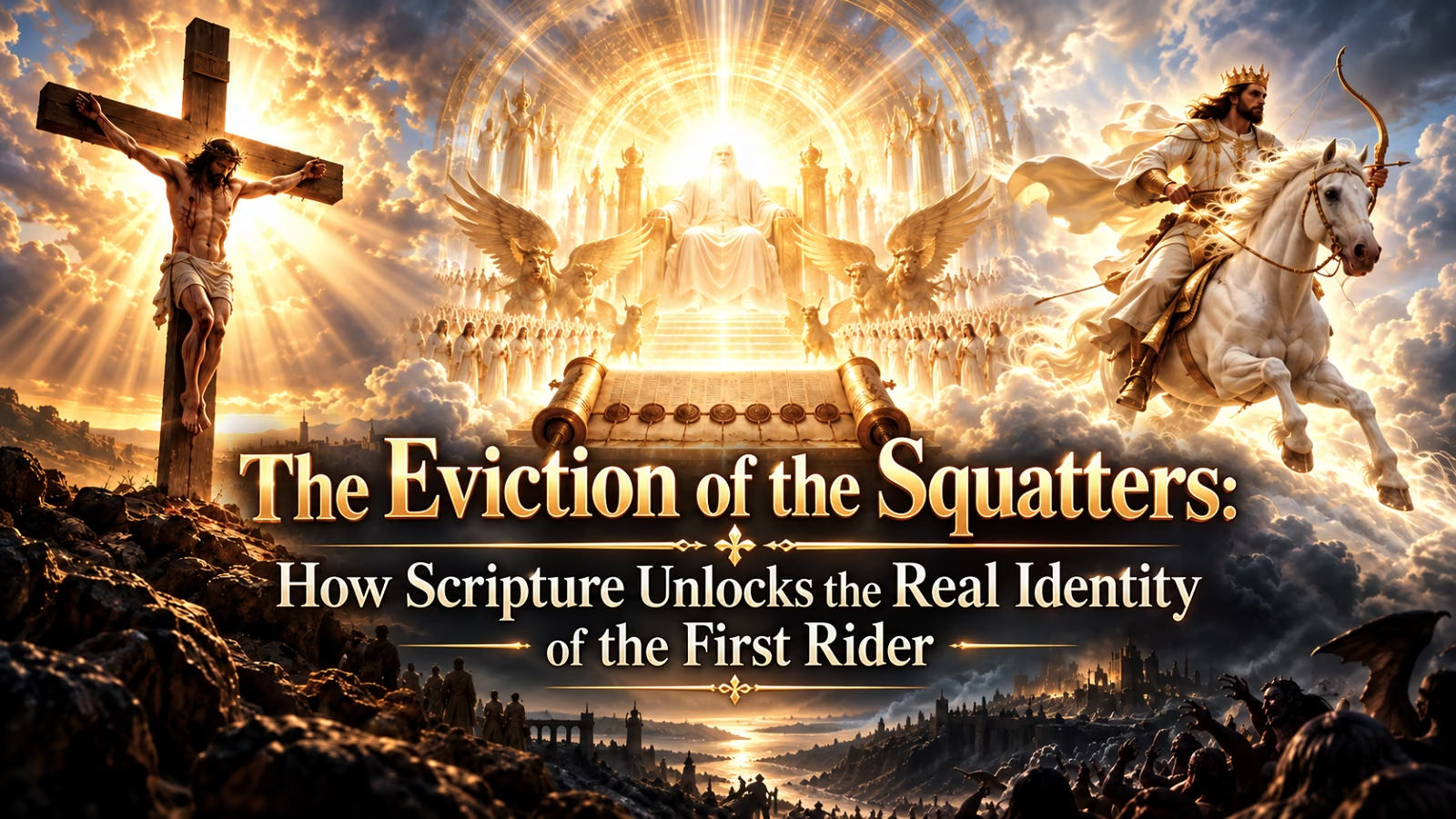
The Eviction of the Squatters: How Scripture Unlocks the Real Identity of the First White Horse Rider
Revelation 6 opens with one of the most disputed figures in Scripture:
“And I looked, and behold, a white horse. He who sat on it had a bow; and a crown was given to him, and he went out conquering and to conquer.”
— Revelation 6:2
Who is this rider?
The answer should not begin with tradition. It should begin with the sequence Scripture itself establishes—from the Cross, to Christ’s ascent, to the throne and the scroll, to the opening of the seals, and finally to the physical return of Christ in Revelation 19.
When that sequence is followed without breaking it apart, the identity of the first rider begins to emerge. He is not going out to win the decisive battle.
That battle has already been won.
He is going out to enforce the victory.
The Victory Was Already Won at the Cross
Jesus’ final declaration from the Cross was not tentative:
“It is finished.”
— John 19:30
The Cross accomplished something decisive in the conflict with the kingdom of darkness. Jesus had already said:
“Now is the judgment of this world; now the ruler of this world will be cast out.”
— John 12:31
Paul later describes what happened there:
“Having disarmed principalities and powers, He made a public spectacle of them, triumphing over them in it.”
— Colossians 2:15
Hebrews says that through death Christ broke the power of the one who held the power of death (Hebrews 2:14). Yet Satan did not disappear at Calvary.
Decades later Paul could still write:
“For we do not wrestle against flesh and blood, but against principalities, against powers… against spiritual hosts of wickedness in the heavenly places.”
— Ephesians 6:12
There is no contradiction. The Cross settled the decisive question of authority, but the defeated powers remained present and resistant.
That is the sense in which they may be compared to squatters. The analogy is not Scripture’s terminology, but it captures the condition Scripture describes: powers whose claim has been defeated, yet which refuse to surrender their occupation.
The legal victory therefore precedes the full execution of that victory. That distinction is essential to understanding the seals.
Before the Seals: The Lamb Must Ascend
On resurrection morning Jesus said something remarkable to Mary:
“Do not touch Me, for I have not yet ascended to My Father.”
— John 20:17
The reason He gives is explicit: He has not yet ascended to the Father. Later, however, the women take hold of His feet and worship Him (Matthew 28:9), and Jesus declares:
“All authority has been given to Me in heaven and on earth.”
— Matthew 28:18
Something has changed.
Revelation 5 gives us the heavenly side of that transition. John sees the throne of God and a scroll in the right hand of the One seated upon it. A mighty angel asks:
“Who is worthy to open the scroll and to loose its seals?”
— Revelation 5:2
The question is not who possesses enough brute force. No one in heaven, on earth, or under the earth is found worthy. John weeps because no one is qualified to take the scroll.
Then the Lamb appears—not merely a lion displaying raw power, but:
“A Lamb as though it had been slain.”
— Revelation 5:6
His qualification is inseparable from His completed redemptive victory. The Lamb takes the scroll, and heaven erupts:
“You are worthy to take the scroll,
— Revelation 5:9
And to open its seals;
For You were slain…”
The sequence is unmistakable:
Cross → resurrection → ascent → the slain Lamb appears before the throne → He is declared worthy → He takes the scroll → the seals can now be opened.
The scroll therefore functions as an authority-bearing Kingdom execution document. Scripture does not explicitly label it with that phrase, but its function reveals its character: no one can take it without qualification, and once the worthy Lamb takes it and begins opening its seals, actions are authorized and executed that ultimately result in the transfer of earthly dominion:
“The kingdoms of this world have become the kingdoms of our Lord and of His Christ.”
— Revelation 11:15
The seals are not detached predictions. They are the execution sequence by which Christ’s completed victory moves toward its manifested conclusion.
The Holy Spirit Cannot Be Missing From That Sequence
Before Jesus went to the Father, He told His disciples:
“It is to your advantage that I go away; for if I do not go away, the Helper will not come to you; but if I depart, I will send Him to you.”
— John 16:7
Jesus specifically connects His departure with the sending of the Holy Spirit, and the Spirit is indispensable to everything that follows. It is by the Spirit that believers put to death the deeds of the body (Romans 8:13), the Spirit who gives life to mortal bodies (Romans 8:11), and through the Spirit that believers are transformed into the image of Christ (2 Corinthians 3:18).
The struggle in which believers participate is also against spiritual powers in the heavenly realm (Ephesians 6:12). The Kingdom cannot be prepared merely by destroying external enemies. God must also conquer the flesh, transform His people, build them together in Christ, and carry the victory of the Cross through the very human beings who will share His Kingdom.
That requires the Holy Spirit.
Revelation therefore places the Spirit directly in the throne scene before the seals are opened. Revelation 4:5 describes:
“Seven lamps of fire… which are the seven Spirits of God.”
Then Revelation 5:6 describes the Lamb together with:
“The seven Spirits of God sent out into all the earth.”
Acts 2:33 records the earthly side of this reality:
“Having received from the Father the promise of the Holy Spirit, He poured out this which you now see and hear.”
Acts shows what happened on earth. Revelation gives us the throne-side sequence from which that sending proceeds.
And immediately after the Lamb takes the scroll, the first seal opens.
The First Rider Goes Out Conquering
John sees:
“A white horse. He who sat on it had a bow; and a crown was given to him, and he went out conquering and to conquer.”
— Revelation 6:2
Every element matters.
He Already Has the Bow
The bow is not given to the rider; he already possesses it. The crown, however, is given to him.
The bow therefore belongs to his existing identity and identifies him as a warrior. But something remarkable is missing:
There are no arrows.
Elsewhere Scripture knows exactly how to describe a warrior using a bow in battle. Psalm 45 portrays the victorious King:
“Gird Your sword upon Your thigh, O Mighty One…”
Then:
“Your arrows are sharp in the heart of the King’s enemies.”
— Psalm 45:3, 5
There the arrows are present because enemies are being struck. Revelation 6 presents a different picture.
The rider possesses the warrior’s bow, but John mentions no arrows. Yet the rider is not defeated, disarmed, or retreating. He receives a stephanos, a victor’s crown, and goes forth conquering.
Why would a conquering warrior go out with a bow but no arrows?
Because the decisive battle establishing his authority has already been won.
Revelation 6 does not show the rider departing heaven to determine whether Christ will triumph. Christ has already said:
“It is finished.”
The rulers and authorities have already been disarmed. The rider therefore carries the sign of warfare but goes forth under accomplished victory.
The arrows belong to the battle by which victory is established. The bow remains as the mark of the conquering warrior.
Conquering Is Not the Same as Destroying
Revelation is extremely precise. The first rider does not go out destroying. He goes out:
“Conquering and to conquer.”
That distinction is crucial. Christ intends to inherit the earth; His purpose is not simply to obliterate His creation. The first rider goes forth to carry Christ’s victory into territory still occupied by defeated powers.
He conquers the flesh in those who walk by the Spirit, transforms the saints, advances the testimony of Christ, displaces the kingdom of darkness, and carries forward in history what Christ established decisively at the Cross.
This is an eviction, not an uncertain battle for ownership. The squatters resist, but resistance does not restore their defeated claim.
John Lived to See Christ Come Through the Spirit
This also illuminates Jesus’ words concerning John. Peter asked what would happen to him, and Jesus answered:
“If I will that he remain till I come, what is that to you? You follow Me.”
— John 21:22
John carefully explains that Jesus had not promised that he would never die (John 21:23). But that clarification does not erase Jesus’ words: “Till I come.”
Scripture itself establishes that Christ can genuinely come to His disciples through the Spirit. During the same discourse in which Jesus promises the Helper, He says:
“I will not leave you orphans; I will come to you.”
— John 14:18
Jesus departs, the Spirit is sent, and yet Jesus describes that event as:
“I will come to you.”
John lived through that coming. Christ’s final physical return remained future, but Christ had genuinely come to His people through the Spirit exactly as He had promised.
Revelation 6:2 reveals the heavenly execution of that mission: the crowned conqueror goes forth.
Why the Red Horse Does Not Break the Sequence
A natural question follows. If the first rider goes forth in the first century, what about the other horses?
Revelation 6:4 says the red horse also comes forth:
“Another horse, fiery red, went out.”
But the distinction lies in the commission. The first rider goes out already conquering and to conquer. The red rider is given authority:
“To take peace from the earth, and that people should kill one another.”
Has peace been taken from the earth in that comprehensive sense?
Human history has always contained both peace and war. Nations have fought while other nations remained at peace. Families have lived ordinary lives while wars raged elsewhere. Even during enormous conflicts, peace has never been universally removed from human existence.
Revelation 6:4 describes something more severe:
Peace itself is taken from the earth.
Paul describes a remarkably similar transition:
“For when they say, ‘Peace and safety!’ then sudden destruction comes upon them…”
— 1 Thessalonians 5:3
Notice the order:
Peace and safety → sudden destruction.
That is not a two-thousand-year progressive fading of peace. It is an abrupt transition.
The red horse may appear in the heavenly seal vision, but his earthly commission—to take peace from the earth—belongs to the coming judgment period. That preserves the distinction between the first rider’s immediate conquering mission and the later catastrophic judgments.
Why the First Rider Cannot Be the Beast
The chronology creates an even greater problem for identifying the first rider as the Antichrist or Beast. The first rider appears at seal one, comes under the authority of the Lamb who has just taken the scroll, and moves within the heavenly execution sequence initiated by Christ.
The Beast, however, enters Revelation from an entirely different direction. Revelation 13 describes:
“A beast rising up out of the sea.”
Revelation 17:8 adds:
“The beast that you saw was, and is not, and will ascend out of the bottomless pit…”
The contrast is striking. The first rider is released within the Lamb’s heavenly seal sequence, while the Beast rises from below. Revelation does not even present the abyss as being opened until later in the narrative.
This creates a serious chronological and directional difficulty for identifying the seal-one rider with the Beast. One proceeds under the Lamb’s authority from the throne-side execution of the scroll; the other emerges later from below.
They do not naturally occupy the same place in Revelation’s sequence.
Revelation 19 Shows Where the Conquest Is Going
Revelation 6 begins with a white horse. Revelation 19 ends the long conflict with another white horse:
“Now I saw heaven opened, and behold, a white horse. And He who sat on him was called Faithful and True…”
— Revelation 19:11
This rider is explicitly Jesus Christ. The similarity does not require the riders to be identical; it reveals continuity of victory.
Revelation 6 begins the enforcement of Christ’s accomplished victory. Revelation 19 brings that victory into its final physical manifestation.
In Revelation 6, the Spirit goes forth conquering—working in the saints, against the flesh, and against the kingdom of darkness. In Revelation 19, heaven itself opens and Christ physically comes forth.
The armies of heaven follow Him. The Beast and the false prophet are removed, and Revelation 20 then records Satan being bound and cast into the abyss.
Only then does the Kingdom Age openly manifest upon the earth.
The sequence is therefore continuous:
Cross → resurrection → ascent → throne and scroll → Spirit sent forth conquering → transformation and spiritual enforcement → Tribulation judgments → Christ comes physically from heaven → Satan bound → Kingdom manifested on earth.
The First Rider in the Whole Biblical Story
Revelation 6:2 should not be interpreted in isolation. The rider stands inside a much larger biblical sequence.
Christ wins the decisive victory at the Cross. He ascends to the Father, the slain Lamb is declared worthy, He takes the scroll, and the Spirit stands in the throne scene destined for all the earth. Then the first seal opens.
A white horse appears. The rider already possesses the warrior’s bow, yet no arrows are mentioned. A victor’s crown is given to him, and he goes forth—not destroying, not desperately fighting for an uncertain outcome, but:
“Conquering and to conquer.”
The later judgment riders do not overturn this picture. Their catastrophic commissions belong to the final judgment sequence. The Beast does not fit the first rider’s position in the chronology because he emerges later and from below, while Christ Himself is not shown physically riding out of heaven until Revelation 19.
Taken together, the sequence points in one direction.
The first rider is the Holy Spirit, sent forth under the authority of the victorious Lamb to execute in creation what Christ legally accomplished at the Cross.
The decisive victory is already finished, but the enemy has not yet been fully removed. The Spirit goes forth to conquer the occupied ground, and when that long enforcement reaches its appointed conclusion, heaven opens, Christ Himself rides out, the squatters are finally removed, Satan is bound, and the Kingdom secured at the Cross becomes openly manifested upon the earth.
The first seal is therefore not the beginning of Christ’s attempt to win.
It is the beginning of the execution of a victory already won.