


In This Article

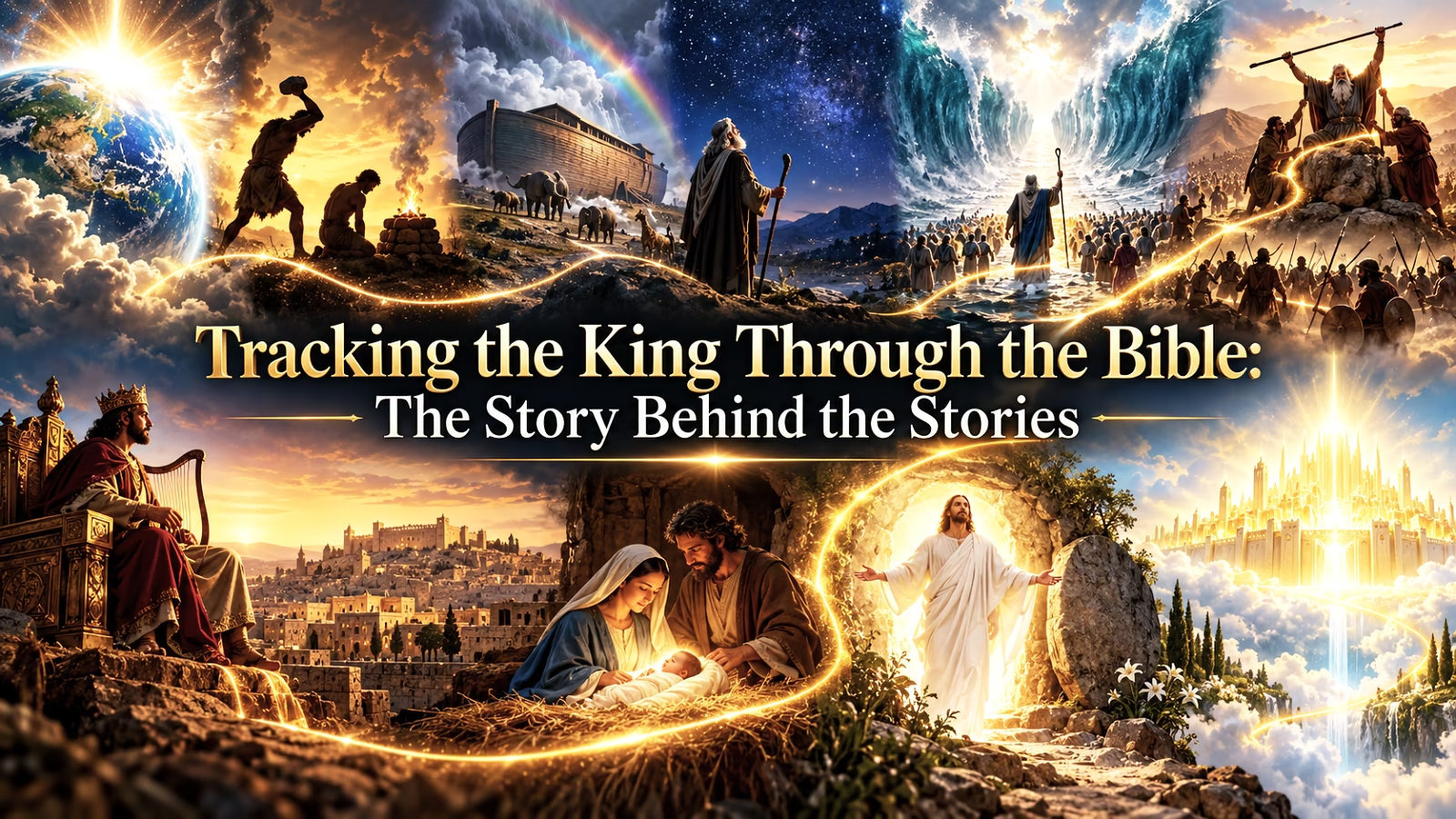
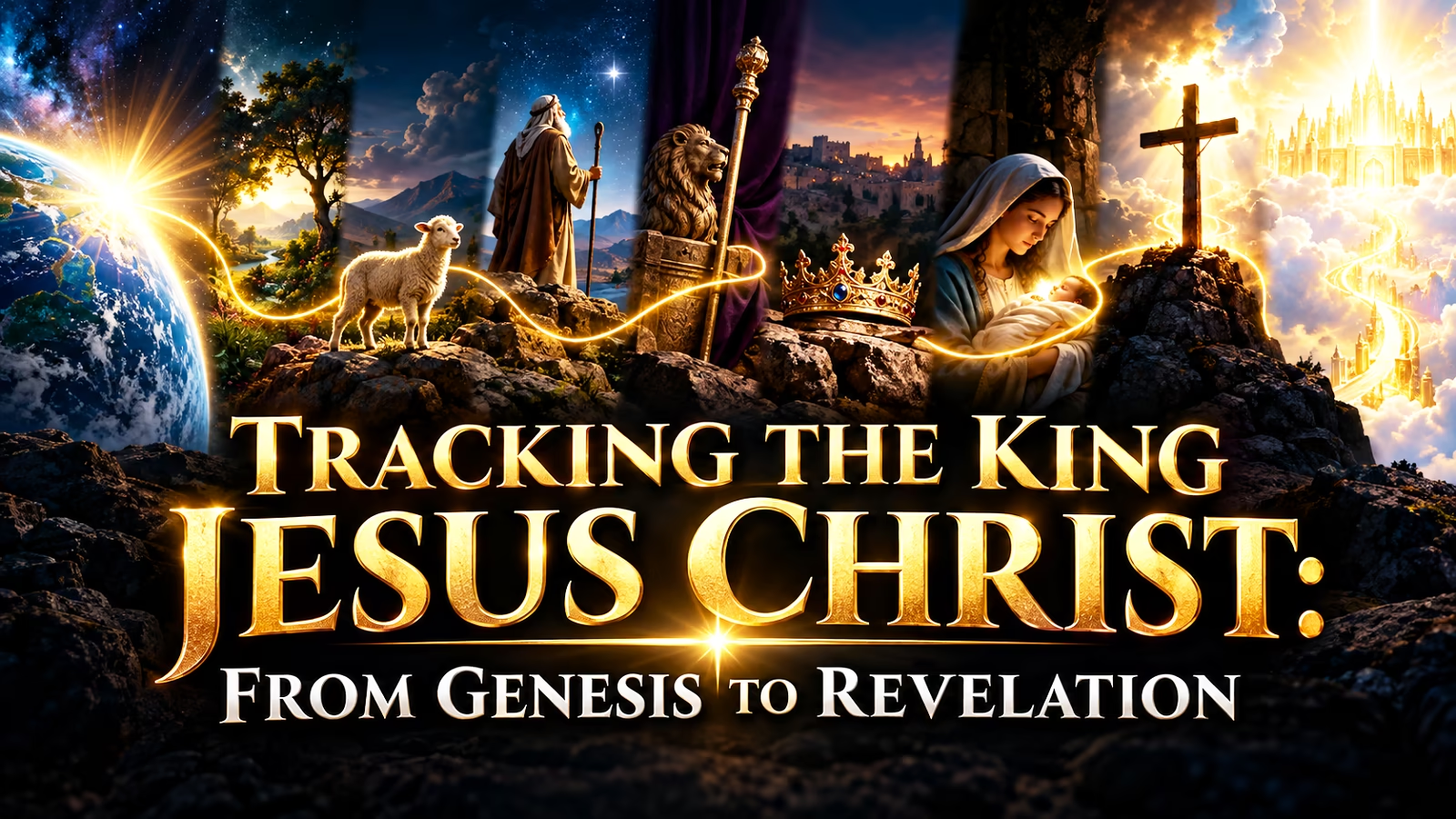
Tracking The King Jesus Christ: from Genesis to Revelation
The Bible contains thousands of people, many nations, countless families, wars, kingdoms, migrations, judgments, and covenants. Yet beneath all of that history, Scripture continually returns to one particular line.
It is following the King.
The line begins with Adam, passes through judgment, survives the Flood, narrows through Abraham, Isaac, Jacob, Judah, and David, and finally reaches the incarnation of Jesus Christ. Once this thread is recognized, the genealogies stop looking like interruptions and become part of the central story Scripture has been telling from the beginning.
The Light Appears Before the Seed Is Tracked
Before Scripture begins following the royal Seed through human history, Genesis presents the larger conflict into which that Seed will eventually come.
Creation lies under darkness following judgment, and God announces His answer:
“And God said, Let there be light: and there was light.”
— Genesis 1:3
The rest of Scripture reveals that the Light is not merely an attribute.
The Light is a Person.
“In him was life; and the life was the light of men. And the light shineth in the darkness; and the darkness apprehended it not.”
— John 1:4–5
Christ is the true Light, the King coming forth into the darkness as God’s answer to the rebellion. Yet the eternal Son will eventually enter the physical creation as a Man.
That requires a human line.
The Seed Is Announced
After the serpent enters human history in Eden, God immediately announces the coming conflict between two seeds.
“And I will put enmity between thee and the woman, and between thy seed and her seed: he shall bruise thy head, and thou shalt bruise his heel.”
— Genesis 3:15
This is the first explicit announcement of the Seed who will crush the serpent.
The wording is remarkable. God does not speak merely of the seed of a man, but of the Seed of the woman.
From this point forward, Scripture begins following and preserving the human line through which that Seed will come.
The Bible is not merely recording human history.
It is tracking the arrival of the King.
From Adam to Noah
Genesis 5 does something extremely important. It traces one specific line from Adam forward.
Cain’s descendants are recorded earlier, but the line Scripture follows toward the promised Seed proceeds through Seth.
“And Adam lived a hundred and thirty years, and begat a son in his own likeness, after his image; and called his name Seth.”
— Genesis 5:3
Generation follows generation until the genealogy reaches Noah.
This matters because the Flood is not merely about preserving life upon the earth. The Seed line must also survive the judgment.
Noah stands directly inside the genealogy descending from Adam, and his household passes safely through the Flood.
“...wherein few, that is, eight souls, were saved through water.”
— 1 Peter 3:20
The Ark therefore preserves more than eight individual lives.
It preserves the human line through which the promised King will eventually come.
After the Flood, Scripture Narrows Again
Genesis 10 describes nations spreading across the earth according to families, languages, lands, and nations.
“Of these were the isles of the nations divided in their lands, every one after his tongue, after their families, in their nations.”
— Genesis 10:5
“These are the families of the sons of Noah, after their generations, in their nations: and of these were the nations divided in the earth after the flood.”
— Genesis 10:32
Humanity is spreading outward.
Yet Scripture does not attempt to follow every nation equally. Genesis 11 immediately narrows the genealogy through Shem until it reaches Terah and then Abram.
That narrowing is deliberate.
The Bible is following the Seed.
Abraham Is Called Because the Seed Is Coming
God’s call of Abraham is therefore not an isolated religious event.
The royal line is moving forward.
“And I will make of thee a great nation, and I will bless thee, and make thy name great; and be thou a blessing; and I will bless them that bless thee, and him that curseth thee will I curse: and in thee shall all the families of the earth be blessed.”
— Genesis 12:2–3
Later, God makes the Seed connection even more explicit.
“And in thy seed shall all the nations of the earth be blessed.”
— Genesis 22:18
Thousands of years later, Paul tells us exactly where that promise was going.
“Now to Abraham were the promises spoken, and to his seed. He saith not, And to seeds, as of many; but as of one, And to thy seed, which is Christ.”
— Galatians 3:16
The New Testament therefore does not leave the destination of Abraham’s Seed unresolved.
The Seed is Christ.
The promise reaches all nations, but the promised Seed does not arise through every nation. He comes through one carefully preserved line.
The Line Narrows Through Isaac
Abraham has more than one son, but Scripture does not leave the promised line ambiguous.
“For in Isaac shall thy seed be called.”
— Genesis 21:12
The line passes through Isaac.
It does not pass through Ishmael.
This narrowing occurs again in the next generation. Isaac fathers Jacob and Esau, yet the covenantal line continues through Jacob.
The thread is becoming increasingly specific.
From Jacob to Judah
Jacob fathers twelve sons. Any one of them could appear to be the next link in the royal line, but Genesis identifies Judah.
“The sceptre shall not depart from Judah,
— Genesis 49:10
Nor the ruler’s staff from between his feet,
Until Shiloh come:
And unto him shall the obedience of the peoples be.”
Now the line is not merely a Seed line.
It is explicitly royal.
The sceptre belongs to Judah.
The King will come through him.
The Line Moves Toward David
Generations later, the book of Ruth gives another critical link in the chain.
Ruth enters the story as a Moabite woman, but Scripture does not leave the continuation of the royal line legally unresolved. Boaz acts as kinsman-redeemer.
“Moreover Ruth the Moabitess, the wife of Mahlon, have I purchased to be my wife, to raise up the name of the dead upon his inheritance, that the name of the dead be not cut off from among his brethren, and from the gate of his place: ye are witnesses this day.”
— Ruth 4:10
The line then moves directly toward David.
“And Obed begat Jesse, and Jesse begat David.”
— Ruth 4:22
What might appear to be a small family story in Bethlehem is actually another stage in preserving the royal Seed.
The King is still coming.
God Establishes the Davidic Throne
With David, the promise becomes even more precise.
God does not merely promise that someone associated with David will someday rule. He promises physical seed proceeding from David himself.
“When thy days are fulfilled, and thou shalt sleep with thy fathers, I will set up thy seed after thee, that shall proceed out of thy bowels, and I will establish his kingdom.”
— 2 Samuel 7:12
The promise then takes on extraordinary language.
“I will be his father, and he shall be my son...”
— 2 Samuel 7:14
The physical Seed and the royal throne now converge. The coming King must genuinely stand in David’s physical line.
The New Testament later confirms that this requirement was fulfilled in Jesus Christ.
“Concerning his Son, who was born of the seed of David according to the flesh.”
— Romans 1:3
That statement is decisive.
Jesus is not merely associated with David legally, symbolically, or prophetically. According to His human flesh, He is genuinely the seed of David.
The Royal Seed Nearly Disappears
At one point in Judah’s history, the royal line appears to come within one child of extinction.
Athaliah attempts to destroy it.
“Now when Athaliah the mother of Ahaziah saw that her son was dead, she arose and destroyed all the seed royal.”
— 2 Kings 11:1
If the royal seed disappears, the promise to David appears impossible to fulfill.
But one child survives.
“But Jehosheba, the daughter of king Joram, sister of Ahaziah, took Joash the son of Ahaziah, and stole him away from among the king’s sons that were slain, even him and his nurse, and put them in the bedchamber; and they hid him from Athaliah, so that he was not slain.”
— 2 Kings 11:2
The preservation of Joash is therefore much larger than the survival of one boy.
The royal thread continues.
What God promised cannot be extinguished.
Then Comes Jeconiah
Near the end of the kingdom of Judah, another problem appears.
Jeconiah, also called Coniah and Jehoiachin, stands directly in the royal succession through Solomon.
Scripture does not hide his condition before God.
“And he did that which was evil in the sight of Jehovah, according to all that his father had done.”
— 2 Kings 24:9
The problem becomes much larger when God pronounces judgment upon him.
The Judgment on Coniah
Jeremiah records a sentence that appears capable of creating an enormous obstacle for the promised King.
“Thus saith Jehovah, Write ye this man childless, a man that shall not prosper in his days; for no more shall a man of his seed prosper, sitting upon the throne of David, and ruling in Judah.”
— Jeremiah 22:30
God had already promised David that his Seed would possess the throne.
Now a man standing directly in Solomon’s royal succession receives a judgment declaring that no man of his seed would prosper sitting upon David’s throne.
God cannot solve that problem by contradicting Himself.
He will not disregard His promise to David, and He will not disregard His judgment upon Coniah.
Jeremiah had used another striking image immediately before this judgment.
“As I live, saith Jehovah, though Coniah the son of Jehoiakim king of Judah were the signet upon my right hand, yet would I pluck thee thence.”
— Jeremiah 22:24
Coniah is removed like a signet from God’s hand.
Yet generations later, God speaks to Zerubbabel, a descendant appearing in the same royal line, and again uses the image of a signet.
“In that day, saith Jehovah of hosts, will I take thee, O Zerubbabel, my servant, the son of Shealtiel, saith Jehovah, and will make thee as a signet; for I have chosen thee, saith Jehovah of hosts.”
— Haggai 2:23
This does not erase Jeremiah’s judgment.
Zerubbabel is chosen and restored to important service, but Scripture never records him sitting upon David’s throne as king. The specific sentence of Jeremiah 22:30 therefore remains intact.
The royal house survives.
But the problem of Coniah’s physical seed sitting upon David’s throne has not simply disappeared.
Yet when Matthew opens the New Testament, he deliberately includes Jeconiah.
“And Josiah begat Jechoniah and his brethren, at the time of the carrying away to Babylon.”
— Matthew 1:11
Matthew then carries that royal line forward until it reaches Joseph.
That is not an embarrassing detail hidden inside the genealogy.
It is part of the solution.
Joseph Stands in the Royal Line
Matthew repeatedly uses the language of one man begetting another as he moves through the genealogy.
Then, when he reaches Jesus Christ, the wording changes.
“And Jacob begat Joseph the husband of Mary, of whom was born Jesus, who is called Christ.”
— Matthew 1:16
Matthew does not say Joseph begat Jesus.
Joseph is identified as the husband of Mary, and Jesus is born of Mary.
Yet Joseph stands in the royal succession Matthew has just traced through Solomon, Jeconiah, and the house of David.
Joseph therefore matters enormously.
Through Joseph, Jesus stands lawfully within David’s royal house and its dynastic succession. Yet because Joseph does not physically beget Him, Jesus is not biologically generated through the condemned seed of Coniah.
God has not ignored either side of the problem.
The royal connection remains.
The physical judgment upon Coniah’s seed remains.
And the King still comes.
Two Davidic Lines Meet at the Incarnation
Matthew traces the royal succession through David’s son Solomon until it reaches Joseph.
Luke traces Jesus’ physical genealogy through a different son of David: Nathan.
“The son of Melea, the son of Menna, the son of Mattatha, the son of Nathan, the son of David.”
— Luke 3:31
These are not competing genealogies.
They reveal the convergence of two requirements in the birth of the King.
Joseph stands in the royal and dynastic succession through Solomon.
Mary supplies Jesus’ actual human descent through David.
Scripture has already made Mary’s physical relationship to Jesus unmistakable. She conceives Him, carries Him, gives birth to Him, and is repeatedly called His mother.
Joseph is not His biological father.
Therefore, when Paul tells us that Jesus is “born of the seed of David according to the flesh,” that physical Davidic descent necessarily reaches Him through Mary.
This is why Joseph and Mary are not interchangeable figures who happened to be available when the Messiah was born.
Both matter.
Mary gives the King His genuine human and Davidic physical descent without passing through Coniah’s condemned physical seed.
Joseph places Him within the royal house and succession of David through Solomon.
At the incarnation, the requirements meet.
The Seed of the Woman Finally Appears
Genesis had spoken from the beginning of the Seed of the woman.
Now the unusual language becomes visible in history.
Isaiah had also announced that the promised Son would enter humanity in an extraordinary way.
“Therefore the Lord himself will give you a sign: behold, a virgin shall conceive, and bear a son, and shall call his name Immanuel.”
— Isaiah 7:14
Then Gabriel explains to Mary how this Son will be conceived.
“And the angel answered and said unto her, The Holy Spirit shall come upon thee, and the power of the Most High shall overshadow thee: wherefore also the holy thing which is begotten shall be called the Son of God.”
— Luke 1:35
Jesus is genuinely human through Mary.
He is truly the Seed of the woman and truly the Seed of David according to the flesh.
Yet He is not begotten by an Adamic father.
Why the Virgin Conception Matters
The virgin conception is therefore far more than a miraculous sign surrounding Jesus’ birth.
It stands directly within the biblical Seed line.
Scripture places the entrance of sin and death into humanity upon one man.
“Therefore, as through one man sin entered into the world, and death through sin; and so death passed unto all men, for that all sinned.”
— Romans 5:12
Paul repeats the same headship principle.
“For as through the one man’s disobedience the many were made sinners, even so through the obedience of the one shall the many be made righteous.”
— Romans 5:19
Jesus enters genuine humanity, but He does not enter through ordinary human generation from an Adamic father.
The Holy Spirit produces the conception in Mary.
Luke therefore calls the One conceived in her holy.
Paul later describes the extraordinary result with equal precision.
“For what the law could not do, in that it was weak through the flesh, God, sending his own Son in the likeness of sinful flesh and for sin, condemned sin in the flesh.”
— Romans 8:3
Jesus possesses real human flesh.
He enters the same human world in which sin has ruled and death has reigned, yet Adam’s sin does not enter Him.
He is holy from His conception.
The Seed promised in Eden has entered the battlefield without belonging to the serpent and without carrying the corruption that came through Adam.
The Living Tabernacle Enters Humanity
This also helps explain something larger about the incarnation.
The Word did not merely appear human.
“And the Word became flesh, and dwelt among us (and we beheld his glory, glory as of the only begotten from the Father), full of grace and truth.”
— John 1:14
The language of dwelling reaches back toward the tabernacle.
God had previously dwelt among His people in a holy sanctuary. Fallen man could not simply enter that holy presence on his own terms.
Now God enters humanity itself in the Person of Jesus Christ.
Jesus later speaks of His own body as the temple.
“Jesus answered and said unto them, Destroy this temple, and in three days I will raise it up.”
— John 2:19
John immediately explains:
“But he spake of the temple of his body.”
— John 2:21
Christ is the holy human dwelling place of God.
The One conceived by the Holy Spirit becomes the living Tabernacle in which God enters the human conflict without sin dwelling in Him.
The Preserved Seed Must Also Overcome
Preserving the line and bringing the King into the world does not end the conflict.
The serpent who opposed the promised Seed now confronts Him directly.
Jesus enters that testing already holy.
Luke has established that from His conception.
“And the angel answered and said unto her, The Holy Spirit shall come upon thee, and the power of the Most High shall overshadow thee: wherefore also the holy thing which is begotten shall be called the Son of God.”
— Luke 1:35
His testing does not make Him holy.
It proves His obedience under genuine pressure.
“For in that he himself hath suffered being tempted, he is able to succor them that are tempted.”
— Hebrews 2:18
Hebrews does not present His testing as theater.
“For we have not a high priest that cannot be touched with the feeling of our infirmities; but one that hath been in all points tempted like as we are, yet without sin.”
— Hebrews 4:15
The Son remains completely obedient to the Father through every test.
“Though he was a Son, yet learned obedience by the things which he suffered.”
— Hebrews 5:8
The One who entered the testing holy comes through the testing obedient and without sin.
His obedience under real testing is the outcome through which He stands as the proven spotless Lamb who can go to the cross.
The serpent has been given no artificial contest and no false victory has been declared.
Christ is genuinely tested.
Christ genuinely obeys.
Christ genuinely overcomes.
The prince of this world finds nothing in Him.
“I will no more speak much with you, for the prince of the world cometh: and he hath nothing in me.”
— John 14:30
Nothing.
The Seed has arrived.
The King has been tested.
The serpent has found no ground in Him.
The Seed Line Was Always Moving Toward the Cross
Genesis 3:15 never promised merely that the Seed would be born.
It promised conflict and victory.
“...he shall bruise thy head, and thou shalt bruise his heel.”
— Genesis 3:15
The line preserved through thousands of years leads finally to the Man who can enter that conflict.
The Flood cannot erase Him from history.
Barrenness cannot prevent Him.
Athaliah cannot destroy His royal house.
Babylon cannot erase the promise.
Coniah’s judgment cannot invalidate His claim.
And Adam’s fall cannot contaminate Him.
Every apparent barrier is answered without God breaking His promise, reversing His righteousness, or contradicting His own judgment.
The King arrives lawfully, physically, and holy.
Matthew and Luke Are Not Genealogical Filler
This is why the New Testament opens with genealogy.
Matthew begins:
“The book of the generation of Jesus Christ, the son of David, the son of Abraham.”
— Matthew 1:1
Those two names summarize centuries of promise.
Abraham identifies the promised Seed.
David identifies the promised King.
Matthew then traces the royal succession that reaches Joseph.
Luke carries Christ’s human genealogy backward through David, Abraham, Noah, Seth, and finally Adam.
“The son of Enos, the son of Seth, the son of Adam, the son of God.”
— Luke 3:38
The genealogies are not detached historical records.
They are evidence.
They show that the Person promised in Genesis has entered humanity exactly where Scripture said He would.
The Bible Has Been Following the King All Along
Once the pattern becomes visible, the progression is difficult to miss:
- Adam → Seth → Noah → Shem
- Abraham → Isaac → Jacob
- Judah → David
- the royal house preserved through Joash
- the royal succession through Solomon and Joseph
- the physical Davidic line through Mary
- Jesus Christ, the promised Seed and King
The rest of humanity has not been forgotten.
God’s purpose ultimately reaches the nations.
But Scripture follows this particular thread because it is following the Person through whom God’s purpose for humanity and creation will be accomplished.
The Genealogies Are the Footprints of the King
The long lists of names in Scripture are therefore not meaningless interruptions.
They are the footprints of the King moving through history.
Every preserved generation says the same thing:
The King is still coming.
The Flood does not destroy the line.
The scattering of the nations does not lose the line.
Barrenness does not end the line.
Foreign oppression does not end the line.
Athaliah does not destroy the royal house.
Babylon does not erase the promise.
Coniah’s judgment does not disqualify the coming King.
Joseph does not have to biologically beget Him.
Mary supplies the physical Davidic descent.
The Holy Spirit brings the holy Son into humanity.
Nothing breaks the thread.
The Seed Becomes the King
Genesis begins with God answering darkness by announcing the Light.
Then, after the serpent enters human history, God announces the Seed who will crush him.
From that point forward, Scripture tracks that Seed with extraordinary precision until the Word becomes flesh.
“And the Word became flesh, and dwelt among us (and we beheld his glory, glory as of the only begotten from the Father), full of grace and truth.”
— John 1:14
The Light announced in Genesis has entered humanity.
The Seed promised to the woman has arrived.
The Seed promised through Abraham has arrived.
The sceptre promised through Judah has arrived.
The Son promised through David has arrived.
The genealogies have reached their destination.
Jesus Christ is the King Scripture has been following all along.
The Thread Never Breaks
The Old Testament is not wandering through unrelated family histories while waiting for Jesus to appear.
It is moving toward Him.
From Adam to Noah, from Noah to Abraham, from Abraham to Judah, from Judah to David, and from David to the incarnation, Scripture preserves one continuous Messianic thread.
Along the way, the requirements become increasingly precise.
- He must be human.
- He must come through the woman.
- He must come through Abraham.
- He must come through Isaac.
- He must come through Jacob.
- He must come through Judah.
- He must be David’s physical Seed.
- He must possess the royal claim to David’s throne.
- He cannot be physically generated through the condemned seed of Coniah.
- He must enter humanity holy.
- He must remain obedient through genuine testing.
And every requirement meets in one Person.
The Word becomes flesh.
The King enters humanity.
And the unbroken Seed line reaches the Person for whom it had been preserved from the beginning:
Jesus Christ, the Son of God, the Son of Man, the promised Seed, and the King.