

In This Article

The White Horse, the Crown, and the Spirit’s Victory
Revelation does not begin the opening of the seals with defeat. It begins with victory.
Before the red horse brings slaughter, before the black horse brings famine, and before Death rides the pale horse, John sees something entirely different:
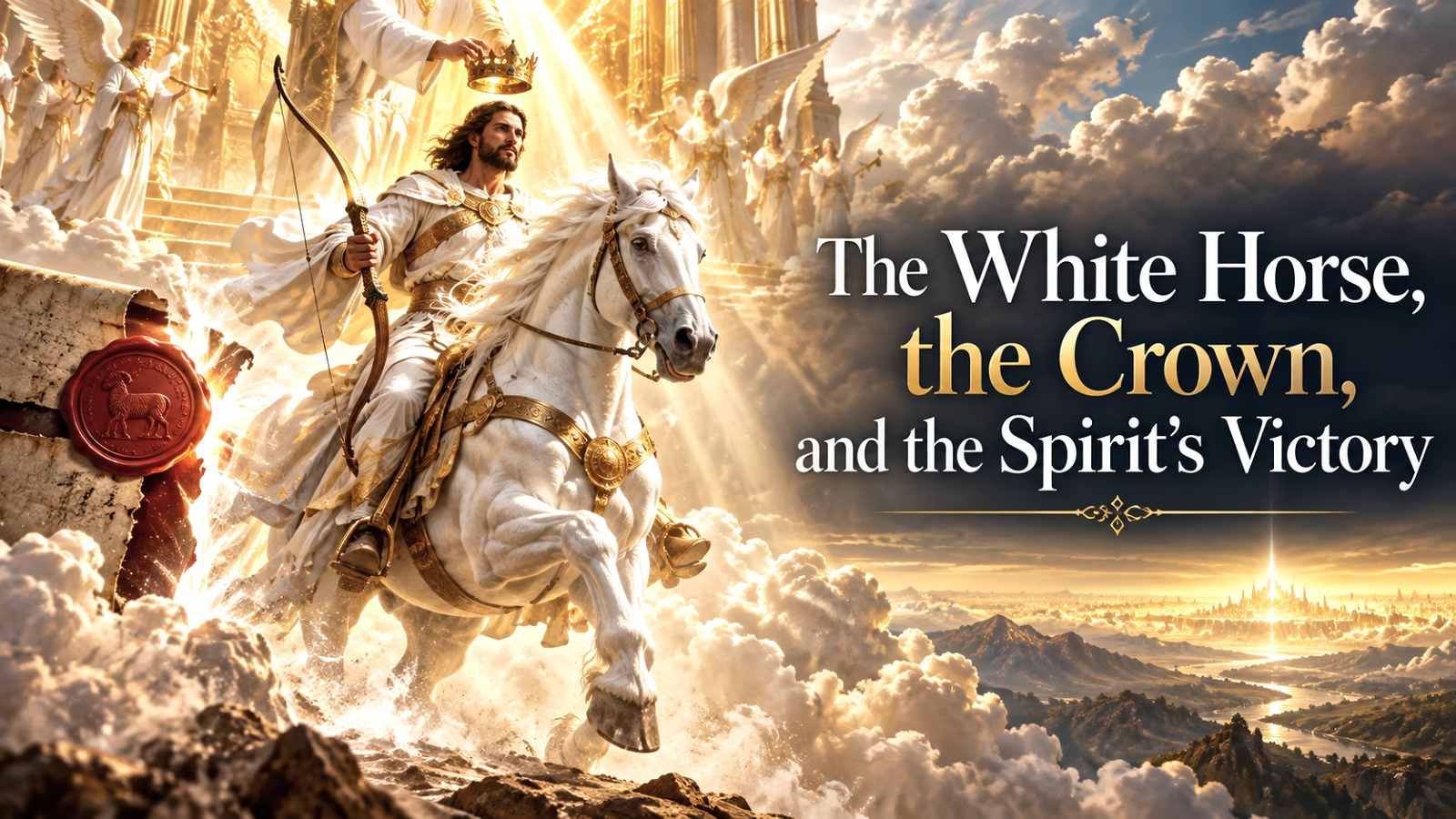
“And I looked, and behold, a white horse! And its rider had a bow, and a crown was given to him, and he came out conquering, and to conquer.”
— Revelation 6:2 ESV
The scene contains four unmistakable elements:
- a white horse,
- a bow,
- a crown given from above,
- and conquest that proceeds toward completion.
The question is simple: Who is this rider, and what conquest is taking place?
If Revelation 6:2 is read in isolation, the rider can easily become disconnected from the rest of Scripture. But Revelation does not stand apart from the biblical story. The victory of Christ, His ascension, the sending of the Holy Spirit, the judgment of the ruler of this world, the transformation of the saints, and the eventual removal of the spiritual enemy all belong to one continuous movement.
When that line is followed carefully, the first rider fits naturally into the work that begins after Christ’s victory at the cross.
The Decisive Victory Was Won at the Cross
The conquest of Revelation 6:2 does not begin with an uncertain battle whose outcome remains undecided. The decisive battle has already taken place.
Paul says that through the cross Christ:
“disarmed the rulers and authorities and put them to open shame, by triumphing over them.”
— Colossians 2:15 ESV
Hebrews says that through death Christ destroyed:
“the one who has the power of death, that is, the devil.”
— Hebrews 2:14 ESV
The cross therefore changed the position of the enemy. Before Calvary, the demons understood that a time of judgment was still ahead. When Jesus confronted them, they cried:
“Have you come here to torment us before the time?”
— Matthew 8:29 ESV
They knew judgment was coming, but they also knew the appointed time had not yet arrived.
Throughout His earthly ministry, Jesus repeatedly spoke of His hour as something still ahead. Then the hour came. Christ went to the cross, defeated the hostile powers, and established the basis for their removal.
The victory was accomplished. The enemy was judged, and the hostile rulers and authorities were disarmed. What remained was not another Calvary, but the carrying forward, application, and enforcement of the victory Christ had already won.
That distinction is essential to understanding the white horse.
Why the Spirit Had to Come
Before going to the cross, Jesus told His disciples something that must have sounded almost impossible:
“It is to your advantage that I go away.”
— John 16:7 ESV
Why would it be better for Jesus to leave? He immediately explained:
“if I do not go away, the Helper will not come to you.”
— John 16:7 ESV
Christ’s departure opened a new stage in God’s work. The eternal Word had become flesh. Jesus had lived, died, risen, and ascended. The victory had been accomplished in Him.
Now the Holy Spirit would come to carry that victory forward: transforming the saints into the Body of Christ while progressively clearing the hostile spiritual powers that continued occupying territory over which they no longer possessed legitimate authority. The work begun at Calvary would continue until the way was prepared for Christ’s Kingdom.
Jesus directly connected the Spirit’s coming with the judgment of the ruler of this world:
“concerning judgment, because the ruler of this world is judged.”
— John 16:11 ESV
Notice the wording: the ruler is judged.
The Spirit does not come to determine whether Christ will defeat the enemy. He comes after the decisive victory has already been secured.
Jesus also says of the Spirit:
“He will glorify me, for he will take what is mine and declare it to you.”
— John 16:14 ESV
The Spirit takes what belongs to Christ and makes it living and effective in His people. The pattern is therefore clear:
- Christ wins the victory.
- Christ ascends.
- The Spirit is sent.
- The Spirit carries forward what Christ accomplished.
- The judged ruler of this world progressively loses the ground he has continued to occupy.
The cross accomplished the victory. The Spirit applies it.
The First Seal Fits That Mission
The seven seals unfold the movement toward the establishment of Christ’s rule on earth. The Lamb receives the scroll, the seals are opened, and history moves toward the Kingdom.
The enormous post-ascension work of the Holy Spirit therefore cannot be treated as though it has no place in that prophetic movement. Jesus said He must go so that the Spirit could come. The Spirit would confront a ruler already judged, give life, transform the saints, and carry forward what Christ had accomplished.
Then the first seal opens.
John sees:
- a white horse,
- a bow,
- a crown given from above,
- and a rider going forth “conquering, and to conquer.”
This is not the language of uncertain warfare. It is the language of authorized victory.
The rider does not seize the crown; the crown is given. His authority does not arise independently. He appears only when the victorious Lamb opens the first seal, and his commission proceeds under that heavenly authority.
He does not go forth hoping that victory might eventually be achieved. He rides under the authority of a victory already established.
That fits exactly with the position of the Spirit after Calvary.
The Bow Points Back to an Accomplished Battle
The bow is one of the most important details in the vision. John tells us that the rider has a bow, but he does not describe arrows. He does not describe the rider firing into an enemy line, nor does he describe a battle whose result remains in doubt.
Instead, the rider carries the bow, receives the crown, and goes forth “conquering, and to conquer.” That sequence makes sense if the decisive battle has already occurred.
The bow remains as testimony to victory already accomplished. The battle belongs to Calvary, and the enemy who once could say, “Our time has not yet come,” can no longer make that claim. The cross has answered it.
The bow therefore points backward as well as forward. It testifies that the battle has been fought, while the rider now carries the authority of that accomplished victory into the continuing conquest.
This is why the absence of arrows matters. The emphasis is not on winning Calvary again. Christ is not repeatedly defeating the enemy at the cross.
The victory is finished.
What continues is its application.
The Crown Shows That Victory Has Been Recognized
John also tells us that:
“a crown was given to him.”
— Revelation 6:2 ESV
The Greek word is stephanos—the victor’s crown. That becomes especially significant when Revelation 6 is read directly after Revelation 5.
John weeps because no one is found worthy to take the scroll or open its seals. The crisis ends only when the victorious Lamb appears. Christ alone is found worthy to take the scroll and begin opening it.
The first rider therefore does not appear independently of Christ’s victory. He appears only after the Lamb opens the first seal, and the stephanos is given to him.
The order is significant:
victory established, authority granted, conquest carried forward.
The same Christ who alone is worthy to open the scroll later speaks to the seven churches concerning the crowns of His overcomers. He determines the reward. He tells Smyrna:
“Be faithful unto death, and I will give you the crown of life.”
— Revelation 2:10 ESV
And He tells Philadelphia:
“Hold fast what you have, so that no one may seize your crown.”
— Revelation 3:11 ESV
The crown therefore does not suggest an enemy who has somehow seized authority from Christ. The rider receives a victor’s crown within a sequence controlled by the victorious Lamb, the very One who determines the crowns of those who overcome.
The bow testifies to the battle already fought. The crown testifies that the victory has been recognized and that the continuing conquest proceeds under authorized rule.
“Conquering, and to Conquer”
The final phrase is equally important:
“he came out conquering, and to conquer.”
— Revelation 6:2 ESV
The language contains both present movement and continuing purpose. The rider goes forth already conquering, yet the conquest proceeds toward completion.
This is exactly the relationship between Calvary and the Spirit’s present work. Christ has already won, yet everything opposed to that victory has not yet been removed. The ruler of this world is judged, yet spiritual warfare continues.
The hostile powers have been disarmed, yet Paul still tells believers that:
“we do not wrestle against flesh and blood”
— Ephesians 6:12 ESV
The victory has been established, but its consequences are still being carried through. That is not a contradiction.
A defeated enemy may remain in territory from which he has not yet been fully removed. The question is no longer whether the enemy has legitimate title. The question is how completely the accomplished victory of Christ will be applied until the hostile occupation is cleared.
“Conquering, and to conquer” describes that movement perfectly.
The Conquest Reaches Into the Saints
The Spirit’s work is not limited to an external conflict with spiritual powers. Christ’s victory must also be worked into His people.
Paul writes that believers are:
“being transformed into the same image from one degree of glory to another.”
— 2 Corinthians 3:18 ESV
The Spirit is forming Christ in human beings. The enemy’s legal position was broken at the cross, but the effects of the fallen order remain active within humanity. The Spirit applies the finished victory of Christ to that territory as well.
Paul describes the practical answer:
“if by the Spirit you put to death the deeds of the body, you will live.”
— Romans 8:13 ESV
This is not another cross. It is the application of the cross.
Christ does not need to die again. The Spirit takes the accomplished victory and carries it into the believer. The territory is being cleared, the life of Christ is being formed in His people, believers are being built together as God’s dwelling, and the one new man is being brought toward maturity.
The conquest of the white horse therefore has both a spiritual and transformational dimension. The victory of Christ moves outward against the hostile spiritual order and inward through the transforming work of the Spirit in the saints.
Revelation Shows the Same Conflict in the Heavenly Realm
Revelation later shows the spiritual conflict reaching a heavenly climax. In Revelation 12, war breaks out in heaven. The dragon and his angels lose their place and are cast down.
That scene belongs naturally to the same overall movement. The enemy whose judgment was established at the cross progressively loses the territory he has continued to occupy.
Calvary establishes the judgment. The Spirit carries forward the victory. The spiritual enemy is eventually driven from his heavenly position.
By the time Christ openly appears to take possession of the earth, the spiritual conflict has reached its conclusion.
The battle then moves from the spiritual realm to the physical.
Why the First Rider Is Different From the Other Three
The contrast between the first horseman and the next three is striking.
The first rider is associated with:
- white,
- a bow,
- a crown,
- and conquest.
No slaughter is attributed to him. No famine follows him. No pestilence is connected with him. He is not called Death.
The next three riders are radically different. The red horse removes peace from the earth. The black horse brings catastrophic scarcity. The pale horse brings Death and Hades, with authority over a fourth of the earth through sword, famine, pestilence, and wild beasts.
Those are not vague descriptions of ordinary historical conditions. Their commissions produce unmistakable consequences on an extraordinary scale.
The later horsemen therefore should not simply be assumed to have been riding alongside the first throughout the entire Church age. Their stated effects belong naturally with the catastrophic judgments of the Great Tribulation, when destruction reaches the unparalleled scale Scripture describes.
The first rider is different.
His commission is not defined by slaughter, famine, pestilence, or death. His mission is conquest, and that conquest can continue throughout the present spiritual age while the catastrophic judgments represented by the later horsemen remain ahead.
This difference also creates a serious problem for identifying the first rider with Antichrist.
The white-horse rider goes forth when the Lamb opens the first seal. Yet the abyss is not opened until Revelation 9, after the sixth seal, after the opening of the seventh seal, and after the trumpet judgments have begun.
The Beast is later described as one who:
“was, and is not, and is about to rise from the bottomless pit”
— Revelation 17:8 ESV
Revelation 13 likewise depicts the Beast rising from the sea.
That is a fundamentally different origin from the first rider.
The first rider appears when the victorious Lamb opens the seal and receives a crown that is given under heavenly authority. The Beast, by contrast, is associated with emergence from below—from the abyss and from the sea.
On the straightforward sequence Revelation presents, nothing has released the Beast from the abyss at the first seal. To identify him with the first rider therefore requires inserting an unrecorded release before Revelation ever describes the abyss being opened.
It would require the Beast to emerge prematurely, appear within the first-seal sequence, receive a victor’s crown under the authority released by the Lamb, and then ride out as a counterfeit of the very victory Christ has just accomplished.
The text never describes such a sequence.
The first rider, however, fits something already underway.
Since Christ’s ascension:
- the Spirit has been sent,
- the Gospel has gone forth,
- the ruler of this world stands judged,
- Christ has been formed in His people,
- spiritual warfare has continued,
- and the victory of Calvary is being carried forward.
The rider has gone forth “conquering, and to conquer.”
Revelation 19 Shows the Completion, Not the Beginning
Revelation 19 presents a very different rider. There the rider is explicitly Christ. He is called Faithful and True, the Word of God, and King of kings and Lord of lords.
The eternal Word who became flesh now appears openly to take possession of the earth.
This is not the beginning of the victory. It is the final movement of an already-established victory into the physical realm.
The cross established the legal and spiritual defeat of the enemy. The Holy Spirit carried that victory forward, transforming the saints and driving the hostile spiritual order from its remaining position.
Then the Word of God appears openly.
And He does not come alone. Revelation describes the armies of heaven following Him on white horses, clothed in fine linen, white and pure. Immediately before this, Revelation identifies the fine linen with the righteous deeds of the saints.
The sequence is coherent.
At the cross, Christ wins the decisive victory.
After His ascension, the Spirit carries that victory forward.
The saints are transformed.
The hostile spiritual order loses its position.
Then Revelation 19 reveals the Word Himself appearing openly with His victorious company to take possession of the earth.
The conflict has moved from the spiritual to the physical.
Armageddon is therefore not another attempt to determine who will win. It is the execution of a victory already established.
The first rider carries forward Christ’s victory through the spiritual realm.
The returning Word openly takes possession of the earth.
The White Horse Belongs to Christ’s Victory
Revelation 6:2 does not need to be forced into the role of an evil counterfeit. Its own imagery and its position within Revelation point in another direction.
The rider appears when the victorious Lamb opens the first seal. He rides a white horse, carries the bow of an accomplished battle, receives the victor’s crown under heavenly authority, and is commissioned to go forth “conquering, and to conquer.”
Every element fits the movement that begins after Calvary.
Christ has defeated and disarmed the hostile powers. He has ascended. The Spirit has been sent. The ruler of this world is already judged. The victory is now being applied in the saints and carried through the spiritual realm until everything hostile to God’s rule is brought under the consequences of what Christ accomplished.
The bow says the decisive battle has been fought.
The crown says the victory has been recognized and the continuing conquest authorized.
The white horse speaks of the righteous character of that conquest.
And the commission tells us what the rider continues to do:
“conquering, and to conquer.”
— Revelation 6:2 ESV
Not an uncertain war.
Not a counterfeit victory.
Not the beginning of Antichrist’s reign.
The first rider is the onward movement of Christ’s victory through the Holy Spirit. The cross accomplished the victory, the Spirit carries it forward, and Revelation moves steadily toward the day when the Word of God Himself appears openly with His victorious saints to take possession of the earth.