

In This Article

The True Purpose of the Kingdom Age
Why does the Kingdom Age exist at all?
If God’s eternal goal is New Jerusalem, why does He not move directly from the present age into the new heaven and new earth? Why place a thousand-year Kingdom between the age of grace and eternity?
The answer becomes clear when we understand what New Jerusalem actually is, what the Kingdom prize actually is, and what remains unfinished when Christ returns.
New Jerusalem is the completed expression of God’s work in His redeemed people. The thousand-year Kingdom is the final age in which everything necessary for that eternal order is brought to completion.
New Jerusalem Is the Goal Toward Which Scripture Has Been Moving
John does not merely see a magnificent city at the end of Revelation. He is specifically told that he is about to be shown the Bride.
“And there came one of the seven angels… saying, Come hither, I will show thee the bride, the wife of the Lamb.
And he carried me away in the Spirit to a mountain great and high, and showed me the holy city Jerusalem, coming down out of heaven from God.”
— Revelation 21:9–10
The Bride and New Jerusalem are therefore inseparable. The city is the corporate expression of God’s completed people, filled with His life and shining with His glory.
Peter uses the same building language when speaking of believers.
“ye also, as living stones, are built up a spiritual house.”
— 1 Peter 2:5
Paul likewise says that God is building His people together into His habitation.
“in whom each several building, fitly framed together, groweth into a holy temple in the Lord;
in whom ye also are builded together for a habitation of God in the Spirit.”
— Ephesians 2:21–22
God’s eternal purpose is therefore not merely to rescue individuals from judgment. He is producing a corporate dwelling place in which God and redeemed humanity are perfectly united.
The question is whether every believer reaches that completed condition during the present age.
Scripture clearly shows that they do not.
Salvation Is a Gift, but the Kingdom Is a Prize
Every believer who receives eternal life possesses something Christ Himself guarantees. Eternal life is not earned by running well, overcoming, or reaching spiritual maturity.
“and I give unto them eternal life; and they shall never perish, and no one shall snatch them out of my hand.”
— John 10:28
The Kingdom prize is different.
Paul had eternal life already, yet he still pursued something he had not automatically obtained.
“if by any means I may attain unto the resurrection from the dead.
Not that I have already obtained, or am already made perfect…
I press on toward the goal unto the prize of the high calling of God in Christ Jesus.”
— Philippians 3:11–14
Paul uses an unusual expression here: the out-resurrection from among the dead. He then immediately describes it as something he must attain while pressing toward a prize.
That cannot be the resurrection guaranteed to every believer. A guaranteed gift does not need to be attained through running a race.
The out-resurrection belongs to the overcomers.
The First Resurrection Is the Kingdom Prize
Revelation connects the first resurrection directly with reigning with Christ.
“Blessed and holy is he that hath part in the first resurrection: over these the second death hath no power…
and shall reign with him a thousand years.”
— Revelation 20:6
These are believers who have reached the maturity required for the Kingdom reward. They are qualified to reign with Christ and share His Kingdom glory.
The promises to the overcomers in Revelation 2–3 describe this same privileged company.
They receive such things as:
- access to the tree of life in the Paradise of God;
- immunity from being hurt by the second death;
- white garments;
- a new name;
- authority over the nations;
- a place as pillars in God’s temple;
- and the privilege of sitting with Christ upon His throne.
These promises are not descriptions of basic eternal salvation. They are rewards promised specifically to those who overcome.
The Overcoming Company Is Gathered Before the Final Tribulation Crisis
Revelation presents a company that is kept from the hour of trial coming upon the whole inhabited earth.
“Because thou didst keep the word of my patience, I also will keep thee from the hour of trial, that hour which is to come upon the whole world, to try them that dwell upon the earth.”
— Revelation 3:10
Revelation 12 gives another picture of this overcoming company through the man-child caught up to God and His throne.
The woman from whom the man-child comes reaches across God’s entire covenant history. Her imagery recalls Joseph’s dream of the sun, moon, and stars and therefore encompasses God’s people across the ages rather than merely one generation.
The man-child represents the stronger, overcoming portion brought forth from that corporate woman.
“And she was delivered of a son, a man child, who is to rule all the nations with a rod of iron: and her child was caught up unto God, and unto his throne.”
— Revelation 12:5
Christ is the Head of this overcoming company, but Christ Himself had ascended long before John received the vision. The body of the man-child is therefore caught up to join the ascended Head.
The faithful of both Old Testament and New Testament history can belong to this overcoming company. God’s Kingdom reward is not restricted to saints living after Pentecost.
The Remaining Saints Are Raised at the Last Trumpet
Not every believer attains the out-resurrection.
Those who remain are raised and changed at the final trumpet.
“Behold, I tell you a mystery: We all shall not sleep, but we shall all be changed,
in a moment, in the twinkling of an eye, at the last trump: for the trumpet shall sound, and the dead shall be raised incorruptible, and we shall be changed.”
— 1 Corinthians 15:51–52
Revelation contains seven final eschatological trumpets. The seventh is the last trumpet in that sequence, and no eighth trumpet follows it.
When it sounds, the Kingdom is proclaimed.
“And the seventh angel sounded; and there followed great voices in heaven, and they said, The kingdom of the world is become the kingdom of our Lord, and of his Christ: and he shall reign for ever and ever.”
— Revelation 11:15
Paul’s “last trumpet” therefore corresponds to Revelation’s seventh trumpet.
At that time the remaining dead believers rise, while the believers still alive are changed.
“For the Lord himself shall descend from heaven, with a shout, with the voice of the archangel, and with the trump of God: and the dead in Christ shall rise first;
then we that are alive, that are left, shall together with them be caught up in the clouds, to meet the Lord in the air.”
— 1 Thessalonians 4:16–17
This is the general resurrection and transformation promised to the remaining believers.
They receive incorruptibility and immortality. Christ keeps His promise that everyone possessing eternal life will ultimately be delivered from Adam’s curse.
But receiving immortality does not retroactively make someone an overcomer.
The race has already been run.
Why the Judgment Seat Is in the Air
Christ descends from heaven, and the remaining saints are gathered to meet Him in the air.
Paul also tells us that every believer must appear before Christ’s judgment seat.
“For we must all be made manifest before the judgment-seat of Christ; that each one may receive the things done in the body, according to what he hath done, whether it be good or bad.”
— 2 Corinthians 5:10
The biblical sequence places this evaluation as Christ descends and the remaining saints are gathered to Him before the Kingdom begins.
The location matters.
Throughout Scripture, access to God’s dwelling corresponds to spiritual qualification.
Adam was driven from the Garden after the fall. Under the tabernacle and temple order, not every Israelite could enter the priestly places, and not even every priest could enter the Holy of Holies.
The same principle appears in the promises to the overcomers.
The Paradise of God, the throne, the temple, the white garments, and the privileged presence of Christ are not presented as automatic Kingdom possessions for every believer regardless of how he ran.
The judgment seat therefore determines Kingdom participation, not eternal salvation.
The Bride Is Ready Before the Kingdom Begins
Immediately before Christ appears openly, Revelation announces something remarkable.
“Let us rejoice and be exceeding glad, and let us give the glory unto him: for the marriage of the Lamb is come, and his wife hath made herself ready.”
— Revelation 19:7
The Bride is ready before the thousand years begin.
This does not mean every redeemed believer has already reached the final condition displayed in Revelation 21. It means the overcoming bridal company has reached the maturity required for the marriage and Kingdom reward.
Revelation then moves directly toward Christ’s appearing, the defeat of His enemies, and the establishment of His thousand-year reign.
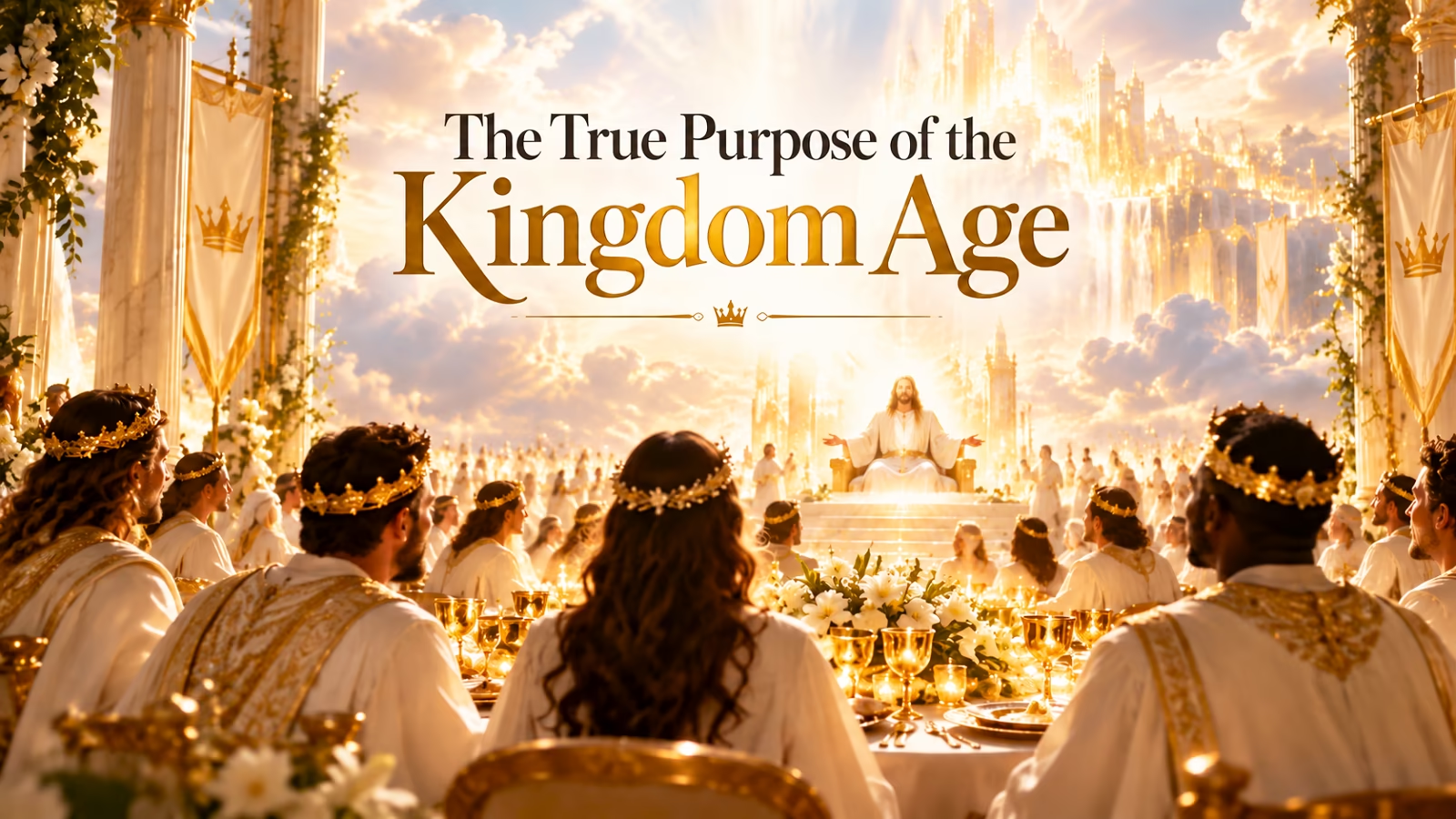
The Kingdom Age is therefore the marriage feast and Kingdom celebration enjoyed by the overcoming company with Christ.
The Wedding Feast Is a Kingdom Reward
Jesus repeatedly connected the Kingdom with a wedding feast.
In Matthew 25, the prepared virgins enter with the Bridegroom while others find the door shut. In Matthew 22, the wedding feast likewise contains both invitation and exclusion.
Jesus also describes the Kingdom banquet this way:
“And I say unto you, that many shall come from the east and the west, and shall sit down with Abraham, and Isaac, and Jacob, in the kingdom of heaven:
but the sons of the kingdom shall be cast forth into the outer darkness: there shall be the weeping and the gnashing of teeth.”
— Matthew 8:11–12
Outer darkness is therefore directly connected with exclusion from Kingdom enjoyment.
The excluded have not ceased to belong to Christ. They have lost the prize.
Outer Darkness Is the Completing Place for Defeated Saints
The warnings of Jesus are real.
A believer who spends the present age protecting the soul-life, refusing the cross, remaining spiritually immature, or failing to overcome does not simply receive the same Kingdom experience as the believer who gave everything to follow Christ.
That would make the race meaningless.
Paul says plainly that a believer can suffer real loss while still being saved.
“If any man’s work shall be burned, he shall suffer loss: but he himself shall be saved; yet so as through fire.”
— 1 Corinthians 3:15
The believer is saved.
Yet he suffers loss.
And his salvation through that judgment is described as being “through fire.”
The Fire and the Second Death
Revelation tells the overcomer:
“He that hath an ear, let him hear what the Spirit saith to the churches. He that overcometh shall not be hurt of the second death.”
— Revelation 2:11
Revelation later repeats the same protection concerning those who share the first resurrection.
“Blessed and holy is he that hath part in the first resurrection: over these the second death hath no power.”
— Revelation 20:6
Revelation then identifies the second death.
“And death and Hades were cast into the lake of fire. This is the second death, even the lake of fire.”
— Revelation 20:14
The connection is difficult to miss.
The overcomer is specifically promised that the second death will not hurt him. The first-resurrection company likewise stands outside its power.
The defeated believer, by contrast, is saved “through fire.”
This cannot mean eternal destruction, because the person is explicitly saved and possesses eternal life. It means the defeated believer is hurt by the fire of the second death without being eternally consumed by it.
The experience is painful because Kingdom loss is real.
But it remains part of God’s completing work.
Weeping and Gnashing of Teeth Is Real Loss, Not Eternal Damnation
Outer darkness therefore should not be softened into a meaningless metaphor.
The defeated believer sees what was available, what the overcomers received, and what was lost through failure during the age of grace. The weeping and gnashing of teeth reflect genuine anguish and regret.
Yet God does not abandon His child there.
The purpose is completion.
God’s mercy, love, grace, and kindness remain active even toward believers who failed the race.
They are not being prepared for destruction. They are being finished for eternity.
The Book of Life and Kingdom Participation
Christ makes another promise specifically to the overcomer.
“He that overcometh… I will in no wise blot his name out of the book of life.”
— Revelation 3:5
The contrast has meaning.
The overcomer is protected from blotting because he has gained the Kingdom prize. The defeated believer suffers the corresponding Kingdom consequence.
This cannot represent permanent loss of eternal life because Christ has already promised that His sheep will never perish.
The blotting therefore belongs to Kingdom exclusion, not eternal condemnation.
When God’s completing work is finished, no redeemed child of God is missing from the eternal Bride.
The Kingdom Age Completes What the Age of Grace Did Not
The age of grace is the race.
During this age believers can overcome, grow into maturity, live by the Spirit, lose the soul-life for Christ, and become qualified for the Kingdom reward.
When Christ returns, that race is finished.
Those who overcame receive the prize.
Those who did not overcome cannot simply be treated as though nothing was lost. They require completion before they can appear as part of the perfected Bride.
The thousand-year Kingdom provides that final completing age.
The overcomers enjoy the marriage feast with Christ.
The defeated saints undergo the painful but merciful completing work represented by outer darkness, loss, weeping, and being saved through fire.
At the end, every child whom Christ redeemed is complete.
Christ Is Also Preparing the Nations
The saints are the central concern, but they are not the only people for whom the Kingdom has a purpose.
The nations that survive into the Kingdom Age have lived under the influence of Satan’s world-system. They carry the habits, structures, and learned disobedience produced during thousands of years under his deception.
During the Kingdom that active satanic influence is removed.
“And he laid hold on the dragon, the old serpent, which is the Devil and Satan, and bound him for a thousand years…
that he should deceive the nations no more, until the thousand years should be finished.”
— Revelation 20:2–3
Christ then rules with a rod of iron.
Sin is not permitted to develop into another satanic civilization. Disobedience is confronted immediately under the righteous government of the King.
The nations spend a thousand years learning obedience under Christ.
The residual effects of Satan’s long rule are worked out through direct exposure to righteous government.
The Final Test of the Nations
At the end of the thousand years Satan is released briefly.
“And when the thousand years are finished, Satan shall be loosed out of his prison,
and shall come forth to deceive the nations.”
— Revelation 20:7–8
This final release exposes what remains hidden.
Those willing to follow Satan reveal themselves openly. Their rebellion is destroyed, and Satan is permanently cast into the lake of fire.
Only after that final testing and removal does Scripture move to the new heaven and new earth.
The nations, like the saints, must be ready for the eternal order.
Israel’s Kingdom Role Is Not Temporary or Disposable
Israel also has a central place in the Kingdom Age.
Christ restores Israel, and Jerusalem becomes the earthly governmental center from which God’s law goes forth to the nations.
“For out of Zion shall go forth the law, and the word of Jehovah from Jerusalem.”
— Isaiah 2:3
The nations come to learn God’s ways.
Israel serves under Christ in the priestly and governmental function for which God called that nation.
This role does not make Israel a temporary workshop tool that God later discards.
God’s covenant with Abraham does not end when the thousand years finish.
“And in thee shall all the families of the earth be blessed.”
— Genesis 12:3
That promise reaches its full expression, not its cancellation, in the eternal order.
Israel Is Carried Forward Into New Jerusalem
When John sees New Jerusalem, the twelve tribes have not disappeared.
They are written upon the city’s twelve gates.
“having a wall great and high; having twelve gates, and at the gates twelve angels; and names written thereon, which are the names of the twelve tribes of the children of Israel.”
— Revelation 21:12
Those gates are not memorial plaques to a vanished nation.
They are functioning gates.
Revelation says they are never shut and that the nations bring their glory into the city through them.
“And the gates thereof shall in no wise be shut by day (for there shall be no night there):
and they shall bring the glory and the honor of the nations into it.”
— Revelation 21:25–26
Israel therefore remains functionally connected with the nations in eternity.
During the Kingdom Age, Israel administers God’s righteous order under Christ while the nations learn His ways. In New Jerusalem, that same calling reaches its perfected eternal form through the twelve Israel-named gates.
Christ is the King.
Israel does not replace Him.
Israel serves under Him as the twelvefold governmental gateway through which the nations approach the city according to God’s righteous order.
The Twelve Gates Reveal Governmental Order
The number twelve repeatedly marks governmental completeness in Scripture.
There are twelve tribes of Israel, twelve apostles, twelve gates, and twelve foundations.
New Jerusalem brings both sides together.
The tribes are associated with the gates.
The apostles are associated with the foundations.
Nothing is accidental.
The whole city expresses perfected divine government.
New Jerusalem Is the Tabernacle Brought to Completion
The structure seen throughout Scripture also reaches completion in New Jerusalem.
Before the fall, God had His dwelling place in Eden, while humanity existed beyond that specially prepared sphere. Adam stood in direct relationship with God and was given responsibility under Him.
Later, the tabernacle displayed another ordered approach to God.
There was an outer realm, a priestly realm, and the innermost dwelling place of God.
Not everyone had the same access.
The Kingdom continues this principle.
Christ and the overcoming saints enjoy the highest Kingdom sphere. Israel serves in the governmental and priestly administration toward the nations.
New Jerusalem is the perfected enlargement of this entire dwelling-place pattern.
The glorified children of God dwell with Christ in God’s eternal habitation. Israel stands at the gates in its perfected covenant function, while the nations live outside the city and approach it through those gates.
The structure has not been discarded.
It has been brought to completion.
Why the Restored Earth Exists During the Thousand Years
The restored earth is therefore not merely scenery.
It is the Kingdom environment in which Christ openly establishes righteous government after the collapse of Satan’s world-system.
During those thousand years:
- the overcomers enjoy their Kingdom prize with Christ;
- the defeated saints are completed;
- Israel fulfills its restored governmental and priestly calling;
- the nations learn obedience under the King;
- Satan is absent from world government;
- and everything necessary for the eternal order is brought to completion.
The Kingdom is therefore neither unnecessary nor an interruption between two more important ages.
It is the indispensable completion age between the race and eternity.
The Bride Is Finally Seen in Her Full Glory
This explains one of Revelation’s most important sequences.
In Revelation 19 the Bride has made herself ready for the marriage.
But John is not actually shown the Bride in her full corporate form as New Jerusalem until after the thousand years, after the final rebellion, after Satan’s removal, after the judgment of death and Hades, and after the old heaven and earth have passed away.
Then the angel says:
“Come hither, I will show thee the bride, the wife of the Lamb.”
— Revelation 21:9
And John sees New Jerusalem.
For the first time the complete Bride is openly manifested in her eternal form.
“having the glory of God.”
— Revelation 21:11
Every redeemed child of God is now complete.
The overcomers have received their Kingdom reward.
The defeated saints have been finished through God’s merciful completing work.
The nations have passed through Christ’s thousand-year government and final testing.
Israel’s eternal place remains established.
Satan is gone.
Death is gone.
The old creation is gone.
Everything is now ready.
The Spirit and the Bride Finally Speak Together
At the end of Revelation, Scripture gives one of its most beautiful pictures of completion.
“And the Spirit and the bride say, Come.”
— Revelation 22:17
The Bride now speaks in complete harmony with the Spirit.
The work begun within redeemed humanity has reached its consummation.
The living stones are finished.
The building is complete.
The Bride is fully prepared and openly manifested in the glory of God.
The Complete Purpose of the Kingdom Age
The thousand-year Kingdom exists because several parts of God’s work still require completion when the age of grace ends.
Its purpose can be seen clearly:
- Christ receives His Kingdom openly and rules the earth as King.
- The overcomers receive the prize they pursued during the age of grace and share Christ’s Kingdom reign and marriage celebration.
- The defeated saints suffer real Kingdom loss, including outer darkness and being saved through fire, yet are completed rather than eternally lost.
- Israel is restored and serves under Christ in its priestly and governmental calling toward the nations.
- The nations are trained in obedience after Satan’s active deception is removed.
- Satan is released once more for a final test, exposing every remaining allegiance to rebellion.
- Satan, death, and Hades are permanently removed.
- The old creation passes away.
- The completed Bride is finally revealed as New Jerusalem.
The Kingdom Age is therefore far more than a temporary restoration of the earth.
It is the age in which Christ openly brings every remaining part of God’s purpose to completion before eternity begins.
The Kingdom Age Is the Completion Age
God does not abandon unfinished children.
He does not break His promise of eternal life because a believer failed to gain the Kingdom prize.
Neither does He erase the seriousness of the race by giving the defeated believer the same thousand-year reward as the overcomer.
Both truths stand.
The overcomer receives the prize.
The defeated believer suffers genuine loss.
Yet God’s mercy, love, grace, and kindness continue until every redeemed child is complete.
Israel is not discarded.
The nations are not ignored.
The Bride is not unveiled prematurely.
Everything reaches its appointed conclusion under Christ.
Then John finally sees what the entire biblical story has been moving toward:
“And I saw the holy city, new Jerusalem, coming down out of heaven from God, made ready as a bride adorned for her husband.”
— Revelation 21:2
The Kingdom Age is the completion age.
It is the thousand-year reign in which Christ rewards the overcomers, completes the defeated saints, establishes Israel in its proper governmental calling, trains the nations under perfect righteousness, removes every remaining enemy, and prepares the entire created order for New Jerusalem.
Only then is the Bride seen in her full glory.
Only then are all things new.
And only then does eternity begin.