


In This Article

The Out-Resurrection and the Kingdom Prize
Paul wrote some of the clearest statements in the New Testament concerning the resurrection of God's children. He knew that death would not have the final word, and he taught that the dead would be raised while those believers who remained alive at the Lord's coming would be changed, with the mortal putting on immortality and the corruptible putting on incorruption.
Yet in Philippians 3, Paul speaks about resurrection in a remarkably different way:
“that I may know him and the power of his resurrection, and the fellowship of his sufferings, becoming conformed to his death, if by any means I may attain to the resurrection from the dead. Not that I have already obtained, or am already made perfect; but I press on, that I may take hold of that for which also I was taken hold of by Christ Jesus.”
— Philippians 3:10–12
Paul then continues:
“Brothers, I don't regard myself as yet having taken hold, but one thing I do: forgetting the things which are behind and stretching forward to the things which are before, I press on toward the goal for the prize of the high calling of God in Christ Jesus.”
— Philippians 3:13–14
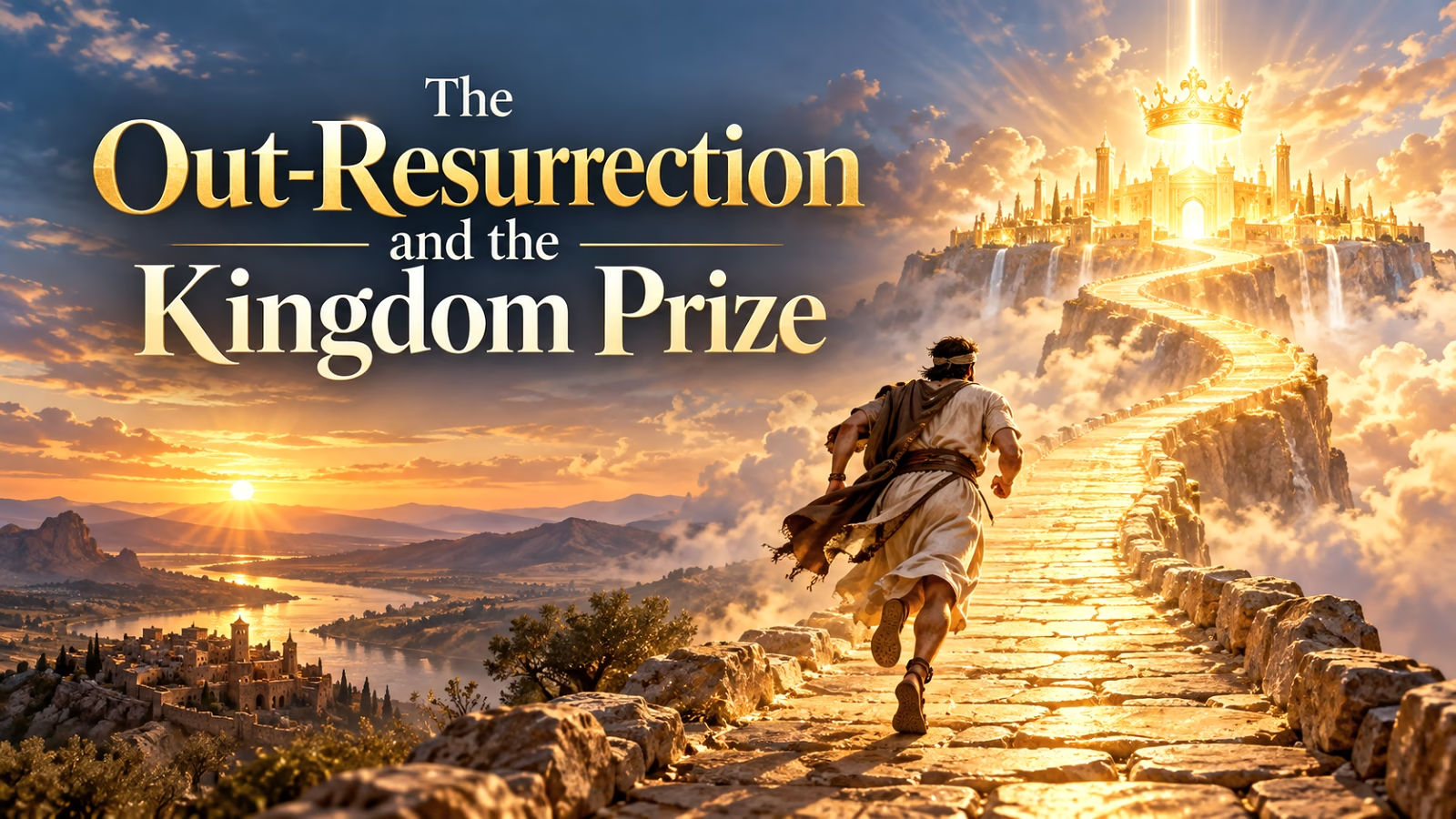
Paul knew he would be raised, yet here he speaks about a resurrection he had not yet attained. He says, “if by any means I may attain,” “not that I have already obtained,” “I press on,” “the goal,” and “the prize,” which is not the language of something Paul regarded as automatic but the language of a runner pressing toward something still ahead.
This distinction connects the resurrection of Philippians 3 directly with the Kingdom prize.
What Was Paul Trying to Attain?
The word Paul uses in Philippians 3:11 is unusual: exanastasis, commonly rendered an “out-resurrection” or resurrection “out from among the dead.” The entire argument should not rest upon a single Greek word, nor does it need to, because Paul's own explanation tells us how he understood what lay before him.
He had not yet attained it, he had not yet been perfected, he was pressing toward it, and he called what lay ahead both a goal and a prize. Whatever Paul is describing, therefore, he does not treat it as something that automatically belonged to him simply because he had been saved.
This matters because Paul unquestionably knew that God's children would ultimately be delivered from physical death. Why, then, would a man who already possessed eternal life and already expected resurrection say, “if by any means I may attain”?
The answer begins to emerge when Philippians 3 remains connected to Paul's language concerning the race and the prize. Paul is not struggling to become one of God's children, because he already belongs to Christ; he is pressing toward the completed resurrection condition associated with the victorious runner.
“We Will All Be Changed”
This understanding does not contradict 1 Corinthians 15, where Paul writes:
“Behold, I tell you a mystery. We will not all sleep, but we will all be changed, in a moment, in the twinkling of an eye, at the last trumpet. For the trumpet will sound and the dead will be raised incorruptible, and we will be changed. For this perishable body must become imperishable, and this mortal must put on immortality.”
— 1 Corinthians 15:51–53
The victory described here is enormous: mortality will not continue forever, the corruptible becomes incorruptible, the mortal puts on immortality, and physical death loses its claim over God's children. Paul does not, however, describe this transformation as something he is uncertain whether he will receive.
In Philippians 3, by contrast, Paul speaks of something he has not yet attained and toward which he must continue pressing. If the transformation of 1 Corinthians 15 and the out-resurrection of Philippians 3 were identical in every respect, Paul's language becomes difficult to explain because he would be pressing to attain as a prize what he had already taught would happen to God's people.
The distinction is therefore not between resurrection and no resurrection, but between deliverance from physical death and the completed resurrection condition associated with the victorious runner and Kingdom inheritance. First Corinthians 15 establishes God's victory over mortality, while Philippians 3 asks whether the runner has attained the out-resurrection connected with the prize.
Christ Shows Us What Resurrection Means
The distinction becomes clearer when we compare Lazarus with Christ. Lazarus was raised from the dead, yet he returned to mortal life, and his raising did not make him the Firstborn from the dead.
Christ's resurrection was different because Jesus did not merely return to the life He possessed before His death; He came out of death in resurrection victory, with death no longer having dominion over Him and the old creation no longer able to hold Him. Scripture can therefore speak of Christ as the Firstborn from the dead even though others, including Lazarus, had previously been restored to physical life.
Christ's resurrection expresses something more than the continuation of biological existence; it is victory over death and emergence into resurrection life. Revelation 5 presents the same Christ as the One who overcame and was therefore qualified to take the scroll and open its seals.
He overcame, passed through death, and emerged victorious. That completed resurrection reality helps us understand what Paul was pressing toward, because he was not simply hoping someday to become physically alive after death but was pressing toward the resurrection condition of the victorious New Man.
The First Resurrection Brings the Pieces Together
Revelation 20 gathers these threads into a single scene:
“I saw thrones, and they sat on them, and judgment was given to them... They lived and reigned with Christ for a thousand years... This is the first resurrection. Blessed and holy is he who has part in the first resurrection. Over these, the second death has no power, but they will be priests of God and of Christ, and will reign with him one thousand years.”
— Revelation 20:4–6
Notice what surrounds this resurrection: thrones, authority, blessedness, holiness, freedom from the authority of the second death, priesthood, and reigning with Christ for one thousand years. Revelation does not describe the first resurrection merely as dead bodies becoming alive; it describes a company qualified for the Kingdom.
That becomes especially significant when Revelation 20 is placed beside Christ's promises to the overcomers in Revelation 2 and 3. Christ says, “He who overcomes won't be harmed by the second death” in Revelation 2:11, while Revelation 20:6 says that over those participating in the first resurrection, “the second death has no power.”
Christ promises the overcomer in Revelation 2:26, “To him who overcomes, and he who keeps my works to the end, to him I will give authority over the nations,” while Revelation 20 shows thrones and authority to judge. In Revelation 3:21 Christ tells the overcomer, “He who overcomes, I will give to him to sit down with me on my throne,” and Revelation 20 shows people seated upon thrones.
Paul adds the same connection when he writes, “If we endure, we will also reign with him” in 2 Timothy 2:12, while Revelation 20 says those participating in the first resurrection “will reign with him one thousand years.” These connections are too consistent to ignore.
The first resurrection is the Kingdom manifestation of what Christ promised to the overcomers. The resurrection Paul pressed toward in Philippians 3, the prize for which he ran, and the thousand-year reign described in Revelation 20 converge upon the same Kingdom reality.
Resurrection Does Not Automatically Mean Kingdom Qualification
Being raised from physical death and being qualified for Kingdom participation are not necessarily identical. A believer can belong eternally to Christ and yet arrive at the Judgment Seat having failed to allow the Spirit to complete the necessary work during this age.
Judgment does not magically turn defeat into victory, because a verdict reveals what the believer has become rather than retroactively making an unfinished race a finished one. The believer who did not endure cannot simply be declared to have endured, the believer who did not overcome cannot simply be handed promises Christ specifically reserved for the one who overcame, and the runner who did not finish cannot simply be awarded the crown as though the race never mattered.
Yet this does not require the defeated believer to remain physically dead, because all believers must appear before the Judgment Seat of Christ, and those who have died must therefore be raised to stand before Him. The issue is not whether they belong to Christ but whether they are qualified for the Kingdom inheritance.
The Wedding Garment Shows the Difference
Jesus gives us another picture in Matthew 22, where the king enters the wedding feast and finds a man without the required wedding garment. The king asks:
“Friend, how did you come in here not wearing wedding clothing?”
— Matthew 22:12
The man is present and alive, so his problem is not that he does not exist but that he is not properly clothed for participation in the wedding feast. He is therefore removed into outer darkness, where there is weeping and gnashing of teeth.
This agrees with the promises in Revelation, where Christ promises white garments to the overcomer while also warning against the shame of nakedness. Paul likewise speaks in 2 Corinthians 5 about being clothed and not being found naked, longing for mortality to be swallowed up by life.
The picture remains consistent: being alive is not identical with being properly clothed for Kingdom participation. The victorious believer is prepared, while the defeated believer may stand alive before Christ and still lack what corresponds to qualified participation in the coming Kingdom.
The Tabernacle Already Established This Principle
The distinction between belonging and qualified access did not begin in the New Testament, because Israel already demonstrated it. All Israel belonged to God under the covenant, the entire nation camped around the Tabernacle, and God dwelt among them as His people.
Yet not every Israelite entered the sanctuary, because only the priesthood ministered in the Holy Place and only the high priest entered the Holy of Holies according to God's appointed way. An Israelite standing outside the sanctuary had not stopped belonging to Israel or somehow become an Egyptian.
The question was not ownership but qualified access to the sphere of God's manifested presence. The New Testament develops the same pattern by calling believers living stones and a royal priesthood, describing God's people as His habitation, and declaring that Christ has made His people a Kingdom and priests.
Revelation 20 then describes the first-resurrection company as priests of God and of Christ who reign with Him. The Kingdom prize, therefore, involves far more than simply being alive, because it includes qualified priestly and governmental participation in Christ's manifested reign.
Firstfruits: The Same Harvest, Ready First
The biblical pattern of firstfruits provides another important picture because firstfruits are not a different species from the rest of the harvest but belong to the same harvest. The difference is maturity: the firstfruits ripen first and are therefore ready first.
Revelation 14 describes a firstfruits company presented to God and to the Lamb, providing a fitting picture of the overcomers. They are not the only people God has redeemed, but they are those among the redeemed who have reached maturity in time to be presented to God for the Kingdom.
The rest of the harvest still belongs to God; it simply has not reached the same condition at the same time. This allows both truths to stand without contradiction, preserving the special place of the overcomers while also preserving God's final purpose for all His redeemed children.
What Happens to the Defeated Believer?
The thousand-year Kingdom answers a question that otherwise remains unresolved: what does God do with children who are eternally His but reach Christ's Judgment Seat unprepared for the inheritance offered to the overcomer? He does not pretend defeat was victory, give the crown to the runner who failed to finish, place the unprepared servant upon the throne as though endurance meant nothing, or give the non-overcomer the privileges He specifically promised to the overcomer.
Yet neither does He abandon His child. The Kingdom is therefore not an empty interval between Christ's return and the New Jerusalem but an age of government in which the victorious enjoy reward, loss is experienced, and Christ reigns.
During those thousand years, Satan is bound, so any discipline experienced by one of God's children takes place under Christ's government rather than under Satan's dominion. The loss is real because the believer understands what could have been gained and what has been forfeited, giving weight to Christ's warnings of weeping and gnashing of teeth.
Kingdom loss is therefore not merely receiving a slightly smaller reward but exclusion from an inheritance for which the believer was called to prepare. Yet that exclusion cannot be eternal, because there is no outer darkness in the New Jerusalem, no continuing Kingdom discipline there, and no permanently unfinished class of God's redeemed children standing outside God's completed habitation.
The Kingdom loss must eventually accomplish its purpose.
The Unfinished Believer Must Still Be Completed
A defeated believer does not need Christ to die again because the cross is complete, nor does Satan need to be defeated again because during the Kingdom Satan is bound. What remains unfinished is the believer himself.
He is still a living stone, but he is not yet a completed living stone. Romans 8 reveals God's way through the Spirit, showing that the Christian life is not merely waiting for physical death but the Spirit carrying out God's transforming work in His children.
A believer who reaches the Judgment Seat without that work having reached its intended maturity cannot simply bypass everything that was refused during the Age of Grace and immediately receive the inheritance promised to those who overcame. The Kingdom therefore reveals both God's righteousness and His mercy, because His righteousness refuses to call defeat victory while His mercy refuses to abandon the child Christ purchased.
The discipline has a purpose: completion.
The New Jerusalem Requires a Finished People
Peter calls believers living stones being built into a spiritual house, while Paul says God's people are being built together into a dwelling place for God in the Spirit. The New Jerusalem is the completed expression of that building.
God's glory fills it, there is no night there, there is no death, and there is no continuing outer darkness. There cannot be permanently unfinished living stones in a finished habitation, nor can there be an eternal class of Christ's redeemed children excluded from God's completed city while the Bride is declared prepared.
Therefore, Kingdom loss must have an end, and discipline must accomplish its purpose. Those who were unfinished must ultimately be brought into God's completed New Creation reality before His eternal habitation reaches its full expression.
What the overcomers enter first as the Kingdom prize eventually becomes the completed condition of all God's redeemed children in the New Jerusalem. The Kingdom is the prize of the overcomers, while the New Jerusalem is God's completed purpose for all His redeemed children.
Paul Finally Finished the Race
When we follow Paul's words through his ministry, something remarkable happens. Earlier, he said:
“lest by any means, after I have preached to others, I myself should be disqualified.”
— 1 Corinthians 9:27
Later, in Philippians, he said:
“I don't regard myself as yet having taken hold... I press on toward the goal for the prize.”
— Philippians 3:13–14
But near the end of his earthly life, Paul's language changes:
“I have fought the good fight. I have finished the course. I have kept the faith. From now on, the crown of righteousness is stored up for me, which the Lord, the righteous judge, will give to me on that day.”
— 2 Timothy 4:7–8
The progression is striking because earlier disqualification was possible, then Paul continued pressing because he had not yet attained, and finally the course was finished. Only then does Paul speak confidently of the crown awaiting him.
Jesus told Philadelphia, “Hold firmly that which you have, so that no one takes your crown” in Revelation 3:11. Paul did exactly that: he held fast, endured, finished the course, and the runner who had once feared disqualification could finally say that the crown was waiting.
Run So That You May Obtain
What, then, was Paul pressing to attain? It was not Christ Himself, because he already belonged to Christ; it was not eternal life, because he already possessed it; and it was not God's final purpose for one of His redeemed children.
Paul was running for the Kingdom prize: the out-resurrection, the crown, the white garment, priestly access, freedom from the authority of the second death, the throne, authority over the nations, and reigning with Christ during the thousand-year Kingdom. These are not unrelated rewards scattered throughout the New Testament but different expressions of the same reality placed before the victorious runner.
This is why Philippians 3 should command our attention. Paul did not assume that because he was saved the race no longer mattered, nor did he assume that because resurrection from physical death was guaranteed every resurrection privilege was therefore automatic.
He pressed on, pursued the goal, sought the prize, and eventually finished the race. The message remains just as serious for us because salvation is a gift, the race is real, the Judgment Seat is real, the crown can be lost, Kingdom inheritance is conditional, the first resurrection is bound up with victory, priesthood, authority, and reigning with Christ, and the out-resurrection stands before the believer as part of the Kingdom prize.
Paul understood what was at stake, which is why he disciplined himself, pressed on, and refused to presume that he had already attained. Every believer should desire to reach the end of the course able to say with him: “I have finished the race.”