


In This Article



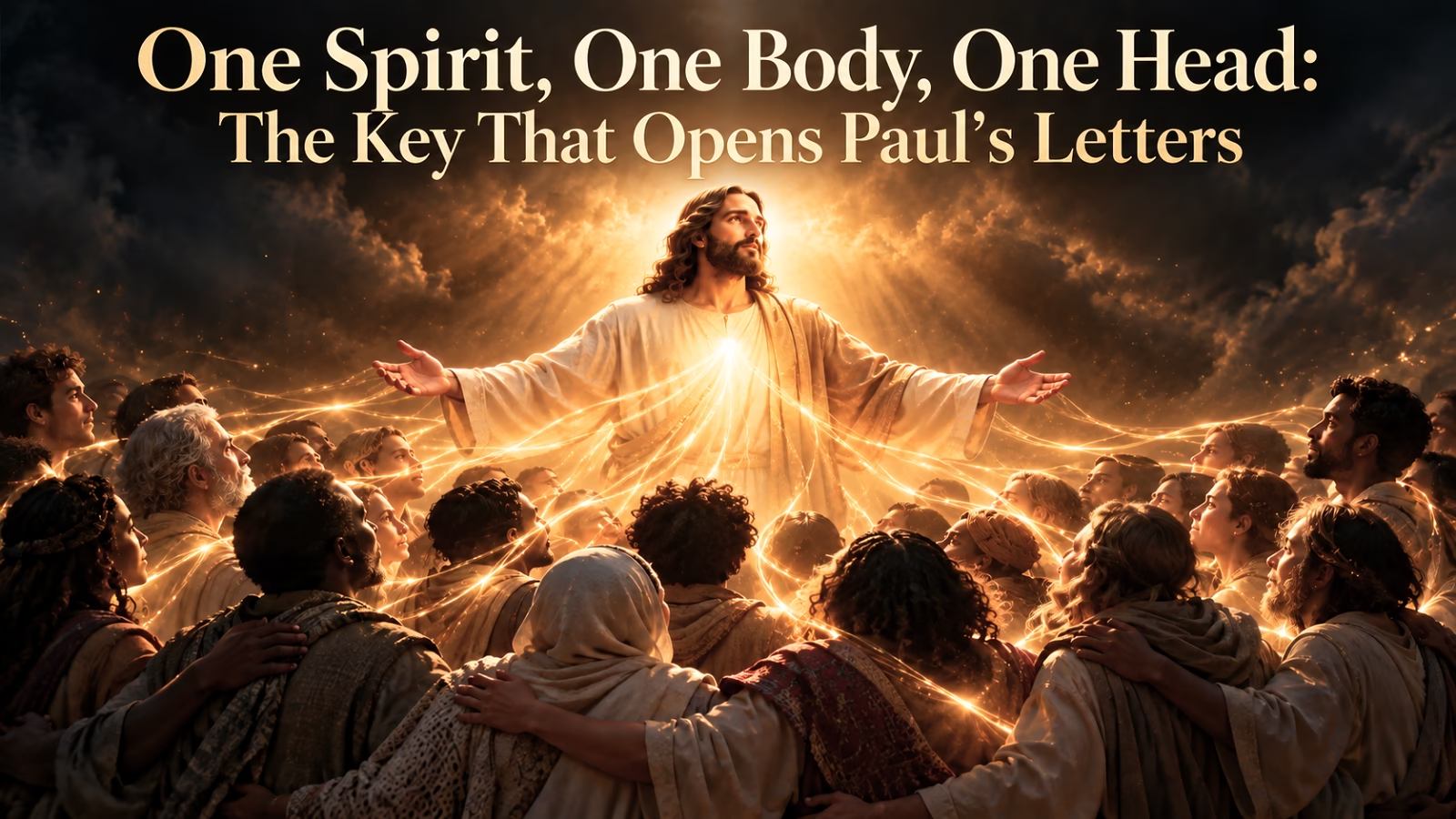
One Spirit, One Body, One Head: The Key That Opens Paul’s Letters
Paul's letters contain some of the most important teaching in the New Testament—and some of the most disputed.
What does Paul mean by being "in Christ"?
What does it mean to be "one Spirit" with the Lord?
How can the Holy Spirit and the human spirit remain distinct, yet truly joined?
What does it mean to "walk according to the Spirit" or to "set the mind on the Spirit"?
Why does Paul describe the Church as one Body while Christ remains its Head?
These questions become much easier to understand when Paul's teaching is read through one consistent foundation:
- Christ is the Head
- The Church is His Body
- The Spirit is the Spirit of the Head
- The human spirit is joined to the Lord
- The mind determines whether the believer walks under the government and supply of that Spirit
Once this relationship is seen, large portions of Paul's letters come into focus as one unified revelation.
He That Is Joined to the Lord Is One Spirit
Paul writes:
"But he that is joined unto the Lord is one Spirit."
— 1 Corinthians 6:17
The Greek manuscripts did not distinguish between uppercase and lowercase letters in the way modern English translations do. Therefore, capitalization alone cannot establish Paul's meaning.
But Paul's entire body of teaching can.
Read 1 Corinthians 6:17 apart from the larger Pauline structure, and several competing interpretations arise.
Does the human spirit somehow merge into God?
Does "one Spirit" merely mean agreement or harmony?
Does the believer lose individual identity in Christ?
Paul's other writings resolve the problem.
The believer does not become the Head. The believer remains a member. Christ remains the Head. Yet the member is genuinely joined to Him.
Paul makes the distinction explicit:
"The Spirit itself beareth witness with our spirit, that we are the children of God."
— Romans 8:16
There is the Spirit, and there is our spirit.
They are distinguishable.
Yet Paul also says that the one joined to the Lord is one Spirit.
The answer comes into view when this is placed within Paul's revelation of the Body.
One Head, One Body, One Spirit
Paul writes:
"There is one body, and one Spirit."
— Ephesians 4:4
And again:
"For by one Spirit are we all baptized into one body."
— 1 Corinthians 12:13
The Body does not possess multiple spiritual heads.
There is one Head:
"Christ is the head of the church."
— Ephesians 5:23
And the entire Body receives its life, direction, and supply from Him.
Paul describes this relationship in remarkable language:
"For as the body is one, and hath many members... so also is Christ."
— 1 Corinthians 12:12
Paul does not merely say, "so also is the Church."
He says:
"so also is Christ."
The members have not become the Head.
Their identities have not been annihilated.
Yet Head and Body form one corporate organism bearing the identity of Christ.
This opens 1 Corinthians 6:17.
The believer's human spirit is joined to the Lord, and through that union the member participates in the one Spirit of Christ the Head.
The human spirit remains human.
Christ remains Christ.
The member remains a member.
Yet there is genuine spiritual oneness.
Why "Spirit" Matters
Using an uppercase S is therefore not an attempt to manufacture doctrine from English typography.
It is a way of preserving the identity of the One to whom the believer is joined.
The wider Pauline context repeatedly identifies this Spirit with Christ.
Paul writes:
"The Spirit of God dwell in you... if any man have not the Spirit of Christ, he is none of his."
— Romans 8:9
Then immediately:
"And if Christ be in you..."
— Romans 8:10
The progression is seamless:
Spirit of God → Spirit of Christ → Christ in you.
Paul says elsewhere:
"Now the Lord is that Spirit."
— 2 Corinthians 3:17
And:
"The last Adam was made a quickening Spirit."
— 1 Corinthians 15:45
And:
"God hath sent forth the Spirit of his Son into your hearts."
— Galatians 4:6
These are not disconnected expressions.
They describe one reality centered in Christ the Head.
The Human Spirit and the Head
Man was created with a human spirit capable of receiving, knowing, and communing with God.
Paul writes:
"What man knoweth the things of a man, save the spirit of man which is in him?"
— 1 Corinthians 2:11
And again:
"The Spirit itself beareth witness with our spirit."
— Romans 8:16
The human spirit is therefore not the Holy Spirit.
The two remain distinguishable.
But the human spirit was created with the capacity to commune with God and to be joined to the Lord.
This is why Paul can speak of the believer as one Spirit with Him without requiring the human spirit to become divine.
The member is joined to the Head.
The Body is not the Head.
But the Body lives from the Head.
The Mind Becomes the Point of Government
Romans 8 explains how this union is practically experienced.
"They that are after the Spirit [mind] the things of the Spirit."
— Romans 8:5
And:
"To be spiritually minded is life and peace."
— Romans 8:6
The believer possesses a human spirit capable of fellowship with God.
But the mind determines the direction of the person.
The mind may be set upon the flesh, or it may be set upon the Spirit.
When the mind is set upon the Spirit, the member comes under the practical leading of the Head.
Paul then says:
"For as many as are led by the Spirit of God, they are the sons of God."
— Romans 8:14
The order becomes clear:
human spirit → mind set upon the Spirit → leading from the Head → expression of the life of Christ through the member.
Romans 8, then, is not a collection of disconnected theological statements.
It describes how the Body lives from its Head.
Berean Testing
The Bereans were commended because they:
"searched the scriptures daily, whether those things were so."
— Acts 17:11
Any interpretation must survive the same test.
It cannot merely sound attractive.
It must remain standing when tested against the whole biblical witness.
This reading must survive:
- Romans 8
- 1 Corinthians 6
- 1 Corinthians 12
- 1 Corinthians 15
- 2 Corinthians 3
- Galatians 4–5
- Ephesians 2–5
- Philippians
- and every other place where Paul speaks of the Spirit, the human spirit, Christ as Head, and believers as members.
When tested across these passages, the structure remains intact.
The Spirit and the human spirit remain distinguishable.
Christ remains the Head.
Believers remain members.
Union remains real.
The believer is not dissolved into God.
The Spirit is not reduced to a metaphor.
The Body is not separated from the Head.
The same structure holds from passage to passage without requiring contradictory explanations to hold Paul's letters together.
Why Paul Becomes Easier to Understand
Without this foundation, Paul's terminology can appear fragmented.
"One Spirit" becomes one theological debate.
"In Christ" becomes another.
"The Body of Christ" becomes another.
"Christ in you" becomes another.
"Walking in the Spirit" becomes another.
"The Spirit of Christ" becomes another.
But Paul is not presenting six unrelated doctrines.
They are different views of the same spiritual reality.
There is one Head.
There is one Spirit.
There is one Body.
The members are joined to the Head.
The Head supplies and directs the Body through His Spirit.
The believer sets the mind upon the Spirit and is led by Him.
Once that foundation is in place, Paul's letters begin to read less like a collection of difficult theological statements and more like one continuous revelation.
The End of the False Choice
1 Corinthians 6:17 is often forced between two extremes.
Either union with Christ becomes so weak that it is reduced to mere agreement or relationship, or it becomes so strong that the human spirit appears to lose its distinct identity in God.
Paul requires neither extreme.
The Body is truly one with its Head without becoming the Head.
The members remain members.
Christ remains Christ.
The human spirit remains human.
Yet the believer joined to the Lord participates in the one Spirit and receives life and direction from the Head.
That is genuine union without confusion.
One Body Under One Head
The significance goes far beyond interpretation.
Paul continually confronted division in the Church.
But division becomes inevitable when members begin functioning independently of the Head.
The solution is not merely doctrinal agreement among the members.
It is common submission to the same Head through the same Spirit.
Paul writes:
"One body, and one Spirit... one Lord."
— Ephesians 4:4–5
The Body is unified because it has one Head.
The members do not manufacture unity.
They live within a unity that already exists in Christ.
When the members set their minds upon the Spirit and receive their direction and life from the Head, the Body begins to function as Paul describes it:
"From whom the whole body fitly joined together and compacted by that which every joint supplieth... maketh increase of the body unto the edifying of itself in love."
— Ephesians 4:16
This is one of the simplest keys to understanding Paul:
Begin with the Head.
Christ is the Head.
His Spirit supplies the Body.
The human spirit is joined to Him.
The mind turns toward the Spirit.
The Spirit leads.
The Body lives.
And what has often seemed difficult in Paul comes into view as one unified revelation:
one Head, one Spirit, one Body, many members—joined together in Christ.