


In This Article


Outer Darkness and the Kingdom: The Warning, the Loss, and the Mercy
One of the most serious warnings running through Scripture is that serving God is not the same thing as doing God’s will. A person can sincerely believe he is acting for God, even accomplish remarkable things in His name, yet still act independently of what God has actually revealed.
This principle does not suddenly appear in the New Testament. From Genesis through Revelation, God repeatedly shows the consequences of substituting human judgment, human effort, or human wisdom for His revealed will.
The First Warning: Man’s Way Instead of God’s Way
After Adam and Eve sinned, they immediately attempted to cover themselves. They sewed fig leaves together and made their own covering, but God later clothed them Himself.
The picture begins early: man recognizes a problem and attempts to solve it according to his own wisdom. God does not accept human improvisation as a substitute for what comes from Him.
This distinction becomes increasingly serious as Scripture unfolds. The issue is not simply whether something appears good, sincere, religious, or even helpful, but whether it proceeds from God and expresses His revealed will.
Jesus later declares:
“I am the way, the truth, and the life.”
John 14:6
He is not one way among many, and service rendered to Him cannot be separated from submission to Him.
Strange Fire Before God
Nadab and Abihu were not pagans attempting to destroy Israel’s worship. They were priests approaching God in His own sanctuary.
Yet Leviticus 10:1 says they offered “strange fire” before the Lord, “which he commanded them not.” Their priestly position did not give them authority to improvise before God.
The lesson is sobering. Something offered to God does not become acceptable merely because it is offered sincerely or by someone who belongs to His service.
God is King. His servants do not improve His instructions, supplement His wisdom, or decide that their own way is close enough.
David, Uzzah, and the Ark
David desired to bring the ark of God to Jerusalem, and his objective appeared entirely honorable. Yet the ark was transported according to human reasoning rather than according to the order God had already established.
When the oxen stumbled, Uzzah reached out to steady the ark and died after touching it. His action may have appeared reasonable, even necessary, but the entire situation existed because God's revealed order had not been followed.
David later understood the problem and said:
“We sought him not after the due order.”
1 Chronicles 15:13
Good intentions had not transformed an unsanctioned method into the will of God. This is a recurring biblical principle: God does not need human beings to rescue His purpose by disregarding His instructions.
Moses and the Good Land
Few servants of God were ever used as greatly as Moses. He confronted Pharaoh, led Israel through the sea, received God's law, interceded repeatedly for Israel, and spoke with God in extraordinary intimacy.
Yet near the end of his journey, God told Moses to speak to the rock. Instead, Moses struck it twice and said:
“Must we fetch you water out of this rock?”
Numbers 20:10
God identified the issue clearly. Moses had failed to believe Him and to sanctify Him before Israel.
Moses had represented God according to Moses rather than representing God exactly as God desired to be represented. One act did not erase decades of faithful service, but neither did decades of faithful service erase the consequence of that act.
Moses would not enter the good land.
He pleaded with God to reconsider, asking to cross over and see “that good land” (Deuteronomy 3:25). God refused and eventually brought Moses to a mountain where he could see the land with his own eyes but could not enter it.
That picture is difficult to miss. After forty years of journeying toward the inheritance, Moses could see what others were about to enjoy while knowing that his own failure had excluded him from participation.
Moses was still God's servant. He had not ceased belonging to God, but he suffered a genuine and deeply painful loss.
“Lord, Lord, Did We Not?”
Jesus presents an even more serious warning in Matthew 7. He describes people who come before Him “in that day” and say:
“Lord, Lord, have we not prophesied in thy name? and in thy name have cast out devils? and in thy name done many wonderful works?”
Matthew 7
Their confidence is striking. They expect their works performed in Christ's name to establish their qualification before the King.
Yet Jesus does not accept their own evaluation of their ministry. He declares:
“I never knew you: depart from me, ye that work lawlessness.”
Matthew 7:23
Christ obviously knows who they are and knows exactly what they have done. The issue is recognition: He does not acknowledge their claimed service as the obedient expression of His Father's will.
That is why the preceding verse is essential. Jesus had already said that entrance into the Kingdom belongs not merely to those saying, “Lord, Lord,” but to the one doing “the will of my Father which is in heaven.”
Their great mistake was believing that works performed in Christ's name automatically meant those works represented Christ. They had apparently never learned the lesson of Moses, Nadab and Abihu, David, and Uzzah.
The servant does not determine whether his work represents the King; the King does.
The King Examines the Garment
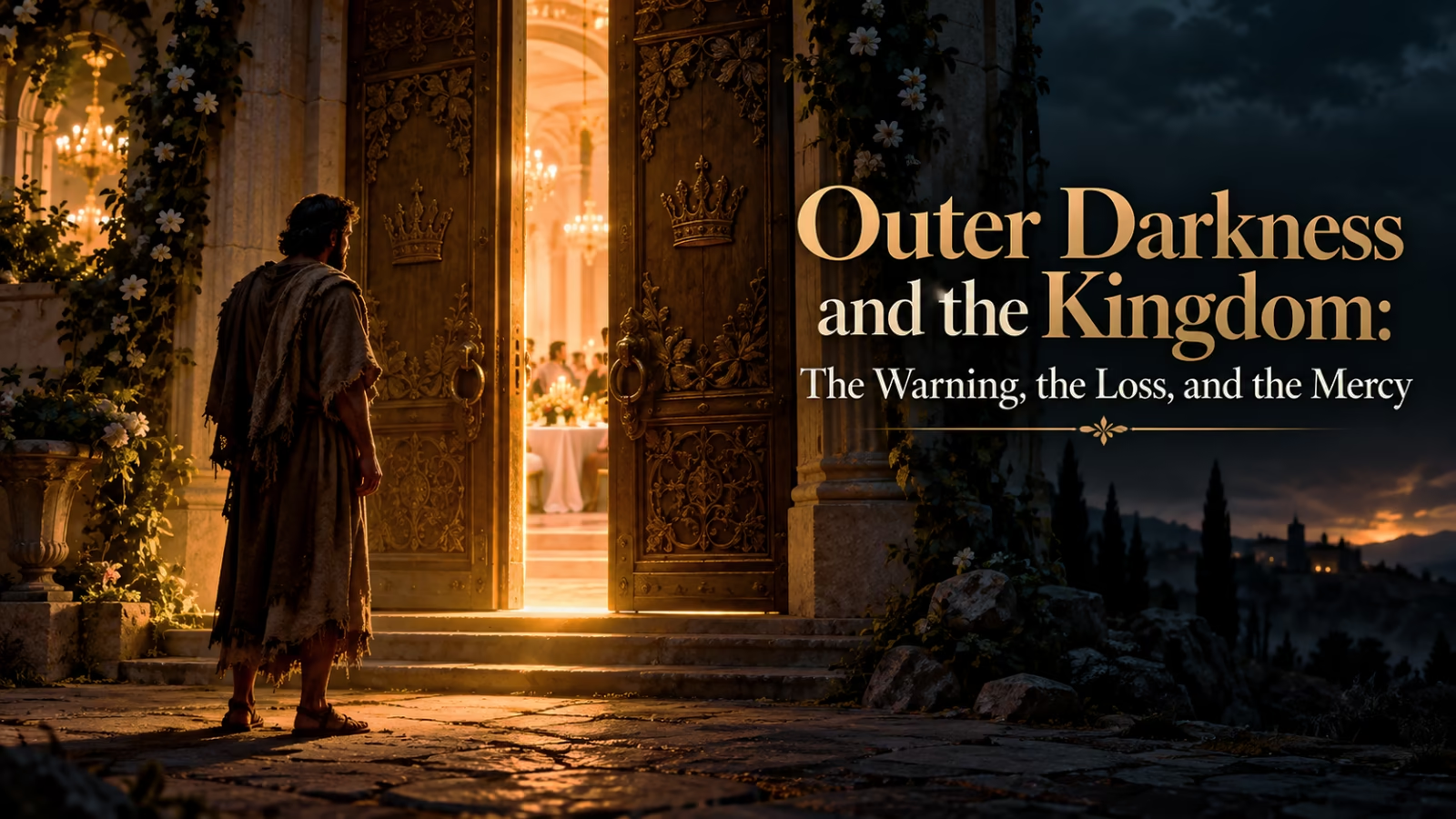
Jesus gives another picture in the wedding feast of Matthew 22. A man enters the wedding but is found without the proper wedding garment.
When the king examines him, the man has no answer, and he is cast into outer darkness. The connection reaches all the way back to Eden: Adam and Eve attempted to provide their own covering, but God supplied what they needed.
A person cannot stand before the King dressed according to his own estimation of what should be acceptable. The King determines what is appropriate for His presence.
The warning therefore concerns more than obvious rebellion. A servant may simply assume that what he has produced, worn, taught, practiced, or accomplished should be acceptable because he believes it is acceptable.
But the final examination belongs to Christ.
The Foolish Virgins and the Closed Door
The ten virgins in Matthew 25 provide another picture of Kingdom readiness. All ten awaited the bridegroom, but only five had properly prepared.
When the bridegroom arrived, those who were ready entered the wedding feast and the door was shut. The others later cried:
“Lord, Lord, open to us.”
Matthew 25
Their problem was not that the bridegroom did not exist to them or that they had never expected his coming. Their problem was that they had not taken preparation seriously enough before the moment arrived.
The blessing was real, and so was the loss.
They eventually understood the importance of what they had neglected, but understanding after the door closed did not restore the opportunity they had missed.
What Is Actually Lost?
Revelation 2 and 3 tells us what Christ promises to the overcomers. The rewards include:
- eating from the tree of life in the paradise of God;
- receiving the hidden manna;
- receiving the crown of life;
- being clothed in white garments;
- receiving authority over the nations;
- receiving the morning star;
- becoming a pillar in God's temple; and
- sitting with Christ upon His throne.
These rewards show that Kingdom loss involves far more than losing a governmental position. The deepest loss is losing the enjoyment of Christ and the paradise of God during the Kingdom age.
Those who overcome enjoy a measure of intimacy, fellowship, honor, nourishment, glory, and participation with Christ that unprepared servants do not enjoy during that age. This gives enormous weight to the expression outer darkness.
It means standing outside what the overcoming saints are enjoying, knowing what has been lost and why it was lost. This naturally explains Christ's repeated description of weeping and gnashing of teeth.
Moses provides an extraordinary Old Testament picture. He stood outside the good land, saw the inheritance, desired the inheritance, belonged to God, yet could not participate in what was taking place inside.
Outer Darkness Is Not the Lake of Fire
Outer darkness must not be confused with the lake of fire. Revelation 20 places Satan in the abyss during the thousand years; outer darkness is not identified as Satan's location.
Likewise, the remaining dead are not raised until after the thousand years, when they stand before the great white throne. The nations living during the Kingdom age are also distinct from the servants Christ examines in His Kingdom warnings.
The outer-darkness passages repeatedly arise in contexts involving:
- the Kingdom;
- servants;
- sons of the Kingdom;
- wedding participation;
- preparation; and
- accountability before the King.
The biblical picture therefore points toward Kingdom exclusion, not eternal destruction.
Outer Darkness Is Also Mercy
Outer darkness is severe, but severity should not be confused with abandonment. God does not stop loving His children because they were unprepared for Kingdom participation.
He does not cease being gracious because His judgment exposes what was incomplete in them. Hebrews 12 teaches that God disciplines those whom He loves because His purpose is that they share His holiness.
First Corinthians 3 likewise describes a person whose work is burned and who suffers loss, while the person himself is still saved. The loss is therefore real, but so is God's purpose in allowing it.
A servant excluded from the paradise of God during the Kingdom age does not need endless torment to understand his failure. Seeing what the overcomers are enjoying while knowing why he stands outside is itself an overwhelming revelation.
Moses needed no one to explain what he had lost when he stood looking into the good land. Outer darkness can therefore be understood not merely as judgment, but as God's mercy, love, and grace continuing to work in those who were not yet ready for the fullness of His Kingdom.
God has not discarded them. He is completing them.
God Will Finish His Building
The story does not end with outer darkness. After the thousand years and the final judgment, Revelation presents an entirely new order.
John hears the One upon the throne declare:
“Behold, I make all things new.”
Revelation 21:5
Then New Jerusalem descends from heaven in perfection. There is no outer darkness in that final scene.
Revelation explicitly tells us that “there is no night there.” Everything God intended is complete.
Scripture describes believers as living stones being built together for God's dwelling. The final city therefore displays not Satan's success in permanently damaging God's purpose, but God's complete victory in bringing His building to perfection.
Satan is repeatedly shown in Scripture as the accuser. Yet in the finished New Jerusalem there is nothing left by which the accuser can claim that God's purpose failed.
There is no ruined stone that Satan successfully kept from God's final building. There is no unfinished work proving that the enemy defeated God's wisdom.
There is only God's completed dwelling, His perfected creation, and His people enjoying Him without the darkness that characterized the former age.
The Blessing of Knowing God's Will
These warnings are not given merely to make believers afraid. They reveal the extraordinary blessing of learning to live under the authority of Christ now.
The safest place for a servant of God is not confidence in his own sincerity, intelligence, experience, ministry success, emotions, or accomplishments. The safest place is humble submission to the King and continual testing of everything according to His revealed Word.
The Bereans were commended because they searched the Scriptures to determine whether what they were hearing was true. That same attitude protects believers from strange fire, unsanctioned carts, striking rocks God said to speak to, and ministries that accomplish impressive things while departing from the Father's will.
Christ is the Head.
The members of His Body are not called to invent His direction but to know Him, remain under Him, and express His will according to what He has revealed. That is freedom, not bondage.
The servant who seeks the King's desire does not have to manufacture God's work or defend his accomplishments before Christ. He simply desires to hear the words every servant should long to hear:
“Well done, good and faithful servant.”
Matthew 25:21
The Warning and the Hope
Scripture's warning is serious because Kingdom loss is serious. A believer can spend years doing things he sincerely believes are for God while never sufficiently asking whether those things actually came from God, remained under God's authority, and agreed with God's revealed Word.
Moses teaches us that great past faithfulness does not make this question unimportant. Nadab and Abihu teach us that religious service does not sanctify what God did not authorize, while David and Uzzah teach us that good intentions cannot replace God's revealed order.
Christ's Kingdom warnings bring all these lessons to their conclusion. The question at His judgment is not, “What did you think you deserved?”
The question is whether the servant knew the King's desire and faithfully did His will.
For those who overcome, the reward is extraordinary: the paradise of God, the tree of life, intimate fellowship with Christ, His approval, His throne, His Kingdom, and participation in His joy. For those who are not ready, the loss will be equally real.
Yet even there, God's mercy has not failed. Outer darkness is not the end of God's purpose for those who belong to Him.
The God who begins His work will bring His people to completion until every living stone is prepared and His dwelling stands in absolute perfection.
Then outer darkness disappears.
The Kingdom-age loss has accomplished its purpose, New Jerusalem is complete, there is no more night, and God's children finally enjoy together what He intended from the beginning: God dwelling with man in a creation completely according to His heart, His wisdom, His holiness, and His will.