


In This Article


God Requires Faithfulness, Not Unnecessary Death
There is a difference between dying because there is no faithful way out and allowing yourself to die when God has provided a way of escape.
That distinction matters.
For centuries, Christians have often treated martyrdom as though death itself were the highest proof of faithfulness. Certainly there are circumstances in which a believer may be faced with an unavoidable choice: remain faithful to Christ or surrender true allegiance to evil. Revelation presents such a situation concerning the beast and his mark.
But Scripture does not teach Christians to seek death, surrender unnecessarily to persecutors, or assume that escaping an evil authority is somehow less spiritual than remaining in its hands. Quite the opposite.
Again and again, Scripture gives us pictures of God's people escaping those who intend to destroy them. And one of the most important pictures may be Peter.
Peter's denial of Christ is usually taught only as a story about failure and forgiveness. That is certainly part of it. But the picture God preserved for us communicates much more.
It shows us that God knows the difference between words extracted by fear and the true allegiance of the heart. And that distinction becomes enormously important whenever Satan attempts to use a believer's testimony as the weapon through which he destroys the believer.
Adam Was Not Lacking in Knowledge
To understand this properly, we should go back to the beginning.
Two trees stood in the garden:
- The Tree of Life
- And the Tree of the Knowledge of Good and Evil
The common assumption is often that one tree represented life while the other represented knowledge—as though God's intention were for man to possess life without knowledge.
But Adam already possessed knowledge before eating from the forbidden tree. He understood God's command. He knew what God permitted. He knew what God prohibited. He knew the consequence God attached to disobedience. He named the animals. He recognized the woman God brought to him. He communicated, reasoned, understood, and made decisions.
Adam was not an unconscious creature waiting for knowledge to enter him.
The issue was therefore not: knowledge versus no knowledge.
The issue was: whose knowledge would govern man?
God had already told Adam what was good. God had already told Adam what was evil. God had already established the line.
Then another voice entered the garden. The serpent contradicted God's judgment.
God said: You shall surely die.
The serpent said: You shall not surely die.
The serpent therefore offered man another standard by which God's word could be judged.
Adam's failure was not that he suddenly began thinking. His failure was that he abandoned the knowledge God had given him and accepted the contrary knowledge presented by the serpent.
That distinction continues throughout Scripture.
Man Was Created to Know God
God never intended man to become a creature void of knowledge, functioning through automatic impulses. That would destroy meaningful obedience. Obedience requires knowledge. You must know what God has said before you can choose whether to obey Him.
You must recognize competing voices before you can reject the false one.
You must discern good from evil before you can consciously choose what is good.
The New Testament therefore repeatedly calls believers to discernment.
"Test all things; hold fast that which is good."
—1 Thessalonians 5:21
"Beloved, believe not every spirit, but try the spirits whether they are of God."
—1 John 4:1
Mature believers are described as those:
"who by reason of use have their senses exercised to discern both good and evil."
—Hebrews 5:14
God's intention is not a passive humanity. It is humanity filled with His life, knowing His thoughts, understanding His will, and consciously choosing what agrees with Him.
Jesus gives us the perfect picture. He did not act independently. He said:
"I seek not mine own will, but the will of the Father which hath sent me."
—John 5:30
Jesus possessed knowledge. He possessed judgment. He possessed intelligence. But He refused another standard.
When Satan tempted Him, Jesus tested what Satan said against what God had already revealed.
Even when Satan quoted Scripture, Jesus did not surrender His discernment. He answered according to God's full word.
That is the opposite of passivity.
Authority Does Not Replace Discernment
This becomes especially important when human authorities enter the picture. A believer cannot surrender his responsibility to discern merely because another person occupies a position of authority. Otherwise, how could anyone determine whether the authority was actually speaking according to God?
Human authorities disagree with one another constantly. Religious leaders disagree. Governments disagree. Churches disagree. Teachers disagree.
If authority itself were enough to establish truth, then believers would have no way to determine which authority should be followed.
Scripture gives us the answer. Everything remains subject to God.
When human commands contradict God, God's word remains supreme.
The apostles said:
"We ought to obey God rather than men."
—Acts 5:29
This does not mean Christians should become rebellious people. It means no human authority possesses the right to replace God's judgment. Human force is not divine authority.
A government may possess the physical ability to imprison someone. It may possess the physical ability to torture someone. It may possess the physical ability to kill someone.
But physical control does not give that government ownership of the believer's conscience. And it certainly does not give the persecutor the authority to determine what God believes about the believer standing before Him.
Satan Can Force the Body but Not the Heart
This distinction becomes crucial when persecution begins.
Suppose an evil ruler says:
"Say these words or die."
Or:
"Sign this document or remain imprisoned."
Or:
"Say that you reject Christ and I will release you."
The persecutor may control the prison. He may control the document. He may control the immediate threat. But he does not control God's judgment.
God sees the entire truth. God sees coercion. God sees fear. God sees intention. God sees whether the heart has actually changed allegiance.
A persecutor may force a person's hand. He may force words from someone's mouth. He cannot force the heart to abandon Christ. And Scripture gives us an extraordinary picture of this difference.
The Example of Peter
Peter had told Jesus that he was willing to die with Him. Yet when the moment came, fear took over. Peter denied knowing Jesus. Not once.Three times.
Outwardly, Peter's words were terrible.
"I know not the man."
If Christianity operated according to nothing more than outward statements, Peter's ministry should have ended there. But Jesus knew something that the people surrounding Peter did not know.
Before Peter failed, Jesus told him:
"but I have prayed for you that your faith may not fail. And when you have turned again, strengthen your brothers"
—Luke 22:32
Notice the distinction. Peter's courage failed. Peter's words failed. Peter's outward testimony failed.
But Jesus said:
"that your faith may not fail."
Jesus knew Peter more deeply than Peter knew himself.
Peter's denial was real. But it was not Judas.
Peter and Judas Are Two Different Pictures
Peter and Judas both acted against Jesus. But Scripture does not treat their actions as spiritually identical.
The Betrayal in Heart
Judas betrayed Christ from a heart. His outward action corresponded with an inward reality.
Peter was different. Peter's outward denial came from fear. His heart had not transferred its allegiance to Satan. That is why immediately afterward Peter wept bitterly. That is why Jesus restored him. That is why Peter was not replaced among the apostles.
Judas was replaced.
Peter remained. And after Christ restored him, Peter returned to ministry. He preached. He strengthened believers. He became one of the central witnesses in the early church. He contributed enormously to the Body of Christ.
A Powerful Picture
The picture is powerful. Peter survived the threat. His frightened words did not define his final relationship with Christ.
Christ knew his heart. Christ restored him. And Peter continued the work.
Why Did God Preserve This Picture?
Not everything God teaches us is presented as a doctrinal sentence.
God teaches through:
- Pictures
- Events
- Through lives
- Through contrasts
- Through types and patterns.
A picture can communicate relationships that would require many pages of propositions to explain.
So why preserve Peter's failure in such detail? Certainly it teaches humility, forgiveness, restoration.
But the picture communicates something else as well. It shows believers what God sees when fear and coercion enter the situation.
The persecutor hears Peter say:
"I do not know Him."
Christ sees:
"This man is Mine."
The crowd sees denial. Christ sees the heart.
Satan may point to Peter's words but Christ already knows that Peter's faith has not ultimately failed. That matters because the church would soon face exactly this kind of attack.
Christians would be threatened. Christians would be imprisoned. Christians would be tortured. Christians would be ordered to say things against their faith or die. And Christians sometimes fail under that kind of pressure.
Peter's story tells them: Your frightened failure does not reveal the allegiance of your heart. And Christ knows the difference.
Scripture Repeatedly Shows God's People Escaping
There is another pattern running throughout Scripture that must be placed beside Peter. God's people frequently escape those who intend to kill them.
Joseph was told:
"Arise, and take the young child and his mother, and flee into Egypt."
—Matthew 2:13
Herod wanted Jesus dead. God's response was not: Submit to the ruler.
God said: Flee.
Later, when people attempted to seize or kill Jesus before His appointed hour, He repeatedly escaped their grasp.
At Nazareth, they intended to throw Him from the hill:
"But he passing through the midst of them went his way."
—Luke 4:30
When they took up stones against Him:
"Jesus hid himself, and went out of the temple."
—John 8:59
Again:
"Therefore they sought again to take him: but he escaped out of their hand."
—John 10:39
Jesus did not allow evil men to determine the timing of His death. He escaped them.
Jesus Explicitly Told His Disciples to Flee
Jesus did more than demonstrate escape. He commanded it.
"When they persecute you in this city, flee ye into another."
—Matthew 10:23
That verse is extraordinarily important.
Jesus did not say: When they persecute you, remain there so that your willingness to suffer can demonstrate your faith.
He said: Flee. Leave. Continue somewhere else. That means escape from persecution can itself be obedience.
Paul Escaped
Paul also escaped when people wanted him dead.
In Damascus:
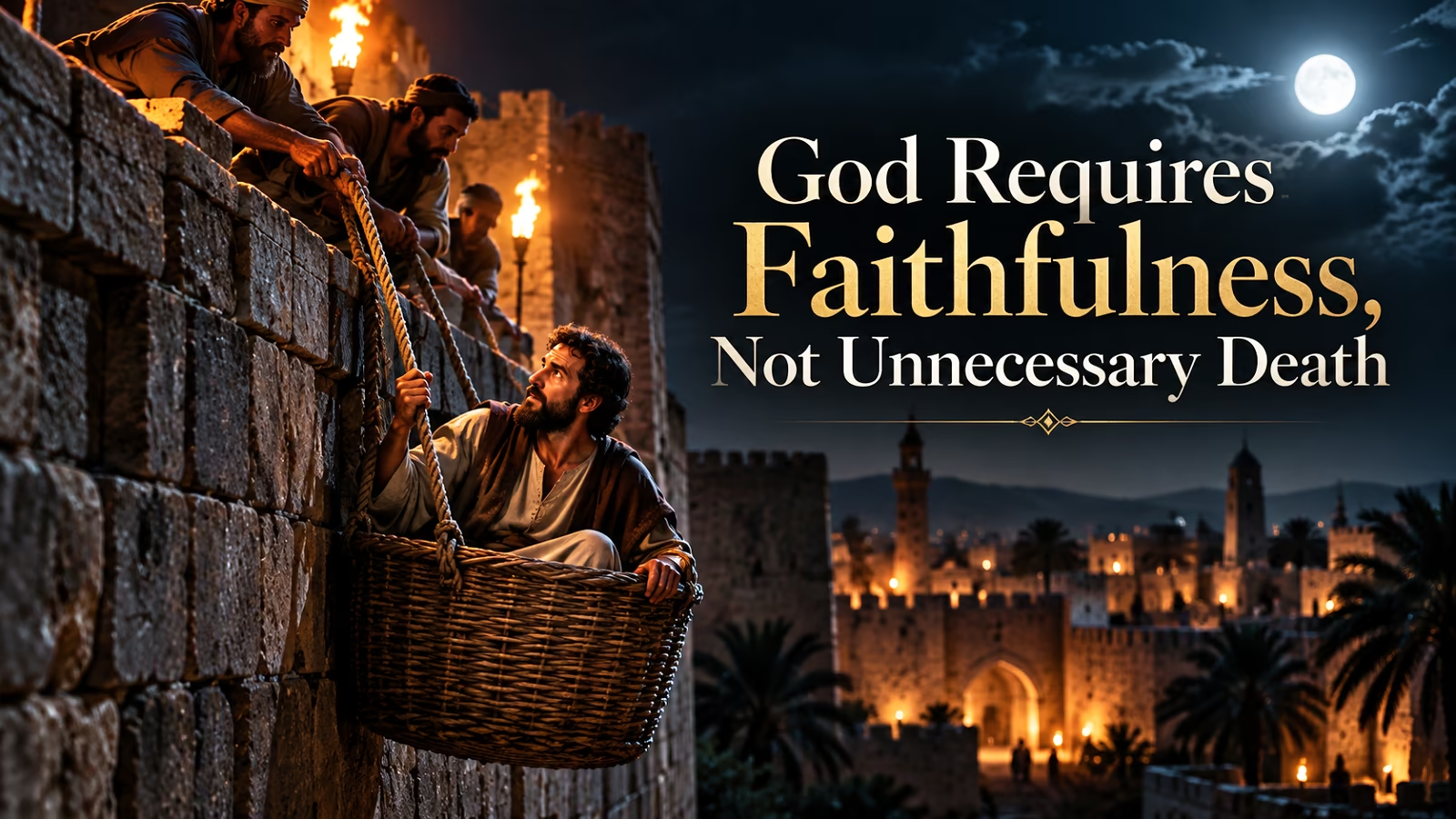
"The disciples took him by night, and let him down by the wall in a basket."
—Acts 9:25
Paul did not stand at the city gate and announce: "I will remain here and let these men kill me because dying would prove my faith." He escaped through the wall. The ministry continued.
Peter Escaped Prison
Peter later found himself imprisoned. When the prison opened, Peter did not remain inside because government officials had placed him there. He left. He escaped. Acts 12 records God's own supernatural involvement in that escape. God did not consider continued imprisonment spiritually necessary. He opened the door. Peter walked out.
David Repeatedly Escaped Saul
David knew Saul was God's anointed king. Yet when Saul attempted to kill him, David ran. Repeatedly.
David respected the position Saul held without concluding that Saul's murderous intentions therefore had divine authority over David's life.
David refused to murder Saul. But he also refused to hand Saul his own life. That distinction is crucial.
Respect for authority did not require cooperation with evil.
Even the Early Martyr Tradition Recognized Escape
The ancient account of Polycarp is especially interesting. Polycarp did not immediately volunteer himself for death. When persecution came, he withdrew. He moved from one location to another.
The early account even condemns the idea of Christians recklessly presenting themselves for martyrdom.
Only after Polycarp was finally captured did he accept what came. That fits the biblical pattern perfectly.
Escape while escape is possible. If there is eventually no escape, remain faithful.
Death Is Not the Command
This brings us to one of the most important distinctions. Scripture commands faithfulness. It does not generally command death.
"Be thou faithful unto death."
—Revelation 2:10
The command is:
Be faithful.
Death may be the consequence.
Likewise:
"Fear not them which kill the body."
—Matthew 10:28
The command is not: Give them your body.
The command is: Do not allow their threat to move you away from God.
Revelation describes believers who:
"loved not their lives unto the death."
—Revelation 12:11
Again, the point is allegiance. They would not transfer allegiance merely to preserve themselves. But none of these verses teaches that Christians must refuse an available escape.
There is an enormous difference between:
I will not betray Christ even if there is no escape and I die.
And:
I must refuse every means of escape because dying would prove my faithfulness.
The first is biblical faithfulness. The second can become unnecessary surrender to evil.
The Mark of the Beast Is Different
Revelation presents a unique end-time situation involving the mark of the beast. The mark is connected with worship and allegiance. It represents something God Himself identifies as spiritually decisive. The believer cannot transfer allegiance to the beast merely to preserve earthly life. If refusing the mark leads to death and no escape exists, faithfulness requires refusing it.
But that does not mean every demand made by every persecuting regime carries the same spiritual significance. A dictator cannot simply create his own equivalent of the mark.
An evil government cannot draft a document and then declare: "God must now interpret your signature exactly as we do."
The tyrant does not control God's throne.
God Judges the Heart
Throughout Scripture, God distinguishes appearance from inward reality.
"The LORD seeth not as man seeth; for man looketh on the outward appearance, but the LORD looketh on the heart."
—1 Samuel 16:7
That principle is fundamental.
God knows whether the believer genuinely rejects Christ. God knows whether someone is terrified. God knows whether someone is being coerced. God knows whether words correspond to inward belief. God knows whether a person intends to escape so that he can continue serving Him.
Satan cannot hide these facts from God. He cannot bring half the evidence into God's presence and suppress everything that reveals the truth.
God already knows everything.
The Blood of Christ Ends Condemnation
And even when a believer genuinely fails, the answer remains Christ.
"There is therefore now no condemnation to them which are in Christ Jesus."
—Romans 8:1
Paul then asks:
"Who shall lay any thing to the charge of God's elect? It is God that justifieth."
—Romans 8:33
And:
"Who is he that condemneth?"
—Romans 8:34
The accuser does not determine the verdict. God does. And the believer stands in Christ.
Peter really did fail. Jesus did not pretend Peter's denial never happened. But neither did Jesus allow Peter's failure to become Peter's final identity. Christ restored him.
The blood does not teach Christians to treat sin casually. It teaches Christians that failure does not give Satan the right to destroy the remainder of their lives through condemnation.
Satan Wants Believers Immobilized
This brings us to the spiritual danger. Satan does not always need to persuade Christians to abandon Christ outright. Sometimes he only needs to persuade them that there is no faithful way out of his trap. He can use conscience itself as the prison.
He can say:
- "If you escape, you are a coward."
- "If you deceive your persecutor, you have denied Christ."
- "If you leave, you have rebelled against authority."
- "If you sign that paper, God will reject you."
- "If you do not voluntarily accept what these people are doing to you, you are not faithful."
The result can be devastating. A believer can cooperate with his own destruction while believing that destruction is required by God.
But Scripture repeatedly breaks that trap. Flee. Escape. Hide. Leave the city. Go over the wall in a basket. Walk out of the prison. Move to another place. Preserve the life God has given you. Continue the work.
We Must Not Turn Satan's Threat Into God's Command
This may be the simplest way to state the principle: Satan's threat is not God's command.
If Satan says: "Remain here and die or prove that you are unfaithful,"
we must first ask: Did God actually say that? If God did not command the death, then Satan does not get to manufacture the command.
If God provides an escape, take it.
If staying means losing decades in which you could serve the Body of Christ, then staying should not automatically be treated as more spiritual.
The question is not: Which option looks more heroic?
The question is: What preserves faithfulness to God and continues His purpose?
Survival Can Serve the Body of Christ
Peter illustrates this beautifully. Imagine if Peter's frightened denial had caused him to surrender himself to death immediately afterward. The church would have lost Peter.
Instead, Christ restored him. Peter stood on Pentecost and proclaimed Christ. Peter strengthened believers. Peter opened the door of the gospel to Gentiles through the events involving Cornelius. Peter wrote to suffering believers. Peter's continued life added enormous wealth to the Body of Christ.
His survival was not spiritual defeat. It became an opportunity for continued service.
That picture should matter whenever Christians are faced with persecution and death.
A believer's life has value to the Body. Remaining alive is not automatically selfish. Escaping can preserve decades of service.
There Is No Glory in Unnecessary Death
Christianity does not worship suffering. It worships Christ. Suffering can accompany obedience. But suffering itself is not the goal.
Death can accompany faithfulness. But death itself is not the goal.
Jesus went to the cross because it was God's appointed purpose. Before that appointed hour, He escaped those who attempted to kill Him.
That distinction should govern our thinking. There was a death Jesus was appointed to die. He did not, therefore, accept every earlier opportunity His enemies created to kill Him.
He knew the difference between:
God's appointed hour
and
Satan's attempted premature destruction.
Believers need that same discernment.
Faithfulness When There Is No Escape
None of this means Christians should abandon Christ to preserve their lives. There may come a situation in which every legitimate avenue is closed. No hiding place remains. No escape exists. No door opens.
The believer may then face a genuine choice between inward allegiance to Christ and inward allegiance to evil.
At that point: Remain faithful. Even unto death.
But that is completely different from voluntarily staying inside a trap when God has provided a way out, any way out that does not sacrafice the alligence in the heart for Christ.
Christian courage is not demonstrated by refusing an escape route.
The Picture Scripture Gives Us
Put all these passages and events together, and a clear picture emerges.
- Adam shows us that the issue is whose word we accept.
- Jesus shows us perfect allegiance to the Father's will. Jesus escapes evil men until God's appointed time. Joseph takes Jesus away from Herod.
- David flees Saul.
- Paul escapes Damascus.
- Peter escapes prison.
- Jesus commands His disciples to flee persecution.
- Peter fails under mortal fear, yet Christ knows his true allegiance and restores him.
- Judas gives us the opposite picture: outward betrayal corresponding to inward betrayal.
- Revelation finally shows the ultimate boundary: when Satan demands actual allegiance that belongs only to God, the believer must refuse regardless of the cost.
These pictures belong together.
The Heart That Signs
An evil ruler may demand a signature. A persecutor may demand certain words. A frightened believer may outwardly comply while inwardly rejecting everything the persecutor claims those words mean.
God sees the heart that signs.
The hand can be coerced. The mouth can speak from fear. The body can be imprisoned. But God knows whether the heart belongs to Christ. And no earthly ruler can override God's knowledge.
If escape is possible, escape. If you must hide, hide. If you must flee, flee. If you can walk out of the prison, walk out. If you can preserve your life and continue serving Christ, do not allow Satan to convince you that unnecessary death would honor God more.
But if every escape route is gone and the final question truly becomes: Whom does your heart belong to?
Then let the answer remain: Jesus Christ. Whatever the cost.
Conclusion
The Bible does not teach passive surrender to evil. It teaches knowledge. Discernment. Testing. Faithfulness. Wisdom.
Escape when escape is available. And steadfastness when it is not.
Peter's story shows us something precious. A believer's frightened words do not necessarily tell God what is in the believer's heart.
Jesus already knows. Peter failed outwardly. His faith remained. Christ restored him.
And because Peter lived, the Body of Christ received years of ministry that would otherwise have been lost. That is not a minor detail. It is a picture.
And perhaps one of its lessons for Christians facing persecution is remarkably simple:
Do not let Satan turn his death sentence into God's command. Remain Christ's in your heart. Use the wisdom God gives you. Escape evil when you can and continue the work.