

In This Article

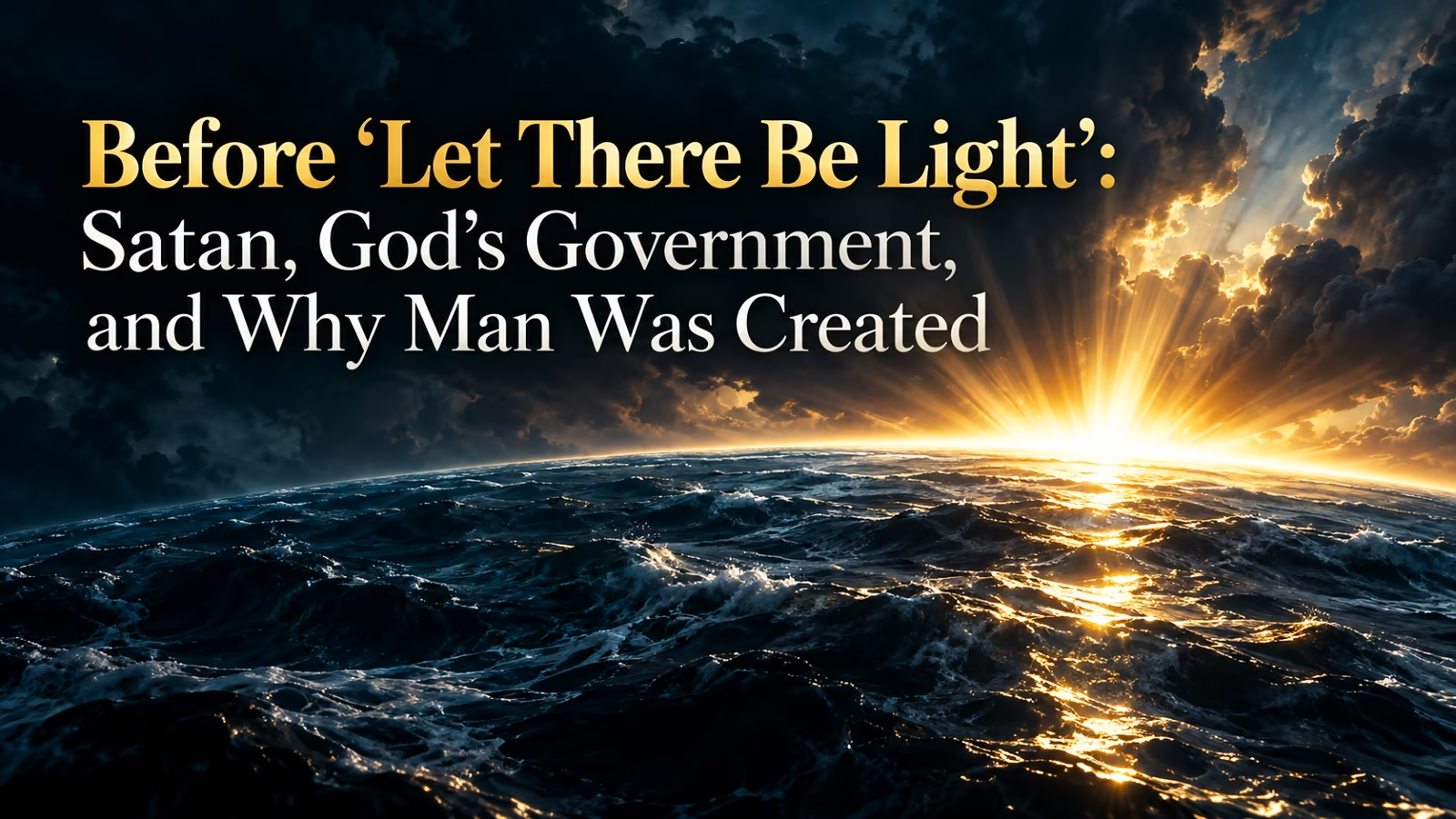
Before “Let There Be Light”: Satan, God’s Government, and Why Man Was Created
Most Christians begin the biblical story with Adam.
The Bible does not.
Genesis begins with God, creation, darkness, and then a recovery that culminates in the creation of man.
Yet Scripture gives very little explanation in Genesis itself for what happened between the original creation of the heavens and the earth and the dark, desolate condition described in Genesis 1:2.
To understand that scene, we have to do what Scripture repeatedly requires us to do: allow the entire Bible to interpret its individual parts.
God did not place everything He wanted us to know about His ancient conflict with Satan in Genesis. Pieces of that revelation appear in Isaiah, Ezekiel, Job, Daniel, Zechariah, the words of Christ, the writings of Paul, Hebrews, and ultimately Revelation.
When those pieces are brought together, an extraordinary picture begins to emerge.
This is not primarily the story of a military struggle between God and Satan. Satan could never challenge God in raw power.
It is the story of government, authority, righteousness, accusation, judgment, legal standing, and ultimately recovery.
And at the center of God's answer stands something completely new:
Man.
The Bible Begins With a Perfect God and a Creation That Suddenly Lies in Darkness
Genesis opens:
“In the beginning God created the heaven and the earth.”
— Genesis 1:1
Then immediately:
“And the earth was without form, and void; and darkness was upon the face of the deep.”
— Genesis 1:2
That transition should make us ask a question.
How did the creation of the God who is light come to be characterized by darkness?
John tells us:
“God is light, and in him is no darkness at all.”
— 1 John 1:5
Isaiah tells us that God did not create the earth tohu—the Hebrew word translated “without form” in Genesis 1:2:
“He created it not in vain [tohu], he formed it to be inhabited.”
— Isaiah 45:18
Jeremiah later uses the exact expression found in Genesis 1:2—tohu va-bohu, “without form and void”—while describing catastrophic judgment:
“I beheld the earth, and, lo, it was without form, and void; and the heavens, and they had no light.”
— Jeremiah 4:23
Genesis 1:2 therefore reads naturally not as the description of God's original intention for creation, but as the condition of a creation that had undergone catastrophe and judgment.
Darkness covers the realm.
The earth lies submerged beneath water.
Life that later appears during the six days is absent from view.
And yet the Spirit of God is there.
“And the Spirit of God moved upon the face of the waters.”
— Genesis 1:2
God has not ceased to exist.
God has not surrendered His sovereignty.
But something terrible has happened within His creation.
Before Adam There Was Lucifer
Human beings were not the first intelligent creatures in God's universe.
Long before Adam, Scripture reveals an ordered heavenly creation populated by beings possessing intelligence, personality, authority, and government.
Paul speaks of:
“thrones, or dominions, or principalities, or powers: all things were created by him, and for him.”
— Colossians 1:16
These are not merely poetic expressions.
Scripture repeatedly reveals heavenly government.
Among those created beings, one stands out dramatically.
Ezekiel 28 describes a being of extraordinary magnificence:
“Thou sealest up the sum, full of wisdom, and perfect in beauty.”
He was:
“the anointed cherub that covereth.”
And God says:
“Thou wast perfect in thy ways from the day that thou wast created, till iniquity was found in thee.”
The immediate prophecy addresses the king of Tyre, but the language reaches beyond any ordinary human king.
This being had been in Eden, was an anointed cherub, walked among the stones of fire, possessed extraordinary wisdom and beauty, and had been created perfect.
Isaiah gives another view:
“For thou hast said in thine heart, I will ascend into heaven, I will exalt my throne above the stars of God...”
— Isaiah 14:13
Notice the wording.
Lucifer speaks of “my throne.”
A throne represents more than prestige.
It represents governmental authority.
Since all thrones and authorities were originally created through Christ, whatever authority Lucifer possessed had ultimately been entrusted to him by God.
This was not some insignificant angel suddenly behaving badly.
Lucifer appears to have been one of the greatest expressions of God's creative wisdom—a creature of extraordinary beauty, intelligence, proximity to God's government, and delegated authority.
Then:
“Iniquity was found in thee.”
Satan Could Never Defeat God Militarily
This point is essential.
Whatever happened in Lucifer's rebellion, it could not have been a conventional war in which Lucifer imagined himself stronger than God.
The comparison would be absurd.
A created being cannot overpower the Creator who gives that creature existence.
Satan's great weapon throughout Scripture is not superior strength.
It is accusation.
It is governmental challenge.
It is the use of legal ground.
It is the exploitation of questions concerning righteousness, justice, authority, and standing before God's government.
In modern language, Satan's strategy is remarkably close to lawfare.
He cannot overpower God, so he seeks to operate on the ground of God's own righteousness.
That does not mean Satan places some external limitation upon God.
It means Satan understands something fundamental about God:
God will never act contrary to Himself.
God cannot become unrighteous in order to defeat unrighteousness.
God cannot violate justice in order to silence an accuser.
Satan's strategy therefore depends entirely upon the perfection of God's character.
And nowhere does Scripture allow us to see this dynamic more clearly than in a book usually approached almost entirely through the experience of one suffering man.
That book is Job.
Job Opens the Heavenly Court
The book of Job contains three principal actors:
God. Satan. Job.
The reader is shown something Job himself never sees.
We are taken behind the visible events on earth and into the heavenly governmental realm.
“Now there was a day when the sons of God came to present themselves before the LORD, and Satan came also among them.”
— Job 1:6
Satan does not burst into God's presence.
He appears within an established governmental setting.
Then God asks:
“Whence comest thou?”
God is not attempting to discover Satan's location.
The God who knows all things does not need Satan to supply missing information.
This is the language of accountability.
Satan answers:
“From going to and fro in the earth, and from walking up and down in it.”
Then God brings Job into the discussion:
“Hast thou considered my servant Job...?”
Satan immediately challenges God's declaration.
“Doth Job fear God for nought?”
His accusation is essentially this:
Job does not love You because You are worthy. Job serves You because You have blessed him. Remove the protection. Remove the blessing. Touch what he possesses, and Job will turn against You.
This is not physical warfare.
It is a case being argued before God's throne.
God Establishes the Boundaries
God does something extremely important.
He does not destroy Satan for making the accusation.
He allows the challenge to proceed—but defines its boundaries.
“Behold, all that he hath is in thy power; only upon himself put not forth thine hand.”
Later:
“Behold, he is in thine hand; but save his life.”
Satan can operate only within limits established by God.
That tells us several things simultaneously:
- Satan is powerful.
- Satan possesses real operational authority.
- Satan is intelligent.
- Satan is hostile.
- Satan operates through accusation.
- Satan remains under the government of God.
Job therefore gives us an extraordinary window into how conflict in the unseen realm operates.
It is governmental.
It is judicial.
It involves accusation.
It involves permissions.
It involves boundaries.
It involves testimony.
And it involves events on earth that cannot be understood merely by looking at the visible circumstances.
Job Was Almost Certainly Not Satan's First Conversation With God
The scene in Job does not read like two beings meeting for the first time.
God knows Satan.
Satan understands God's governmental environment.
He understands how to formulate an accusation.
He understands what grounds may be challenged.
He understands limits imposed by divine authority.
The same dynamic appears again in Job 2.
Later, Zechariah shows Satan performing essentially the same function:
“And he shewed me Joshua the high priest standing before the angel of the LORD, and Satan standing at his right hand to resist him.”
— Zechariah 3:1
The Hebrew idea includes accusation or opposition in a judicial setting.
Then Revelation finally names Satan according to precisely this activity:
“The accuser of our brethren...which accused them before our God day and night.”
— Revelation 12:10
Job is therefore not revealing some strange one-time conversation.
It is opening a window into an ongoing governmental relationship.
If Satan's rebellion occurred long before Adam, there is every reason to take seriously the possibility that this method of accusation reaches back into the original conflict itself.
Satan's Rebellion Produced Real Governmental Ground
We should never say Satan defeated God.
God remained sovereign.
But Satan appears to have gained temporary governmental and legal ground within creation.
Jesus Himself later calls Satan:
“the prince of this world.”
— John 12:31
Paul calls him:
“the god of this world.”
— 2 Corinthians 4:4
Satan even tells Jesus:
“All this power will I give thee, and the glory of them: for that is delivered unto me...”
— Luke 4:6
Jesus does not answer by denying that Satan possesses authority over the kingdoms.
He rejects Satan's demand for worship.
Taken together, these passages show that something real had happened to the government of the created realm.
Satan's rebellion had produced consequences.
And Genesis confronts us with an earth covered by darkness.
Why Did the Earth Come Under Such Severe Judgment?
This question deserves more attention than it usually receives.
Genesis 1:2 does not describe mild disruption.
The earth is desolate.
Darkness covers the deep.
Water covers the earth.
The visible created order that appears during the six days is absent.
If God is righteous, this cannot be treated as an arbitrary or impulsive reaction.
The judgment must correspond to the seriousness of what occurred.
Yet the created kinds that later reappear—plant life, sea life, birds, and land animals—cannot themselves explain such a judgment.
They are not presented in Scripture as morally accountable rebels.
That becomes important when Genesis repeatedly tells us that these forms of life return “after their kind.”
The judgment therefore points beyond the innocent created kinds toward morally accountable rebellion associated with the earthly realm.
Scripture does not give us a verse saying, “Here is a complete census of every intelligent being living on the earth before Adam.”
But the combined evidence matters.
The physical record also shows human-like intelligent beings, tool use, organization, and civilization far earlier than a roughly six-thousand-year Adamic chronology.
That evidence need not be treated as a contradiction of Genesis.
Within the biblical picture developed here, it fits naturally with the existence of intelligent life before Adam.
If morally accountable intelligent life existed within the realm that came under the catastrophic judgment of Genesis 1:2, God's righteousness requires that we take their moral involvement seriously.
A righteous God does not condemn an entire intelligent population for a rebellion in which they had no participation and no capacity to choose.
The biblical picture therefore points toward a rebellion that extended from Lucifer's governmental revolt in the heavenly realm into the created domain associated with the earth.
The innocent creation was caught in the consequences.
The morally accountable rebellion was judged.
The Created Kinds Were Victims, Not Rebels
Romans 8 later gives us an important principle.
Creation can suffer the consequences of rebellion without itself being responsible for that rebellion.
Paul writes:
“For the creature was made subject to vanity, not willingly...”
— Romans 8:20
Creation was subjected “not willingly.”
It suffers under conditions it did not choose.
Paul then tells us that creation waits for something extraordinary:
“For the earnest expectation of the creature waiteth for the manifestation of the sons of God.”
— Romans 8:19
The created order waits for deliverance connected with God's work in His sons.
That helps us understand why the innocent kinds could suffer within a judged realm and yet later be recovered.
Their disappearance in Genesis 1:2 does not mean they were morally condemned as rebels.
They were caught within the consequences of a governmental catastrophe.
Why Didn't God Simply Destroy Satan?
God could have annihilated Satan instantly.
The answer cannot be lack of power.
The answer must be connected to who God is.
Scripture tells us:
“Justice and judgment are the habitation of thy throne.”
— Psalm 89:14
God's throne does not operate through arbitrary power.
God is righteous because righteousness is His nature.
God is holy because holiness is His nature.
God is just because justice belongs to His being.
God cannot become unrighteous in order to defeat unrighteousness.
God therefore deals with rebellion in a manner fully consistent with His own character.
This helps us understand what it means to say Satan gained governmental or legal ground.
Satan had not overpowered God.
Rather, rebellion created a judicial situation that God answered righteously, not merely by the immediate exercise of overwhelming force.
Satan's lawfare could therefore affect the manner in which the conflict unfolded.
Not because Satan was stronger.
Not because God lacked options in the sense of lacking power.
But because God will never deny Himself.
Before the creation of man, the means by which God would ultimately enter creation as the Son of Man and defeat the enemy through the cross had not yet appeared within the created order.
That answer would come later.
Darkness Was Real
If God is light, and if His creation exists to express Him, then the darkness of Genesis 1:2 is deeply significant.
The Spirit of God is present:
“And the Spirit of God moved upon the face of the waters.”
So God has not ceased to exist or surrendered sovereignty.
Yet God's creation is not expressing Him.
There is darkness.
There is desolation.
There is no visible creature bearing God's image.
God's presence and God's expression through creation are not the same thing.
Then God speaks.
“Let there be light.”
And everything begins to change.
“Let There Be Light” — The Beginning of Recovery
At the literal level, light appears.
But notice something important.
The sun, moon, and visible heavenly lights do not appear in their appointed function until later in the six-day sequence.
Whatever is happening in Genesis 1:3, it cannot simply be reduced to the statement, “God turned on the sun.”
Paul later gives this moment spiritual significance:
“For God, who commanded the light to shine out of darkness, hath shined in our hearts...”
— 2 Corinthians 4:6
Paul deliberately reaches back to Genesis.
The God who once commanded light to shine into a dark creation now shines Himself into man.
So Genesis light is not merely an astronomical curiosity.
It becomes a biblical picture of God's expression breaking into darkness.
“Let there be light” can therefore be understood as the beginning of God's manifested recovery of a realm lying under darkness.
God begins once again to express Himself within His creation.
The Six Days Reveal Recovery Before They Reveal Man
What follows is progressive.
Light.
Order.
Heavens.
Seas.
Dry land.
Vegetation.
Living creatures.
Again and again Genesis uses a significant expression:
“after its kind.”
Vegetation appears according to its kind.
Sea creatures according to their kinds.
Birds according to their kinds.
Land animals according to their kinds.
That language matters.
A kind is an established order.
Genesis does not describe God inventing unrelated forms at random.
These creatures appear according to already-established kinds.
Within the recovery framework of Genesis 1, this points to created orders being brought forth again after the judgment of Genesis 1:2.
The kinds are not the new thing in the chapter.
Then the language changes.
Man Is Not Created “After His Kind”
When God reaches man, He does not say:
“Let the earth bring forth man after his kind.”
Instead, divine counsel pauses:
“Let us make man in our image, after our likeness: and let them have dominion...”
— Genesis 1:26
Everything else appears according to an established created kind.
Man appears according to God.
That distinction is enormous.
No earthly kind is man's pattern.
God Himself is the pattern.
“So God created man in his own image...”
— Genesis 1:27
And man immediately receives something else:
“Let them have dominion.”
Image and authority appear together.
That is not accidental.
The recovering earth now receives a creature bearing God's image and entrusted with God's government.
The kinds represent recovery.
Man represents something genuinely new.
Man Was the Decisive New Creature
Man was not simply another animal appearing at the end of the process.
Man was God's representative within the recovered earth.
He bears God's image.
He receives God's delegated authority.
And unlike the earlier created orders, humanity provides something essential to God's eventual answer to Satan.
God Himself can enter humanity.
Without man, there is no incarnation.
Without humanity, there is no Son of Man.
Hebrews makes the connection explicit:
“Forasmuch then as the children are partakers of flesh and blood, he also himself likewise took part of the same; that through death he might destroy him that had the power of death, that is, the devil.”
— Hebrews 2:14
God's answer to Satan ultimately enters creation through man.
Why Man?
This is where the biblical story becomes astonishing.
The realm had experienced rebellion.
The earth had experienced judgment.
The innocent kinds had suffered within that catastrophe.
Then God introduces a creature Satan had never possessed in this form:
a creature made in God's own image.
Man could receive God's life.
Man could express God.
Man could represent God's authority.
And eventually God Himself could enter humanity.
The enemy's rebellion had affected creation.
God's answer would also enter creation.
But this time, God would enter it personally.
The Purpose of Man Was Bigger Than Being the Son's Companion
Genesis 2 introduces another beautiful dimension.
God says:
“It is not good that the man should be alone.”
Eve is taken from Adam and brought back to Adam as his counterpart.
Paul later tells us:
“This is a great mystery: but I speak concerning Christ and the church.”
— Ephesians 5:32
The bridal typology is real.
God's ultimate purpose includes a corporate people joined to Christ, sharing His life and becoming the Bride of the Lamb.
Revelation ends there.
But we should not turn one genuine dimension of God's purpose into the entire explanation for man's creation.
Man was also made for dominion.
And between Genesis and Revelation stands an enemy who must be dealt with.
God's purpose for man therefore includes both:
union with God
and
government on behalf of God.
The Bride is not merely the Son's companion.
She belongs to a much larger purpose involving God's image, God's life, God's government, God's recovery of creation, and God's final victory over Satan.
The Seed of the Woman
Immediately after man's fall, God says something extraordinary to the serpent:
“I will put enmity between thee and the woman, and between thy seed and her seed; it shall bruise thy head...”
— Genesis 3:15
Notice carefully:
the Seed of the woman.
Paul later explains that sin and death entered mankind through one man.
“Wherefore, as by one man sin entered into the world, and death by sin...”
— Romans 5:12
Again:
“For as by one man's disobedience many were made sinners...”
— Romans 5:19
And:
“For as in Adam all die, even so in Christ shall all be made alive.”
— 1 Corinthians 15:22
Eve was deceived.
But Scripture traces the fallen condition of mankind through Adam.
That makes the manner of Christ's entrance into humanity extremely significant.
Isaiah had already prophesied:
“Behold, a virgin shall conceive, and bear a son...”
— Isaiah 7:14
When Mary asks how she can bear a son without having known a man, the angel answers:
“The Holy Ghost shall come upon thee, and the power of the Highest shall overshadow thee...”
— Luke 1:35
Jesus is genuinely human through Mary.
But He is not begotten by an Adamic father.
Joseph provides the lawful royal setting in which Christ enters the Davidic line, but Joseph is not the source of His conception.
The Holy Spirit is.
Christ therefore enters humanity without coming under the fallen Adamic headship that Paul identifies as the source through which sin and death entered mankind.
Paul describes Him as coming:
“in the likeness of sinful flesh...”
— Romans 8:3
He possesses real humanity.
But He is not sinful humanity.
The first Adam brought sin and death.
Christ comes as the last Adam.
And through Him, the enemy who entered man's world through deception is finally answered by God within humanity itself.
The Cross Was a Judicial Victory Before It Became a Physical One
This is one of the most important pieces of the entire biblical story.
Jesus does not describe the cross merely as suffering.
He says:
“Now is the judgment of this world: now shall the prince of this world be cast out.”
— John 12:31
Notice the word:
judgment.
Paul describes the cross in unmistakably judicial language:
“Blotting out the handwriting of ordinances that was against us...nailing it to his cross; and having spoiled principalities and powers, he made a shew of them openly...”
— Colossians 2:14–15
First the record against man is removed.
Then the powers are disarmed.
That order matters.
Satan's great weapon is accusation.
But accusation requires grounds.
At the cross, God does not simply ignore man's sin in order to rescue him.
He deals with sin completely and righteously.
Paul says God demonstrated His righteousness so that He might be:
“just, and the justifier of him which believeth in Jesus.”
— Romans 3:26
God remains righteous while justifying man.
Satan's case collapses.
The legal foundation of accusation is destroyed.
The accuser may continue operating for a period, but the decisive judicial victory has already been accomplished.
The Cross Answers Satan's Lawfare
This is where the ancient conflict reaches its decisive turning point.
Satan's strategy had depended upon accusation.
Christ answers accusation with righteousness.
Satan's strategy depended upon legal ground.
Christ removes the ground.
Satan's strategy depended upon the fact that God would never violate His own justice.
At the cross, God demonstrates that He does not need to violate justice in order to save man and defeat the enemy.
He satisfies righteousness.
He deals with sin.
He justifies the believer.
He disarms the powers.
The enemy's strategy is defeated on the very ground he had relied upon.
Only after that judicial victory does Revelation show the open enforcement of Satan's removal.
Revelation 12 Shows the Verdict Being Enforced
Now Job becomes even more important.
In Job, Satan still possesses access to God's governmental presence.
He appears.
He speaks.
He accuses.
He challenges.
In Revelation 12, something changes permanently.
War breaks out in heaven.
Michael and his angels fight against the dragon and his angels.
Then Scripture says:
“Neither was their place found any more in heaven.”
— Revelation 12:8
Their place is gone.
Then Satan is cast down.
And heaven explains his identity:
“For the accuser of our brethren is cast down, which accused them before our God day and night.”
— Revelation 12:10
The accuser loses the place from which he had accused.
The blood of the Lamb has answered him.
“And they overcame him by the blood of the Lamb, and by the word of their testimony.”
— Revelation 12:11
The judicial victory precedes the military expulsion.
The courtroom phase gives way to enforcement of the verdict.
God Ultimately Uses Force—After the Judicial Question Is Settled
This distinction helps explain Revelation.
God was never opposed to using power.
The issue was never whether God possessed enough power to defeat Satan.
The issue was the righteous resolution of the conflict.
Once the judicial ground has been answered, Scripture openly depicts divine military action.
Revelation 19 shows Christ coming from heaven:
“And the armies which were in heaven followed him...”
The Beast and the kings of the earth are defeated.
Then Revelation 20 shows Satan bound.
After his final release and rebellion, his end comes:
“And the devil that deceived them was cast into the lake of fire and brimstone...”
The ancient conflict is finally over.
What began as rebellion against God's government ends with the complete enforcement of God's judgment.
Job Pulls Back the Curtain on God's Government
This is why Job should not be reduced to a manual explaining how believers should endure suffering.
Job certainly teaches us things about suffering.
It teaches us about self-righteousness.
It teaches us about knowing God rather than merely knowing about God.
But Job himself also complains, challenges God, and repeatedly wants his case heard.
He speaks like a man seeking a courtroom.
And the extraordinary thing is that the reader already knows there is a heavenly court behind the events Job cannot see.
The book opened there.
Satan appeared there.
The accusation was made there.
The boundaries were established there.
Job's earthly circumstances unfolded within that larger governmental setting.
Then God finally answers Job.
But God does not merely explain why Job lost his possessions, his children, or his health.
He takes Job backward—far beyond Job's own lifetime.
“Where wast thou when I laid the foundations of the earth?”
— Job 38:4
God continues:
“When the morning stars sang together, and all the sons of God shouted for joy?”
— Job 38:7
Suddenly the reader is looking at creation before Job existed.
God speaks of foundations.
Boundaries.
Seas.
Heavenly beings.
The ordering of creation.
The vast governmental structure over which He rules.
That is not accidental.
Job's personal experience sits inside a reality vastly larger than Job.
The book begins by pulling back the curtain on the heavenly court.
It ends with God pulling Job's attention back toward the ancient created order and the government behind everything he has experienced.
The clearer New Testament picture of how a believer bears suffering appears in Paul's experience.
When Paul seeks relief, Christ tells him:
“My grace is sufficient for thee: for my strength is made perfect in weakness.”
— 2 Corinthians 12:9
Job therefore gives us something different and extraordinarily valuable.
It gives us a window into God's government, Satan's accusation, heavenly boundaries, and the unseen conflict operating behind human history.
The Story Begins With a Throne and Ends With a Throne
One of the greatest mistakes we can make when reading Scripture is imagining that human beings are the most sophisticated intelligent creatures in existence.
They are not.
Before Adam there was heavenly government.
There were thrones.
Authorities.
Principalities.
Cherubim.
Angelic beings.
Governmental responsibilities.
Spiritual conflict.
And above all of them stood—and still stands—the throne of God.
Human governments are primitive shadows compared with the government of God.
God's kingdom operates with perfect righteousness, perfect justice, perfect knowledge, perfect authority, and perfect order.
Job gives us one of the rare moments when the curtain separating visible human experience from that greater governmental reality is briefly pulled aside.
Job sees circumstances.
His friends see theology.
But the reader sees the court.
That distinction changes everything.
From Darkness to New Jerusalem
Now the whole biblical story can be viewed as one enormous movement.
Genesis begins with:
darkness.
Then God says:
“Let there be light.”
The recovery proceeds.
The established created kinds reappear.
Then something new appears.
Man is created in God's image.
Man receives dominion.
Man falls.
The Seed of the woman is promised.
God enters human history.
The Word becomes flesh.
The Son of Man goes to the cross.
Satan is judged.
The accusation is answered.
The powers are disarmed.
The accuser eventually loses his place in heaven.
The armies of heaven move into action.
The kingdom of this world becomes the kingdom of our Lord and His Christ.
Satan is finally cast into the lake of fire.
Then Revelation unveils God's completed purpose.
“Behold, the tabernacle of God is with men, and he will dwell with them...”
— Revelation 21:3
The Bible that began with creation lying in darkness ends with a city of which Scripture says:
“And the city had no need of the sun, neither of the moon, to shine in it: for the glory of God did lighten it...”
— Revelation 21:23
And finally:
“And there shall be no night there.”
— Revelation 22:5
That is not an accidental ending.
The story that confronted us with darkness in Genesis ends with night abolished forever.
“I Make All Things New”
Revelation does not end with God abandoning His purpose and replacing everything with unrelated creations.
God says:
“Behold, I make all things new.”
— Revelation 21:5
The wording matters.
He does not say:
“I make all new things.”
There is continuity.
There is recovery.
There is transformation.
There is fulfillment.
The created kinds belong to what God recovers.
Redeemed humanity belongs to what God recovers.
The loyal heavenly order remains within God's government.
What is permanently excluded is the rebellious kingdom itself.
Satan is gone.
The enemies of God are judged.
Death is gone.
Night is gone.
The throne stands uncontested.
The New Jerusalem descends.
God dwells with His creation.
The purpose interrupted by rebellion has not been abandoned.
It has been brought to completion.
Why Man Was Created
We can now return to the question with which this entire discussion began.
Why did God create man?
Certainly man was created for fellowship with God.
Certainly God's ultimate purpose includes the Bride of Christ.
Certainly redeemed humanity becomes the corporate counterpart of the Son.
But Scripture reveals something larger.
God created man in His image to contain and express Him, to represent His authority within creation, to receive His life, and to become the created vessel through which God Himself could enter His creation as the Son of Man.
Through that Man, Jesus Christ, God judicially defeated Satan at the cross.
Through those joined to Christ, that victory moves toward manifestation and enforcement until God's enemy is finally removed.
The Bride and the battle belong to the same eternal purpose.
The union and the dominion belong together.
The image and the throne belong together.
The cross and the kingdom belong together.
And man stands at the center—not because man is greater than the heavenly beings, but because God chose to create man in His own image and ultimately chose to enter creation through man Himself.
The Courtroom Behind Human History
Perhaps this is the great contribution Job makes to our understanding.
Human history has a courtroom behind it.
Satan's conflict with God has never fundamentally been about whether Satan possesses enough strength to defeat God.
He does not.
It concerns God's righteous government.
Satan accuses.
God judges.
Satan seeks legal ground.
God answers according to His righteousness.
The cross removes Satan's ground.
Revelation executes the verdict.
What looked in Genesis like a creation swallowed by darkness becomes, in Revelation, a creation permanently illuminated by God Himself.
The opening command was:
“Let there be light.”
The final result is:
“There shall be no night there.”
Between those two statements lies the history of God's recovery of His creation and the accomplishment of His eternal purpose.
At the center of that history stands the Man Christ Jesus—God manifested in flesh, the Seed of the woman, the last Adam, the Son of Man, the Lamb who takes away sin, the King who destroys the enemy, and the One through whom God's creation is finally brought under the uncontested light and government of God.
Lucifer's rebellion did not overturn God's purpose.
The darkness of Genesis 1:2 was not the end.
God spoke.
Light returned.
The created kinds were recovered.
Man was created in God's image.
God entered humanity.
The cross answered the accuser.
The enemy was cast down.
And the biblical story ends exactly where God's eternal purpose was always moving:
God dwelling with His creation, His throne uncontested, His enemy gone, His people reigning with Him, and all things made new.