


In This Article


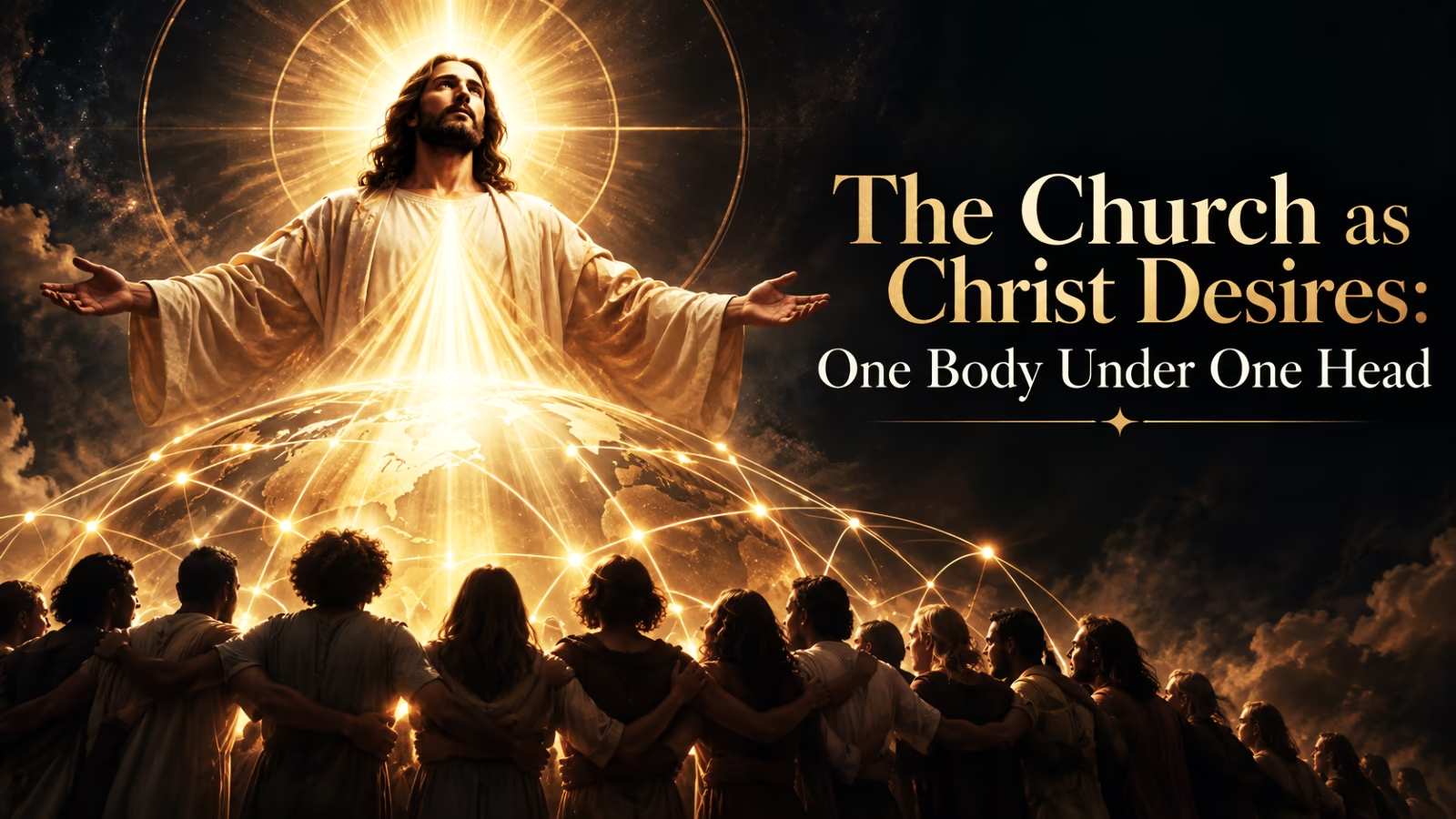
The Church as Christ Desires: One Body Under One Head
The New Testament presents a vision of the Church far greater than an institution, denomination, organization, or weekly gathering. The Church is the living Body of Christ, joined to its Head, living by His Spirit, and composed of believers whom God Himself has placed together according to His purpose.
Paul gives perhaps the clearest picture in 1 Corinthians 12:12–31. Christ gives the foundation for that life in John’s Gospel, Paul develops it throughout his letters, John describes its inner character in his epistles, and Revelation 2–3 shows what Christ praises, corrects, and desires among His churches. Taken together, these passages reveal what a healthy, living Church actually looks like.
One Body Because There Is One Head
Paul begins with something much deeper than organizational unity:
“For as the body is one, and hath many members… so also is Christ.”
1 Corinthians 12:12
Paul does not merely say that believers should cooperate with one another. He says they have become members of one Body.
“For by one Spirit are we all baptized into one body”
1 Corinthians 12:13
The Church therefore does not create its unity. Its unity already exists in Christ, and believers are called to live according to what God has already made them.
Paul develops this further in Ephesians:
“There is one body, and one Spirit… One Lord, one faith, one baptism, one God and Father of all.”
Ephesians 4:4–6
The Church becomes visibly healthy when its practical life begins to express this spiritual reality. Christ is the Head, and every member receives life, direction, purpose, and proper relationship from Him.
Paul writes that believers are to grow “into him in all things, which is the head, even Christ,” from whom “the whole body fitly joined together” makes increase of itself in love (Ephesians 4:15–16).
A healthy Church therefore does not revolve around personalities, institutions, movements, or human authority. It lives under the government of the Head.
Every Member Has a Place
In 1 Corinthians 12, Paul deliberately uses the human body because no healthy body consists of one functioning member.
“The body is not one member, but many”
1 Corinthians 12:14
The foot cannot decide that because it is not the hand it does not belong to the body, and the ear cannot decide that because it is not the eye it has no value. Neither can the eye say to the hand, “I have no need of thee” (1 Corinthians 12:21).
That destroys both inferiority and superiority. No believer should conclude, “I have nothing to contribute,” and no believer should conclude, “I do not need the others.”
God Himself determines the arrangement:
“But now hath God set the members every one of them in the body, as it hath pleased him.”
1 Corinthians 12:18
A healthy Church recognizes this divine placement. Its members are not spectators gathered around a small number of professionals, but living parts of Christ’s Body whose differing measures and functions are meant to contribute to the whole.
Diversity Without Division
Paul does not envision uniformity. The Body contains different members, functions, gifts, and measures, yet all live from the same Head and participate in the same Spirit.
“There are diversities of gifts, but the same Spirit. And there are differences of administrations, but the same Lord”
1 Corinthians 12:4–5
The Spirit distributes “to every man severally as he will” (1 Corinthians 12:11).
The purpose of this diversity is not individual recognition but common benefit:
“The manifestation of the Spirit is given to every man to profit withal.”
1 Corinthians 12:7
The differing gifts all serve the Body:
- Teaching serves the Body.
- Prophecy serves the Body.
- Helps serves the Body.
- Administration serves the Body.
- Mercy serves the Body.
- Giving serves the Body.
- Encouragement serves the Body.
Whatever God gives becomes healthy only when it remains under the Head and is used for the building up of the whole Body.
Paul expresses the governing principle simply:
“Let all things be done unto edifying”
1 Corinthians 14:26
Christ the Head Present as the Spirit
The Church cannot understand its life properly if Christ the Head is separated from the Spirit by whom His members live.
Paul calls Christ “the head of the body, the church” (Colossians 1:18). Yet he also speaks of “the Spirit of Christ” and immediately says, “if Christ be in you” (Romans 8:9–10), while elsewhere declaring, “the Lord is that Spirit” (2 Corinthians 3:17).
The Head is therefore not absent from His Body while some separate spiritual mechanism directs Christian living. Christ Himself is present and experienced in His members as the Spirit.
This makes Paul’s language in Romans 8 intensely practical:
“They that are after the Spirit do mind the things of the Spirit.”
Romans 8:5
To set the mind upon the Spirit is to set the mind upon the living Head.
Then Paul says:
“For as many as are led by the Spirit of God, they are the sons of God.”
Romans 8:14
To be led by the Spirit is to be led by Christ the Head.
This is not automatic Christian living. The believer does not become passive, lose his will, or cease to function as a distinct person; the member consciously turns toward the Head, sets the mind upon Him, receives from Him, and follows His leading.
Before the cross, the disciples experienced this relationship outwardly. Christ stood before them and said, “Follow me,” and they remained distinct persons who chose to hear Him, trust Him, and follow Him.
After His glorification, the same living Head is present within His members as the Spirit. The relationship is no longer merely outward but inward.
Christ leads, and the members respond.
Joined to the Lord in One Spirit
Union with Christ does not destroy individuality. The believer does not disappear into Christ, nor does the human spirit become annihilated or replaced.
Paul can say that the one joined to the Lord is one Spirit with Him, while also saying:
“The Spirit itself beareth witness with our spirit.”
Romans 8:16
The Spirit remains the Spirit, and our spirit remains our spirit. The union is real without being annihilating.
This is essential to Paul’s Body revelation. A body requires living members, not passive extensions without individual function, so each member remains genuinely himself while being joined to the same living Head and participating in the same Spirit.
One Body does not mean one personality. It means many distinct members living under one Head.
Love Is the Life in Which the Body Functions
It is significant that 1 Corinthians 13 stands directly between Paul’s teaching about the members and gifts of the Body in chapters 12 and 14.
Without love, even remarkable spiritual activity becomes empty. A person may speak with extraordinary eloquence, understand mysteries, possess great faith, give away possessions, or make tremendous sacrifices, yet without love Paul says, “I am nothing” (1 Corinthians 13:1–3).
The Body cannot function according to Christ while its members are driven by rivalry, pride, envy, self-promotion, resentment, or ambition.
Love “seeketh not her own.” It is not easily provoked, does not rejoice in wrongdoing but rejoices in truth, and it bears, believes, hopes, and endures (1 Corinthians 13:4–7).
Yet this love is not produced by human beings attempting to imitate Christ.
Christ’s command was:
“A new commandment I give unto you, That ye love one another; as I have loved you.”
John 13:34
That kind of love cannot be manufactured by human effort.
Paul says:
“The love of God is shed abroad in our hearts by the Holy Ghost which is given unto us.”
Romans 5:5
“The fruit of the Spirit is love.”
Galatians 5:22
The love expressed through a healthy Church is therefore not merely love resembling Christ’s love. It is the love of Christ Himself finding expression through members who live under the Head and walk in the Spirit.
Christ then gives that love an evangelistic significance:
“By this shall all men know that ye are my disciples, if ye have love one to another”
John 13:35
The visible evidence of Christ among His people is therefore truth expressed through the actual love of Christ flowing through His Body.
No Schism in the Body
Paul states his objective plainly:
“That there should be no schism in the body; but that the members should have the same care one for another.”
1 Corinthians 12:25
This does not mean overlooking error or abandoning truth. Paul repeatedly confronts false teaching, immorality, disorder, and destructive behavior.
Biblical unity is never unity at the expense of Christ.
Instead, Paul is describing members who recognize that they belong to one another because they already belong to one Body.
“If one member suffer, all the members suffer with it; or one member be honoured, all the members rejoice with it”
1 Corinthians 12:26
There is no competition in such a Church.
Another believer’s usefulness does not threaten us, and another believer’s suffering is not somebody else’s problem. Honor is shared, burdens are shared, correction is given in love, and restoration matters because every member belongs to the same Body.
The Church does not create this oneness. God has already created one Body and one Spirit, and the responsibility of the saints is to express visibly what God has already established spiritually.
Division begins when members cease to live consciously under the one Head and begin functioning from another governing source. Sincere believers can reason carefully, feel deeply certain, and still arrive at conflicting conclusions if their confidence rests in themselves rather than in the Head.
The problem is not merely disagreement. The deeper problem is independent government.
Christ Alone Has the Preeminence
A healthy Church cannot exist where the Head has been displaced.
Paul tells the Colossians that Christ “is the head of the body, the church” and that in all things He must have “the preeminence” (Colossians 1:18).
This changes everything. The Church does not belong to a pastor, teacher, denomination, ministry, movement, or tradition. Those may serve useful functions, but none can become the source of the Church’s identity or the authority that replaces its Head.
Paul confronted this problem at Corinth:
“One saith, I am of Paul; and another, I am of Apollos”
1 Corinthians 3:4
His response was devastatingly simple:
“Who then is Paul, and who is Apollos, but ministers by whom ye believed?”
1 Corinthians 3:5
Paul planted, Apollos watered, and God gave the increase.
The healthy Church appreciates those who serve without gathering itself around them.
Its loyalty belongs to the Head.
Abiding in Christ Produces the Life of the Church
John records the source from which all genuine Church life comes:
“Abide in me, and I in you.”
John 15:4
Christ compares Himself to the vine and believers to branches. A branch possesses no independent life and cannot produce spiritual fruit by effort separated from the vine.
“He that abideth in me, and I in him, the same bringeth forth much fruit: for without me ye can do nothing”
John 15:5
The Church therefore cannot be restored merely by creating a better structure. Its life must come from Christ.
Prayer, worship, fellowship, ministry, teaching, service, holiness, witness, and love become living realities only as believers remain joined practically to the Head and receive His life through the Spirit.
The answer to spiritual deadness is not more human activity. It is renewed connection to the Head.
Growing Into Spiritual Maturity
Paul’s vision is not merely that believers gather together but that the Body grows.
Christ gives ministries “for the perfecting of the saints, for the work of the ministry, for the edifying of the body of Christ” until believers come into unity, knowledge of the Son of God, and spiritual maturity (Ephesians 4:11–13).
The objective is not lifelong dependence upon a few gifted people. It is the equipment of the saints so that the entire Body functions.
Paul contrasts this maturity with spiritual childhood in which believers are “tossed to and fro” by every wind of teaching. Instead, the Church is to speak “the truth in love” and grow up into Christ (Ephesians 4:14–15).
Truth and love therefore belong together.
Truth without love becomes harsh and destructive, while love without truth becomes sentimental and vulnerable to deception. In the Head, truth and love are one harmonious expression of His life.
A Holy Church
Love does not eliminate holiness. Paul repeatedly insists that those who belong to Christ should increasingly express the life of the One to whom they are joined.
The Church is called to put away bitterness, wrath, anger, malice, corrupt speech, sexual immorality, greed, falsehood, and the works of the flesh. In their place should appear kindness, forgiveness, purity, humility, patience, self-control, faithfulness, and love.
Yet holiness is not produced by human beings attempting to imitate Christ through self-effort.
The source of holiness is the Head. As the members set their minds upon the Spirit, remain responsive to Christ, and walk under His government, the holy life of the Head gains expression through the Body.
Human obedience remains real. The believer chooses to yield, follow, resist sin, forgive, serve, and walk in truth, but the life being expressed is not self-generated righteousness.
It is Christ living through His members.
“Ye are the body of Christ, and members in particular”
1 Corinthians 12:27
The character of the Body should therefore increasingly express the character of its Head.
The Positive Testimony of Revelation 2–3
The seven churches of Revelation do not present seven consecutive historical ages. Together they provide a complete spiritual diagnosis of conditions that can exist among churches throughout the entire Church age.
Within Christ’s corrections are also qualities He explicitly praises.
- From Ephesus, we see labor, endurance, discernment, and refusal to tolerate false apostles. Yet Christ warns that even these qualities become deficient if first love for Him is abandoned.
- From Smyrna, we see faithfulness under suffering, spiritual riches despite outward poverty, and willingness to remain faithful even unto death.
- From Pergamos, despite serious corruption requiring correction, Christ acknowledges those who hold fast His name and do not deny the faith even under intense opposition.
- From Thyatira, Christ praises love, service, faith, patience, and works that had grown rather than diminished.
- From Sardis, even amid widespread spiritual deadness, Christ recognizes a few who had not defiled their garments.
- From Philadelphia, we see perhaps the clearest picture of faithful weakness: little strength, yet keeping Christ’s Word and refusing to deny His name. Christ places before them an open door.
- From Laodicea, we see the terrible danger of outward sufficiency combined with inward spiritual poverty. Christ exposes their condition, calls them to repentance, and tells them exactly what they need from Him.
Then His language widens.
“As many as I love, I rebuke and chasten…”
The appeal is no longer confined to one local condition.
“If any man hear my voice, and open the door…”
The call becomes individual.
“To him that overcometh…”
The promise reaches every overcomer.
Finally:
“He that hath an ear, let him hear what the Spirit saith unto the churches.”
Christ’s closing appeal embraces all who belong to Him and all the churches that will hear His voice. To hear what the Spirit says is to hear what the living Head is saying to His Body.
Taken together, the picture becomes remarkably complete.
A healthy Church loves Christ first, discerns error, holds fast His name, keeps His Word, serves faithfully, loves one another, endures suffering, refuses spiritual compromise, walks in purity, remains spiritually awake, depends upon His strength, responds to His correction, and overcomes.
A Church That Can Be Corrected
One of the clearest signs of spiritual health is not perfection but responsiveness to Christ.
Throughout Revelation 2–3, Christ repeatedly calls His people to hear, repent, hold fast, remember, overcome, and return.
The living Church does not defend its traditions merely because they are old, nor its structures merely because they are familiar. When the Head exposes something contrary to Himself, the Body listens.
“He that hath an ear, let him hear what the Spirit saith unto the churches.”
Because the Spirit is the living presence of Christ the Head among His members, hearing what the Spirit says is hearing the government of the Head.
A healthy Church therefore remains teachable before Him. It tests everything, holds fast what is good, and rejects what is contrary to Christ.
A People Led by the Living Head
Paul’s vision cannot be produced by organization alone.
“For as many as are led by the Spirit of God, they are the sons of God.”
Romans 8:14
This is not mysterious machinery operating inside the believer.
Christ is the Head, and the Spirit is Christ present and operative in His Body.
The practical pathway is already given by Paul:
“They that are after the Spirit do mind the things of the Spirit.”
Romans 8:5
The believer sets the mind upon the Spirit, and therefore upon the living Head.
The Head leads. The member follows.
This preserves both divine life and human responsibility. The member does not become passive, but listens, chooses, obeys, responds, serves, speaks, loves, gives, suffers, and functions according to the measure supplied by the Head.
The Spirit does not replace the member’s humanity. The Spirit brings the member into living fellowship with Christ so that the life and government of the Head can be expressed through the Body.
This is also where the difference between true spiritual leading and mere inward certainty becomes critical.
A person may reason carefully, examine the available information, become convinced of a conclusion, and feel completely settled about it, yet none of those things alone proves that the Head is leading. Confidence can accompany truth, but confidence can also accompany the flesh.
Romans 7 shows that sin can operate in the members and war against the mind. Romans 8 does not answer that problem by teaching stronger self-government, but by bringing the mind under another government: “the mind of the Spirit.”
The flesh can influence reasoning, desire, emotion, conviction, and final judgment while still allowing a person to feel sincere and certain. This helps explain how believers can arrive at deeply conflicting positions while each remains convinced that he is right.
The test of spiritual leading is therefore not intensity of feeling, inward certainty, excitement, or emotional peace.
The question is whether the member is living consciously under the government of the Head.
When Inward Experience Replaces the Head
This distinction becomes especially important wherever spirituality is reduced to inward experience.
Feelings are real, emotions are real, and powerful experiences can accompany genuine encounters with God. Yet inward experience becomes dangerous when it is treated as the governing authority rather than something that remains subject to Christ the Head.
A person can feel inspired, peaceful, excited, deeply moved, or spiritually charged without necessarily being led by the Spirit. The Body is not governed by intensity of experience, but by the Head.
When inward experience becomes the final authority, the member begins to govern himself. His own reasoning, desires, emotions, convictions, or preferences effectively take the place that belongs to Christ.
At that point, the language of spirituality may remain, while the practical government of the Head has been displaced.
This can happen in individual believers and in entire churches. A gathering may possess music, emotion, energy, excitement, gifted personalities, and powerful experiences, yet those things do not by themselves prove that the Body is functioning under Christ.
Paul’s test is deeper.
- Is the Body holding the Head?
- Is it walking in the Spirit?
- Is it expressing the love of Christ?
- Is it rejecting rivalry and division?
- Are the members functioning together under one government?
True spirituality is not intensified inward feeling. It is conscious life under the government of Christ the Head.
The Flesh and the Fracturing of the Body
Paul repeatedly connects division with the flesh.
At Corinth he writes:
“For whereas there is among you envying, and strife, and divisions, are ye not carnal?”
1 Corinthians 3:3
Galatians likewise places hatred, strife, rivalry, factions, and envy among the works of the flesh.
These things do not arise because the Body has more than one true Head. They arise when members cease functioning under the one Head and begin acting from the flesh.
The flesh can express itself through pride, ambition, jealousy, personality-following, desire for preeminence, false confidence, religious enthusiasm, or personal conviction. Each can appear reasonable to the person experiencing it, yet still produce division because the governing source is no longer Christ.
Romans 7 exposes the inability of the self-governed person to escape the law operating in the members through greater effort alone. Romans 8 answers that failure by bringing the mind under the Spirit, the living Head.
The deepest answer to division is therefore not merely better conflict resolution. It is restoration to the Head.
One Head produces one Body in living expression. Many independently governed members produce fracture.
United in the Glory of the Head
Before the cross, Christ prayed for those who would believe in Him through the apostles’ testimony. His prayer was not merely that Christians would occupy the same buildings or carry the same organizational name.
He prayed:
“That they all may be one; as thou, Father, art in me, and I in thee.”
John 17:21
He then says something extraordinary:
“And the glory which thou gavest me I have given them; that they may be one, even as we are one.”
John 17:22
Christ is not asking human beings to manufacture unity. The Body is already one. What He desires is the visible expression of that existing oneness through a people living in Him.
The Church expresses this unity as its members remain joined to the Head, receive from the Head, set their minds upon the Spirit, love through the life of the Head, and submit to His government.
This is unity in the glory of the Head.
What the Living Church Looks Like
The New Testament vision is therefore not difficult to identify.
It is one Body under one Head, living in one Spirit.
Every member has value. Every member has a place, and gifts differ while all serve the same Body.
No member exalts himself above another, and no member considers himself unnecessary.
Christ has the preeminence. The members live consciously under the government of the Head.
Truth is spoken in love. Error is discerned without abandoning love, and love is expressed without abandoning truth.
The saints care for one another. They share suffering and honor, forgive, restore, serve, encourage, teach, strengthen, warn, pray, give, bear burdens, and build one another up.
The Church keeps Christ’s Word and refuses to deny His name. It loves Him above everything else.
It remains faithful in suffering, pure amid corruption, awake amid spiritual deadness, humble in weakness, responsive to correction, and dependent upon the life of the Head.
Its ministries equip the saints rather than replacing them. Its gifts build the Body rather than elevate individuals, and its members grow toward maturity rather than remaining permanently dependent upon human leaders.
- Its love is not manufactured.
- Its holiness is not imitation.
- Its unity is not organizational.
- Its spirituality is not emotional self-government.
- Its life comes from Christ.
This is not primarily a blueprint for a better institution. It is a revelation of a living organism whose life, government, love, holiness, direction, and unity come from its Head.
The fracture visible throughout Christianity does not change what Christ’s Body is. It reveals how far its visible expression can fall short of the reality God established.
The answer is therefore not merely better organization, stronger institutions, greater activity, more powerful experiences, or another movement bearing another name. The answer is a return to the Head.
As every member holds fast to Christ, sets the mind upon the Spirit, receives from the Head, submits to the Head, and serves according to the measure the Head supplies, the Body begins again to appear as Paul described it:
“From whom the whole body fitly joined together and compacted by that which every joint supplieth… maketh increase of the body unto the edifying of itself in love.”
Ephesians 4:16
That is the Church brought into healthy expression:
many members, one Body, one Spirit, one life, one love, and one glorious Head—Jesus Christ.