


In This Article

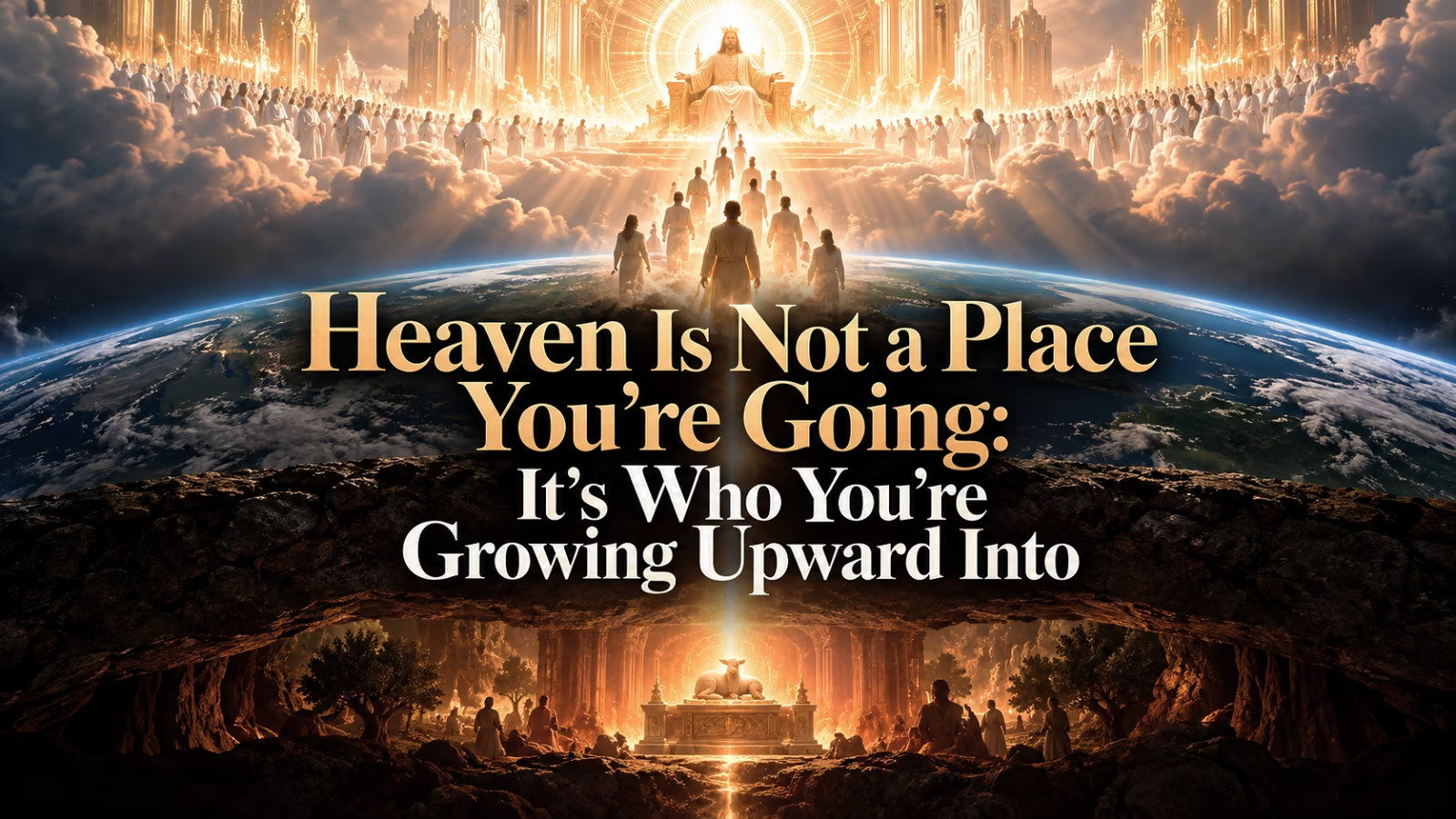
Heaven Is Not a Place You’re Going: It’s Who You’re Growing Upward Into
For centuries, many Christians have understood heaven as the final destination of the believer, imagining that death releases the soul from the earth to dwell forever in the heavens. Yet Scripture reveals something far greater than the departure of individual souls from the physical world.
God's eternal purpose is to bring forth a corporate Body under one Head, Jesus Christ, transforming His children into His likeness until they become His completed dwelling place. This purpose begins with Christ's redemption, advances through our spiritual union with Him, and culminates in the New Jerusalem descending from heaven to the new earth.
The Christian life, therefore, is not primarily about going somewhere when we die. It is about growing up into Someone while we live.
1. Paradise: The Resting Place of the Departed Saints
Jesus revealed that death is not the end of the believer's relationship with God, but neither is it the completion of God's purpose for His children. Scripture distinguishes the rest of the departed saints from the resurrection, the coming Kingdom, and the eternal dwelling of God.
Where Did Jesus Go When He Died?
In Luke 16:19–31, Jesus describes Lazarus resting in Abraham's bosom while the rich man suffers torment in Hades. A great gulf separates them, revealing two distinctly different conditions among the dead: comfort for the righteous and torment for the unrighteous.
This account provides an important foundation for understanding the promise Jesus later made to the thief dying beside Him.
"Verily I say unto thee, To-day shalt thou be with me in Paradise." — Luke 23:43, ASV
Jesus promised the thief Paradise that very day, although Christ had not yet been resurrected or ascended to the Father. Where, then, did Jesus go?
He had already revealed the answer:
"For as Jonah was three days and three nights in the belly of the whale; so shall the Son of man be three days and three nights in the heart of the earth." — Matthew 12:40, ASV
Peter confirms in Acts 2:27–31 that Christ entered Hades but was not abandoned there. His soul was not left in Hades, and His flesh did not experience corruption.
The testimony is consistent: Christ promised the thief Paradise, descended into the heart of the earth, and emerged victorious through resurrection. The Paradise Christ entered at His death was associated with the place of comfort among the departed, not His ascension to the heavenly throne.
Why Are the Martyred Saints Beneath the Altar?
Revelation 6:9 provides another remarkable picture of the departed saints.
"And when he opened the fifth seal, I saw underneath the altar the souls of them that had been slain for the word of God, and for the testimony which they held." — Revelation 6:9, ASV
The identification of this altar matters because the tabernacle contained two distinct altars.
The golden altar of incense stood before the veil, associated with incense and priestly intercession. The altar of burnt offering stood in the outer court, where sacrificial blood was poured out at its base (Leviticus 4:7).
The souls John sees are specifically those who had been slain for God's word and their testimony. Their position beneath the altar corresponds to the sacrificial altar, where blood testified that a life had been offered.
The outer court also provides a meaningful picture of their condition. They belong to God through sacrifice, yet they remain outside the sanctuary, awaiting the appointed time when judgment and reward will determine participation in the coming Kingdom.
When these martyrs cry out for vindication, they are given white robes and instructed to rest a little longer (Revelation 6:10–11). They have not been forgotten, nor have they entered their final inheritance.
Paradise is God's provision of rest for His redeemed children, not the completed Kingdom or the final New Jerusalem.
Does Paul Describe a Different Paradise?
In 2 Corinthians 12:1–4, Paul introduces an extraordinary vision involving the third heaven and Paradise, where he heard words that were not lawful for a man to utter. This upward heavenly revelation is distinct from the account of Christ's descent into Hades and does not describe the relocation of departed believers.
Revelation 2:7 also speaks of the Paradise of God, where the tree of life is found, while Revelation 22:2 places that tree within the New Jerusalem. These passages distinguish the heavenly revelation of God's Paradise from the resting place Christ entered following His death.
The important distinction remains: the departed saints rest while awaiting resurrection, but God's eternal purpose extends far beyond that rest.
2. Seated in Heaven: Growing Up into Christ the Head
The location of departed believers raises a greater question: How can Christians living on earth already be seated in heavenly places?
Paul provides the answer through the relationship between Christ and His Body.
"But he that is joined unto the Lord is one spirit." — 1 Corinthians 6:17, ASV
This verse reveals something extraordinary about our relationship with Christ. We are not merely followers of a distant Lord; we are members of a living Body joined to its heavenly Head.
One Spirit Without Losing Our Individual Identity
Our union with Christ does not mean that God and humanity blend into a new spiritual substance. God remains God, and each believer retains an individual human spirit and personal identity.
The union is spiritual and organic, established through Christ, who is the Head of the Body and who has become the life-giving Spirit (1 Corinthians 15:45). This is the reality expressed by one Spirit: our living union with the Lord without the destruction of our individual personhood.
Ephesians 2:6 declares that God has raised us with Christ and seated us with Him in the heavenly places. Yet our physical bodies remain on earth.
There is no contradiction because our heavenly position is established in Christ, while our experience of that position depends upon living under His Headship through the Spirit.
A believer does not have to die or physically travel through the heavens to experience the life of the heavenly Head. This union is available now, while we are still living in our earthly bodies.
Worshipping in Spirit and Truth
Jesus established the governing principle of our fellowship with God:
"God is a Spirit: and they that worship him must worship in spirit and truth." — John 4:24, ASV
Worship is therefore more than religious activity, emotional experience, or sincere intention. It requires our inward being to come under the governing authority of Christ according to His revealed truth.
Romans 8:5–8 distinguishes those whose minds are set on the flesh from those whose minds are set on the Spirit. The mind of the flesh cannot please God, but the mind of the Spirit is life and peace.
This distinction matters because a person can possess eternal salvation without consistently living under the active Headship of Christ. Religious enthusiasm, confidence, and even carefully reasoned convictions do not establish spiritual leading when they depart from God's revealed will.
To worship in Spirit and truth is to live in fellowship with Christ as Head, allowing His mind and His Word to govern our thoughts, decisions, and actions.
When we turn to the Spirit and submit ourselves to His truth, we experience the life of the heavenly Head. Our physical location does not change, but our spiritual participation in Christ becomes a living reality.
Growing Up into the One New Man
Ephesians 2:15 reveals that Christ created the one new man in Himself. Ephesians 4 then describes how this corporate man grows toward maturity, with every member developing under the direction of the Head.
Paul expresses the destination of this growth:
"but speaking truth in love, may grow up in all things into him, who is the head, even Christ;" — Ephesians 4:15, ASV
Notice the direction: we grow up into Him.
Christ does not cease to be the Head, nor do His members become independent spiritual authorities. The Body grows into the fullness of Christ through its living dependence upon Him.
Second Corinthians 3:18 describes believers being transformed into the same image from glory to glory. Colossians 3:10–11 likewise describes the new man being renewed according to the image of his Creator, with Christ becoming all and in all.
This is the upward movement of the Christian life. As we live by the Spirit and receive the truth of God's Word, Christ transforms us into His likeness and builds us together as His corporate Body.
3. The Earthly Race: Transformation Before the Judgment Seat
Understanding this upward growth changes how we view our remaining time on earth. Salvation brings us into God's family, but our present life is the appointed opportunity to grow into Christ and pursue the Kingdom prize.
Paul understood that receiving eternal life and successfully completing the Christian race were not identical matters.
"I press on toward the goal unto the prize of the high calling of God in Christ Jesus." — Philippians 3:14, ASV
Paul was already a believer when he wrote these words, yet he continued pressing forward. He had not considered the race completed simply because he belonged to Christ.
Why Our Present Life Matters
The Christian race is the daily experience of following the Head, denying the flesh, and allowing the Spirit to transform our inward being. It is not a means of purchasing salvation, but the path of spiritual maturity toward the reward promised to those who overcome.
Paul reinforces this distinction in 1 Corinthians 9:24–27, where he describes disciplined running and warns of the possibility of being disqualified from the prize.
Our earthly lives therefore carry an urgency that must not be dismissed.
- Salvation rests upon Christ's completed sacrifice and secures our eternal relationship with God.
- Transformation takes place as we actively live under Christ's Headship through the Spirit and truth.
- The Kingdom prize concerns the reward of overcoming, determined at Christ's judgment seat.
These distinctions preserve both the security of God's salvation and the seriousness of His calling.
Death Brings Rest, Not Another Race
When a believer dies, the earthly opportunity to run the race comes to an end. The departed saint enters rest, not a second period of earthly-style testing in which unfinished faithfulness can simply be accumulated afterward.
Revelation 6:11 presents the departed martyrs resting, while 2 Corinthians 5:10 establishes that believers must appear before Christ's judgment seat to receive according to what they have done in the body.
The judgment concerns the life that was actually lived, not an imagined continuation of the race in Paradise.
This does not mean God's work of perfecting His children is abandoned at death. It means that the opportunity to run faithfully for the Kingdom prize belongs to our present earthly life, while the eventual completion of God's eternal purpose remains certain.
Christ's promises to the overcomers in Revelation 2–3 show why that distinction matters. The crowns, priestly privileges, and Kingdom participation held before believers are meaningful rewards, not automatic substitutes for the race itself.
We are saved by grace, but we are called to grow up into Christ.
4. The New Jerusalem: The Completed Body Descending to Earth
The upward growth of the Body brings us to the final revelation of God's eternal purpose.
The New Jerusalem is not merely a magnificent city constructed from precious materials. Scripture reveals it as God's completed corporate dwelling, the fully prepared Bride of Christ.
John records:
"And I saw the holy city, new Jerusalem, coming down out of heaven from God, made ready as a bride adorned for her husband." — Revelation 21:2, ASV
The city is identified in Revelation 21:9–10 as the Bride, the wife of the Lamb. Its beauty is therefore inseparable from the people God has redeemed, transformed, and built together for Himself.
Living Stones Built into God's Dwelling
First Peter 2:5 describes believers as living stones being built into a spiritual house. Ephesians 2:21–22 explains that the building grows into a holy temple in the Lord, becoming God's dwelling place in the Spirit.
These are not disconnected pictures. The living stones, the corporate Body, the one new man, and the prepared Bride reveal different aspects of God's work of bringing His children into complete union with Christ.
Every believer is being prepared as part of this living habitation. The purpose is not merely individual holiness, but a corporate dwelling in which God can fully express Himself through His perfected children.
As the Body grows up into the Head, the spiritual building progresses toward completion. The completed New Jerusalem is the glorious expression of that work.
Why the City Descends from Heaven
Here the relationship between the Head and His Body becomes especially significant.
Throughout the present age, Christ is bodily seated in the heavens, while His members live upon the earth. Yet they are already joined to Him in one Spirit and are being built together into God's dwelling.
This explains why the heavenly nature of the New Jerusalem does not require every believer to be physically transported into heaven before the city descends. The Body's union with its heavenly Head is spiritual, not dependent upon all its members occupying the same physical location.
The movement of the city reveals the completion of that union.
At the end of the Kingdom age, the entire corporate Bride is prepared. Every living stone has reached its appointed place in God's completed habitation, and the New Jerusalem is revealed descending from heaven.
The Bride is not presented in her completed form during the Kingdom age. Her appearance in Revelation 21 follows the final judgment and the passing away of the former heaven and earth.
This is why Scripture describes the New Jerusalem as ready. God's eternal habitation is complete, its Bride fully prepared, and the work of bringing His children into the fullness of Christ has reached its glorious conclusion.
Heaven and Earth Meet in God's Eternal Dwelling
The announcement accompanying the descending city declares the fulfillment of God's purpose:
"Behold, the tabernacle of God is with men, and he shall dwell with them, and they shall be his peoples, and God himself shall be with them, and be their God:" — Revelation 21:3, ASV
The direction is unmistakable. The New Jerusalem comes down from heaven, and God's dwelling is established with humanity upon the new earth.
Revelation 22:1–3 places the throne of God and of the Lamb within the completed city. The tree of life, first appearing in Genesis and promised to the overcomers in Revelation, is now found in God's eternal habitation.
There is no longer a separation between the heavenly Head and the completed corporate dwelling in which He makes His home. The saints are not waiting to escape the earth; God's purpose is fulfilled as His glory fills His perfected habitation in the new creation.
The upward growth of the Body reaches its completion in the downward revelation of the New Jerusalem.
5. The Christian Life Is an Upward Calling, Not an Escape from Earth
The whole picture reveals the remarkable direction of God's work.
Christ descended from heaven, passed through death, and rose victorious to become the exalted Head of His Body. Through His sacrifice, believers receive eternal life; through His Spirit, they are called into a living experience of His heavenly Headship.
The stages of this purpose are beautifully connected:
- Christ descends to redeem humanity, opening the way for God's children to receive eternal life.
- The redeemed are joined to Christ in one Spirit, growing upward into Him through the Spirit and truth while living on earth.
- The departed saints rest in Paradise, awaiting resurrection and the fulfillment of God's promises.
- The Body is brought to completion, becoming the fully prepared Bride and God's eternal dwelling.
- The New Jerusalem descends from heaven, revealing the completed habitation of God with His children upon the new earth.
The final destination is not a permanent departure from creation, but God's eternal presence with His perfected people in the new heaven and new earth.
This is why the Christian life cannot be reduced to securing salvation and waiting for death. Christ has called His members to grow into Him now, to live under His Headship, and to participate consciously in the transforming work of the Spirit.
Paul's upward calling is not an invitation to abandon the earth physically. It is the call to know Christ, live by His Spirit, and grow into the fullness of the One who has already ascended.
One day, that growth will be complete. The Bride will be ready, the New Jerusalem will descend, and the Head will dwell with His completed Body in the fullness of God's eternal purpose.
Christ came down to bring us up into Himself, and when His Body is fully prepared, God's eternal dwelling will come down to the earth.
That is the true geography of the Body of Christ—and the glorious destination toward which the whole revelation of Scripture is moving.