

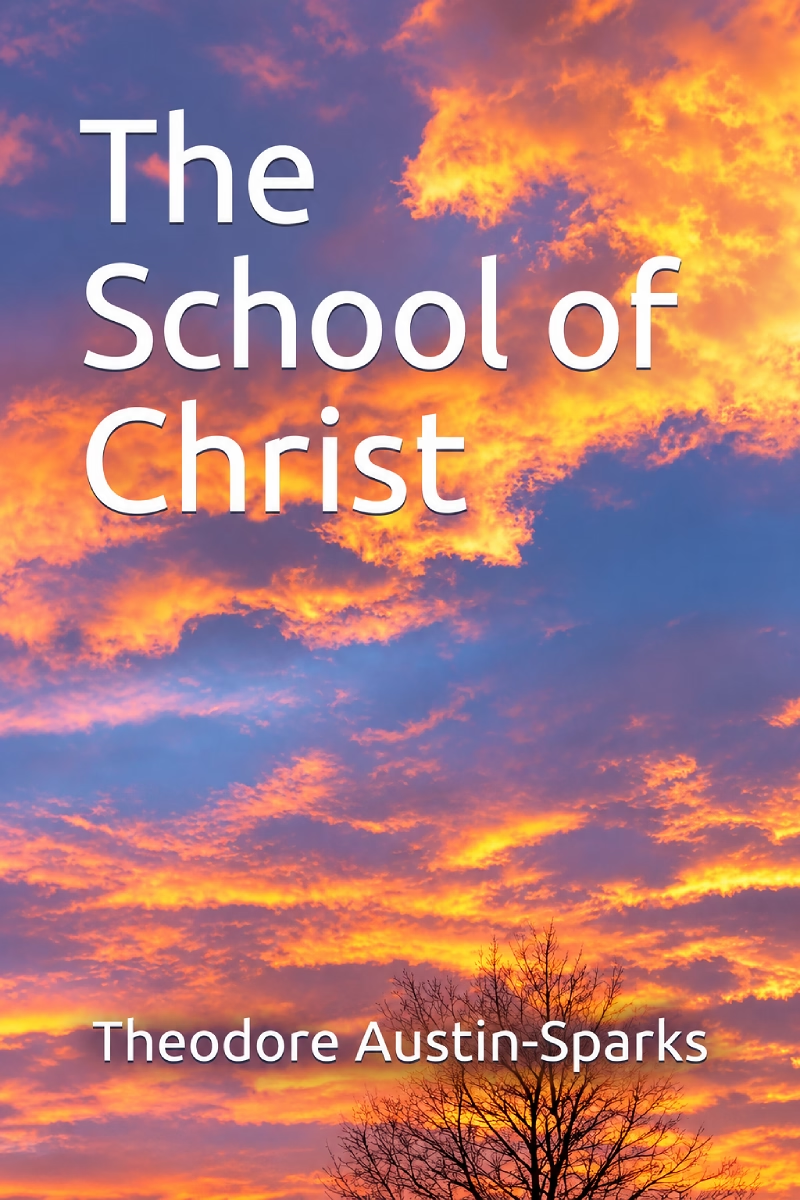
The School of Christ
T. Austin-Sparks portrays Christian growth as a lifelong school in which Christ is the lesson and the Holy Spirit the Teacher. The book moves through revelation, the Cross, the house of God, the light of life, an open heaven, the anointing, and divine love, showing how natural self-life is displaced so the believer increasingly knows and expresses Christ.
Available Instantly
About This Book
The School of Christ presents Christian growth as an inward spiritual education in Jesus Christ. T. Austin-Sparks takes the Lord’s invitation to “learn of Me” and Paul’s language of “learning Christ” as the governing idea of eight connected messages. Christ is both the lesson and God’s standard, the Holy Spirit is the Teacher, and the believer’s circumstances become part of the school in which natural self-life is exposed and the life of Christ is progressively known, formed, and expressed.
The foundation of this education is God’s determination to conform His people to His Son rather than improve fallen human nature into something acceptable. Sparks uses Matthew 11, Ephesians 4, Romans 8, and Ezekiel’s measured house to emphasize the absolute difference between Christ and what humanity is by nature. Spiritual growth therefore begins with a revelation of Christ and continues as the Holy Spirit makes that revelation practical in the believer.
The Cross is indispensable to the process. Sparks treats Jordan as a picture of the Cross clearing away the old ground so that the Holy Spirit may have governing place. The natural man and self-life are not educated into spirituality; their independent rule is judged. Resurrection is the positive side: believers are brought onto new-creation ground to live by another life. The book therefore joins the Cross, resurrection life, the new creation, and union with Christ as realities through which spiritual transformation takes place.
“Learning the Truth” develops Jesus’ statement, “I am the truth.” Truth is not merely a collection of doctrines that can be possessed apart from Christ. The believer learns truth by spiritually knowing the Person in whom truth is embodied. “Learning by Revelation” continues this emphasis, especially through John and Ezekiel. When spiritual decline or practical need exposes inadequacy, God’s answer is a fresh unveiling of His Son by the Holy Spirit rather than an increase of natural religious knowledge.
The chapters on the house of God and the light of life develop a substantial biblical-typological framework. Bethel, Jordan, the altar and blood, Ezekiel’s temple, the temple river, and other Old Testament pictures are interpreted in relation to Christ and the people who are in Him. Christ is the true meeting place of God and humanity, and the Church is the corporate house formed in union with Him on resurrection ground. The temple imagery therefore serves not merely as an illustration but as a way of explaining God’s spiritual dwelling, order, life, and purpose in Christ.
Ezekiel 40–47 contributes repeatedly to this teaching. The measured house presents Christ as God’s standard; the return of the glory and the river of life develop the relationship between God’s presence, divine life, and spiritual fullness. Sparks connects this with John’s Gospel, where life and light are inseparable. The light of God exposes what belongs to the natural man because divine light proceeds from divine life. The glory of God also becomes a governing consideration: what is truly of Christ answers to God’s glory rather than to human reputation, success, or self-interest.
“An Open Heaven” explains why spiritual things require spiritual faculties. A believer does not enter heavenly understanding by enlarging natural intelligence. The Holy Spirit gives a new capacity for seeing and knowing Christ, and the Cross continually removes the obstruction of self-life. “Learning Under the Anointing” makes the Spirit’s lordship explicit. The anointing is not merely power for activity; it means that self-will, natural judgment, and personal preference must yield to the inward government of the Holy Spirit.
The final message identifies divine love as the governing law of the school. God’s work is directed toward a people who increasingly bear the character of His Son, and love is the positive expression of that formation. Sparks relates love to the glory of God and to resurrection life rather than treating it as natural sentiment.
The book addresses readers asking how Christians actually learn Christ, why spiritual revelation differs from information, how the Cross and resurrection produce transformation, what union with Christ means in practical spiritual education, how the Church is related to the house and temple of God, why biblical types such as Bethel and Ezekiel’s temple matter, what an open heaven and the anointing mean, and how the Holy Spirit uses ordinary experience to form Christ within believers.
Book Details

Reading Fit
STUDY LEVEL
Advanced, Intermediate
STUDY SCOPE
Topical
BOOKS INCLUDED

Edition & Format
PUBLISHED
May 4, 2020
AVAILABLE FORMATS
paperback, hardcover, kindle
LENGTH
50 pages

Topics Covered
You Might Also Like