
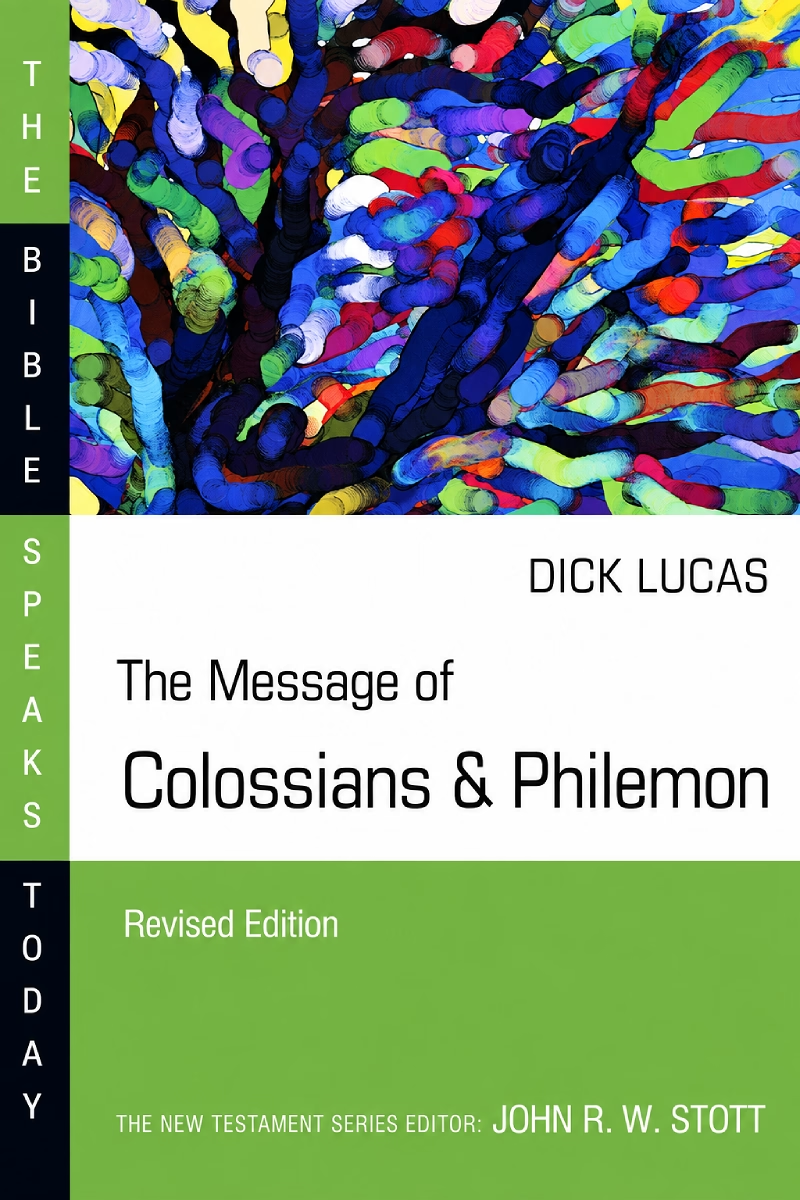
The Message of Colossians & Philemon
R. C. Lucas expounds Colossians and Philemon around Paul’s answer to claims that Christians need something beyond Christ: God’s fullness is in Christ, and believers are complete and free in him. Lucas connects Christ’s supremacy and finished work with victory over evil, church unity, holy living, daily relationships, and gospel-shaped freedom.
Available Instantly
About This Book
R. C. Lucas’s exposition of Colossians and Philemon is organized around two closely related themes: fullness and freedom in Christ. Lucas reads Colossians against the pressure of teachers who suggested that ordinary Christians lacked a deeper spiritual experience, fuller knowledge, greater liberty, stronger protection from evil powers, or a more impressive form of spirituality. Paul’s answer, as Lucas develops it, is that all God’s fullness is in Christ and that those who belong to Christ already share in the sufficiency of his saving work and triumph.
The exposition begins with the gospel that created the Colossian church and with Paul’s prayer that believers be filled with the knowledge of God’s will. Colossians 1:15–20 becomes a major statement of Christ’s supremacy: Christ is Lord over creation, head of the church, the one in whom fullness dwells, and the one through whom reconciliation is accomplished. Lucas connects this high Christology with the practical question behind the letter: if Christ is supreme and sufficient, what could supposedly “advanced” teaching add to him?
That question drives the treatment of Colossians 2. Lucas explains warnings against teachings that promise spiritual advancement but lead believers back into bondage. He gives particular attention to Christ’s authority over rulers and powers, the cancellation of the debt that stood against believers, and Christ’s triumph over hostile spiritual powers in Colossians 2:8–15. The book therefore offers substantial help for readers concerned about spiritual fear, evil powers, religious bondage, or claims that special techniques are required for protection or freedom. The answer is located in Christ’s complete work rather than in a spiritual elite.
Lucas also addresses religious legalism, asceticism, special observances, and claims to visionary or superior spiritual experience in Colossians 2:16–23. He contrasts these shadows and imposed regulations with the substance found in Christ. False spirituality may appear rigorous, but Lucas emphasizes Paul’s warning that it cannot conquer the self-indulgence of the flesh. This prepares for the positive Christian life of Colossians 3.
The second half of Colossians shows what fullness in Christ looks like in ordinary life. Lucas develops the believer’s identification with Christ in Colossians 3:1–4, the putting to death of sinful practices, the putting on of the new self, and the creation of a community marked by compassion, forgiveness, love, peace, gratitude, and the word of Christ. Union with Christ is therefore not treated as a private mystical idea but as the basis for overcoming sin, living in unity, and serving faithfully in the local church.
The commentary then applies Christ-centered living to the household, work, prayer, and relationships with outsiders. Husbands, wives, parents, children, masters, servants, and believers engaging the wider world are all addressed as people whose conduct belongs under the lordship of Christ. Prayer, wise speech, and witness are integrated into the same practical vision.
The exposition of Philemon applies the gospel’s fullness and freedom to the relationship between Philemon and Onesimus. Lucas treats the letter as a public Christian appeal that shows how the gospel reshapes social relationships, status, obligation, forgiveness, brotherhood, and freedom. The short letter therefore complements Colossians by showing the social consequences of belonging to Christ.
This book is especially useful for readers asking whether Christ is enough for the Christian life, how believers should respond to promises of a “deeper” spirituality, how Christ’s victory relates to evil powers, how to resist religious bondage and asceticism, how identity in Christ changes conduct, and how the gospel transforms relationships in church, home, work, and society.
Book Details

Reading Fit
STUDY LEVEL
Fundamental, Intermediate
STUDY SCOPE
Individual Book, New Testament
BOOKS INCLUDED

Edition & Format
PUBLISHED
December 22, 2020
AVAILABLE FORMATS
paperback, kindle
LENGTH
249 pages

Topics Covered
You Might Also Like