

Fellowship
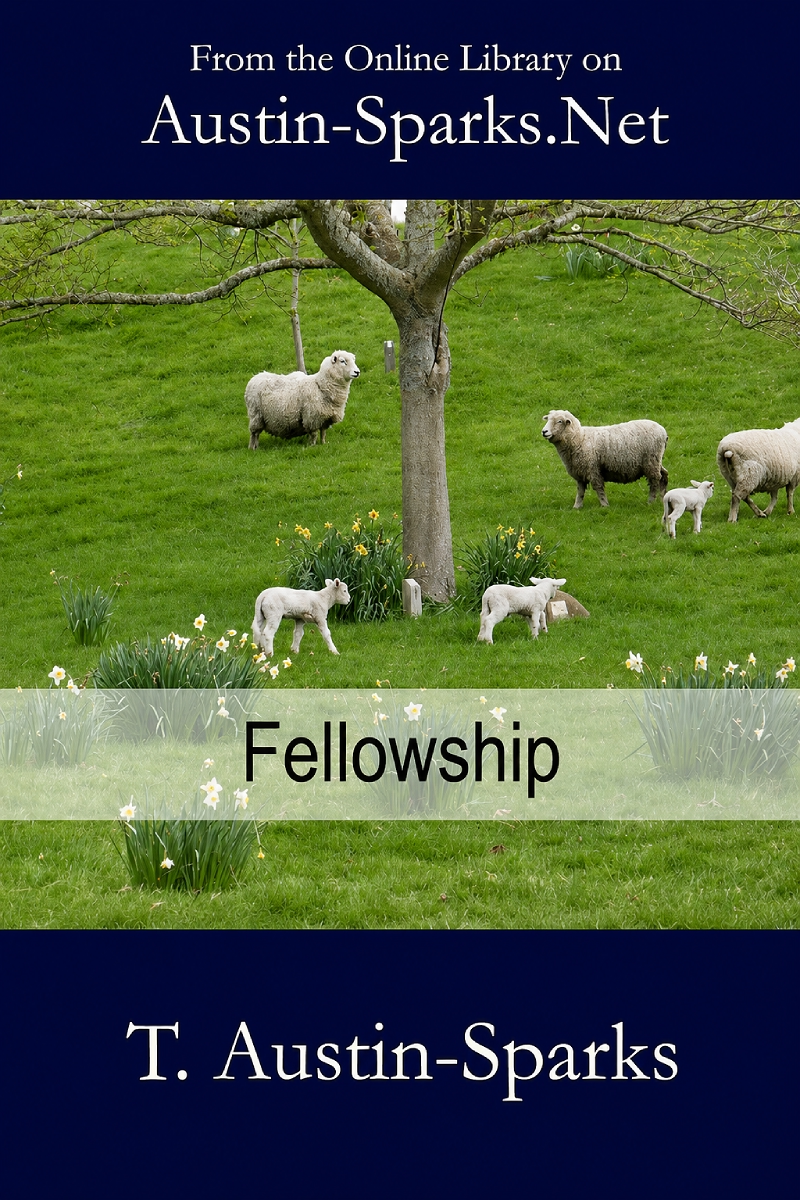
T. Austin-Sparks presents Christian fellowship as a spiritual and corporate reality in Christ, not merely friendly association. He connects the Church’s oneness with Christ’s Headship, the Cross, life in the Holy Spirit, the Body’s growth and service, resistance to spiritual division, and the costly removal of self-interest and independence.
Available Instantly
About This Book
Fellowship is T. Austin-Sparks’s three-part treatment of Christian fellowship as a spiritual and corporate reality created in Christ. Its governing texts include John 17:20–23, Acts 2:42–47, 2 Corinthians 13:14, and especially Philippians 2. Sparks rejects the idea that fellowship is merely being friendly, meeting together, avoiding friction, or maintaining an outward organization. He presents it as an inward oneness bound up with God’s eternal purpose, the sovereign Headship of Jesus Christ, the work of the Cross, life in the Holy Spirit, and the Church as the Body of Christ.
The opening chapter establishes the basis and values of fellowship. Sparks uses the New Testament language of believers being together in Christ to show that fellowship belongs to God’s thought from eternity. Ephesians contributes the picture of believers chosen together in Christ and built together as one spiritual organism. First Chronicles 11:1–3 becomes a major type: Israel gathers to David at Hebron on the ground that they are his bone and flesh, and Sparks applies this organic union to Christ’s Headship. Fellowship is therefore directly related to the practical recognition of Christ as Lord; division and independent action diminish the expression of His sovereign place among His people.
The Cross of Christ is central to Sparks’s explanation of how fellowship becomes possible and how damaged fellowship is restored. He connects John 17 and Christ’s prayer that His people may be one with the Cross immediately before Him. Sin and Satan have produced severance, schism, rivalry, and conflict; the Cross deals not only with guilt but with the old creation from which these divisions arise. Personal rights, sensitivities, jealousies, rivalries, and self-interest must come under the Cross if spiritual oneness is to be maintained. Resurrection in Christ then provides the ground of a people who are one.
Fellowship also demands and reveals life in the Holy Spirit. Human affection is not sufficient to sustain spiritual relationships under strain. Sparks argues that fellowship is maintained as believers live in the Spirit rather than in the flesh. Philippians 2 becomes especially important: Paul’s appeal to one mind and “fellowship of the Spirit” is grounded in Christ’s self-emptying movement from equality with God to obedience unto the death of the Cross. The Spirit works toward the unity and fullness of the one Body, and believers are called to cooperate with that purpose.
The corporate Body is also God’s means of spiritual increase and effective service. Sparks teaches that no isolated Christian reaches the fullness of Christ individually. Ephesians and the Corinthian teaching on the Body show members contributing to one another’s growth. Isolation therefore limits spiritual development and weakens service. The enemy seeks to isolate believers because living organic fellowship gives strength for Christian life and ministry. This makes fellowship a field of spiritual warfare: throughout the apostolic letters, unity must be guarded and division resisted.
The final chapter focuses on “the ruling out of the personal element.” Sparks traces the principle of self-emptying through Christ in Philippians 2 and through biblical people who become types or examples of God’s way with His servants. Abraham must relinquish possessive control of Isaac; Jacob’s self-strength is broken; Joseph is emptied through suffering before his exaltation; Moses moves from natural strength to dependence upon God; David displays selflessness; and Paul becomes a vessel whose weakness makes room for Christ’s power. Genesis, Exodus, Samuel, and Paul’s letters therefore materially contribute to the book’s practical application of the Cross.
Fellowship addresses readers asking what real Christian fellowship is, why Christian relationships divide, how unity can be recovered, why independence and isolation are spiritually dangerous, how Christ’s Lordship relates to the Church’s oneness, why the Cross must deal with self-interest, and how the Holy Spirit forms and strengthens the Body. Its burden is not outward uniformity but organic fellowship in Christ in which self is displaced, the Spirit has liberty, believers build one another up, and the Headship and fullness of Christ gain practical expression.
Book Details

Reading Fit
STUDY LEVEL
Intermediate
STUDY SCOPE
Topical
BOOKS INCLUDED

Edition & Format
PUBLISHED
June 6, 2021
AVAILABLE FORMATS
paperback, kindle
LENGTH
30 pages

Topics Covered
You Might Also Like