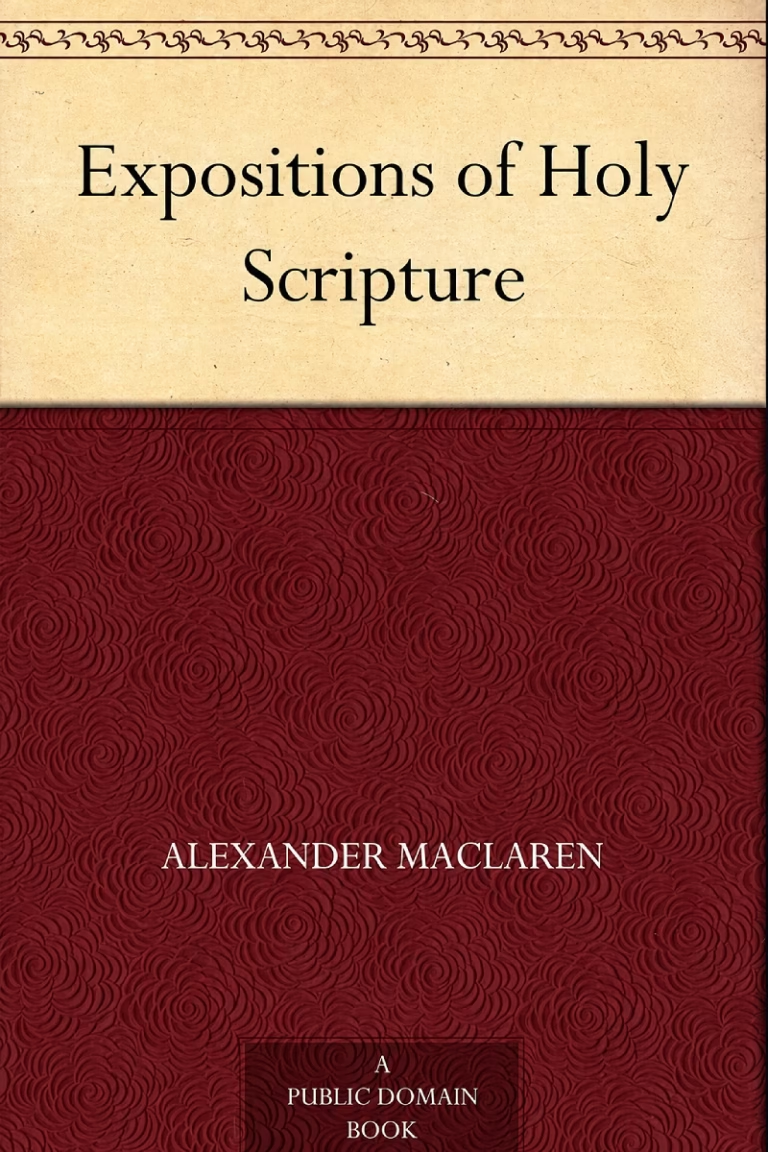

Expositions of Holy Scripture: the Acts
Alexander Maclaren follows Acts from Christ’s ascension and Pentecost to Paul’s witness in Rome, showing the risen Lord continuing His work through the Holy Spirit and His witnesses. The expositions trace the Church’s growth, gospel mission, prayer, persecution, conversion, Gentile inclusion, miracles, and the advance of Christ’s kingdom.
Available Instantly
About This Book
Expositions of Holy Scripture: the Acts is Alexander Maclaren’s sustained exposition of Acts, following the narrative from the ascension of Jesus Christ through Pentecost, the growth and persecution of the Jerusalem church, the opening of the gospel to the Gentiles, Paul’s missionary journeys, and his final witness in Rome. Maclaren’s governing interpretation is established at Acts 1:1–2 and 28:30–31: Acts records what the risen and ascended Christ continues to do and teach through His servants. The apostles are witnesses and instruments; Christ remains the true Worker.
Acts 1 gives the theological and practical starting point. Maclaren develops Christ’s resurrection and ascension, the forty days of instruction concerning the kingdom of God, the commission to witness, and the promise of power through the Holy Spirit. Acts 1:8 becomes a pattern for the book’s outward movement: witness begins in Jerusalem and extends beyond inherited boundaries. Christian mission is therefore not presented as human enterprise but as the continuing work of Christ, empowered and directed by the Spirit.
Pentecost in Acts 2 receives extensive attention. Maclaren distinguishes the abiding gift of the Holy Spirit from the extraordinary signs that accompanied His coming and treats the Spirit as the source of courage, utterance, guidance, holiness, and missionary expansion. Peter’s sermon links the crucified Jesus with resurrection, exaltation, lordship, repentance, forgiveness, and the gift of the Spirit. Acts 2:42–47 then supplies a picture of the early Church formed around apostolic teaching, fellowship, breaking of bread, prayer, shared life, and growth.
The expositions of Acts 3–7 follow apostolic witness under opposition. Miracles are treated as signs of Christ’s continuing power, while the arrests of Peter and John, the Church’s prayer for boldness, Ananias and Sapphira, the choosing of servants, and Stephen’s martyrdom show the pressures accompanying faithful testimony. Maclaren repeatedly connects persecution with prayer, Spirit-given courage, obedience to God, and renewed witness rather than retreat.
Acts 8–12 marks decisive expansion. Philip’s work in Samaria and with the Ethiopian, Saul’s conversion in Acts 9, Peter’s ministry, Cornelius in Acts 10, the defense of Gentile inclusion in Acts 11, Antioch, and Peter’s deliverance from prison show the gospel crossing ethnic and religious barriers. Saul’s conversion becomes a concentrated display of grace overcoming hostility. Cornelius and the Jerusalem response demonstrate that God Himself receives Gentiles and that the Church must follow the Spirit’s work rather than restrict it by inherited prejudice.
The later chapters trace Paul’s missionary advance through Asia Minor, Macedonia, Greece, and toward Rome. Acts 13–15 joins mission to the Gentiles with the Jerusalem council and the question of whether Gentile believers must come under the Mosaic ceremonial system. Maclaren emphasizes salvation through the grace of the Lord Jesus rather than religious works. Acts 16–20 develops conversion, guidance, Scripture, preaching, opposition, and pastoral ministry through Philippi, Thessalonica, Berea, Athens, Corinth, and Ephesus. Paul’s Areopagus address receives attention for its teaching on God as Creator, idolatry, repentance, judgment, and resurrection, while Ephesus shows the gospel confronting occult practice and entrenched interests.
The final section follows Paul through arrest, repeated defenses, imprisonment, voyage, shipwreck, and Rome. His testimony repeatedly returns to his encounter with Christ and his vocation as a witness. Maclaren also gives substantial attention to the Cross of Christ and resurrection as the foundation and vindication of the apostolic gospel, to prayer as the Church’s resource, to the kingdom of God as the subject of Christ’s teaching and Paul’s preaching, and to the Church as the sphere in which Christ continues His work.
The book directly serves readers asking what Acts teaches about the Holy Spirit, Pentecost, Christian witness and mission, the growth of the early Church, persecution, prayer, Paul’s conversion, Gentile inclusion, salvation by grace, missionary journeys, miracles, and the continuing ministry of the risen Christ. Its practical burden is that the same Lord who acted through the first witnesses remains the source of courage, power, guidance, endurance, and gospel advance.
Book Details

Reading Fit
STUDY LEVEL
Intermediate
STUDY SCOPE
Individual Book, New Testament
BOOKS INCLUDED

Edition & Format
PUBLISHED
May 12, 2012
AVAILABLE FORMATS
paperback, hardcover, kindle
LENGTH
662 pages

Topics Covered
You Might Also Like