
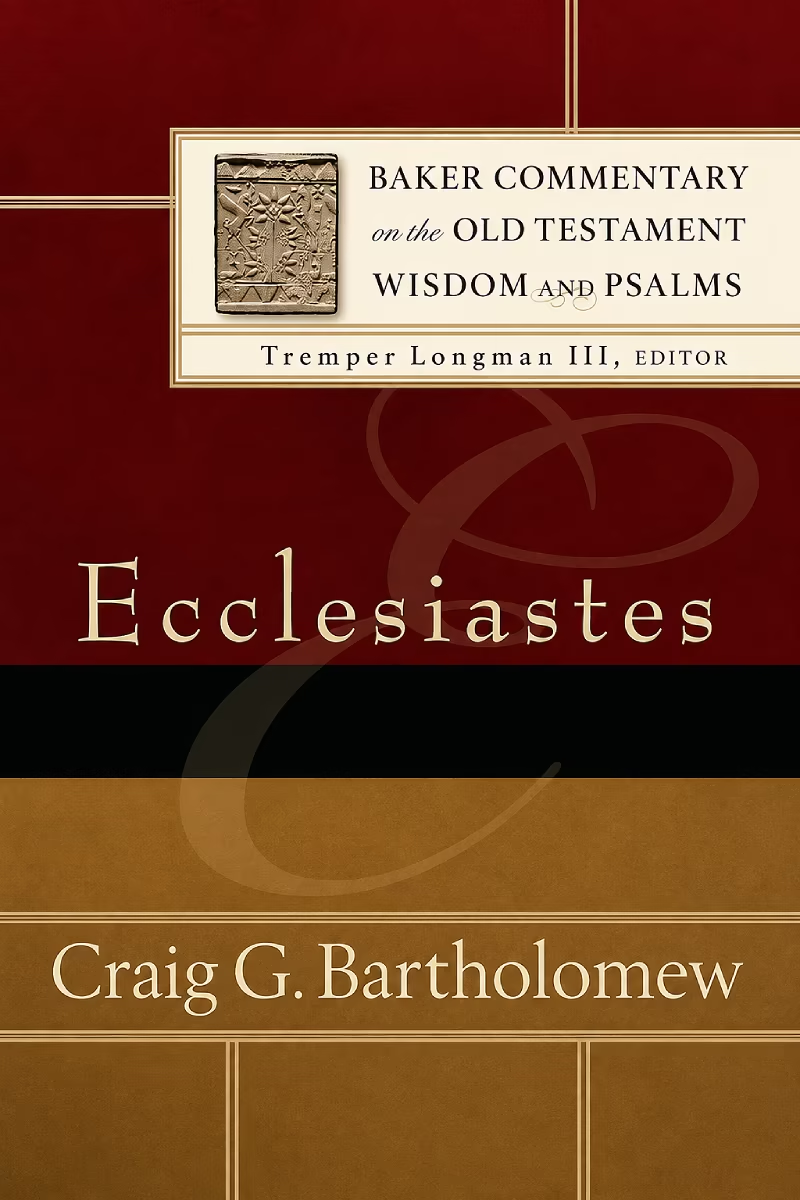
Ecclesiastes
Craig G. Bartholomew follows Ecclesiastes through its unsettling search for meaning amid work, pleasure, injustice, uncertainty, and death. His theological reading takes the book’s hebel seriously without ending in despair: human reason cannot master life, yet creaturely wisdom learns to fear God, receive His gifts with joy, remember the Creator, and live before His coming judgment.
Available Instantly
About This Book
Craig G. Bartholomew’s Ecclesiastes in the Baker Commentary on the Old Testament Wisdom and Psalms is a detailed exegetical and theological study of Qohelet’s exploration of the meaning of life. Bartholomew organizes the book around the frame narrative of Ecclesiastes 1:1–11 and 12:8–14 and the long central investigation in 1:12–12:7. His reading takes seriously both sides of Ecclesiastes: the repeated encounter with hebel—the elusive, enigmatic, frustrating character of life—and the recurring calls to receive and enjoy God’s gifts.
A distinctive feature of Bartholomew’s interpretation is his attention to how Qohelet tries to know the world. Qohelet repeatedly observes life “under the sun,” tests wisdom, pleasure, work, achievement, wealth, justice, and human conduct, and asks what lasting gain human beings can secure. Bartholomew describes this as an experiment in autonomous or empirically controlled human reason. The problem is not that observation has no value, but that human reason cannot stand outside creation and master its meaning. Again and again the search runs into realities that cannot be controlled or made fully coherent.
The language of hebel is therefore central. Rather than treating Ecclesiastes as a simple declaration that nothing matters, Bartholomew emphasizes life’s enigmatic and elusive quality. Work can be fruitful and yet its results pass to another. Wisdom is better than folly and yet the wise die like fools. Wealth can be enjoyed and yet cannot secure lasting gain. Justice matters and yet oppression and distorted judgment remain visible. Human beings recognize that life has order but cannot discover or control everything God is doing. The commentary helps readers name the experience of living in a world where important things are real and valuable but still resistant to human mastery.
Work and toil receive sustained attention because Ecclesiastes repeatedly asks what profit remains from human labor. Bartholomew examines ambition, rivalry, achievement, wealth, possessions, and the inability to guarantee the future. Pleasure is tested as another possible answer to the search for gain. These themes make the book directly relevant to modern questions about career, productivity, money, success, and whether achievement can carry the weight of a person’s identity or purpose.
Death and mortality intensify the problem. Death relativizes status, wisdom, possessions, and accomplishments, while time and chance expose the limits of human prediction. Ecclesiastes also confronts injustice and suffering: oppression occurs, courts fail, the righteous may suffer, and the wicked may prosper. Bartholomew does not smooth these tensions away. He shows how the book trains readers to live truthfully before God without pretending that every mystery has a visible explanation.
At the same time, Ecclesiastes repeatedly commends enjoyment. Food, drink, work, companionship, and the ordinary goods of embodied life can be received as gifts from God. In Bartholomew’s reading, this joy is not escapism from hebel. It belongs to a creaturely posture that receives what God gives instead of trying to secure ultimate meaning by autonomous control. Ecclesiastes 3 is especially important for the relation of time, divine action, human limitation, and enjoyment.
The closing movement toward Ecclesiastes 12 brings the fear of God, remembrance of the Creator, obedience, and divine judgment into sharper focus. The book’s answer is not mastery of life’s riddles but wise creatureliness before God. The final judgment gives moral seriousness to actions that may appear unresolved within present experience. Fear of God therefore stands against both despair and self-sufficient reason.
Bartholomew’s commentary is useful for readers asking why life can feel futile or incoherent, whether work or pleasure can provide lasting meaning, how Christians should live with injustice and uncertainty, what death does to human ambitions, and how joy can coexist with life’s limits. Its theological synthesis presents Ecclesiastes as a disciplined search for meaning that exposes the limits of autonomous wisdom and redirects the reader toward fear of God, grateful enjoyment, faithful obedience, and life before the Creator.
Book Details

Reading Fit
STUDY LEVEL
Advanced, Intermediate
STUDY SCOPE
Individual Book, Old Testament
BOOKS INCLUDED

Edition & Format
PUBLISHED
July 15, 2014
AVAILABLE FORMATS
paperback, hardcover, kindle
LENGTH
448 pages

Topics Covered
You Might Also Like