
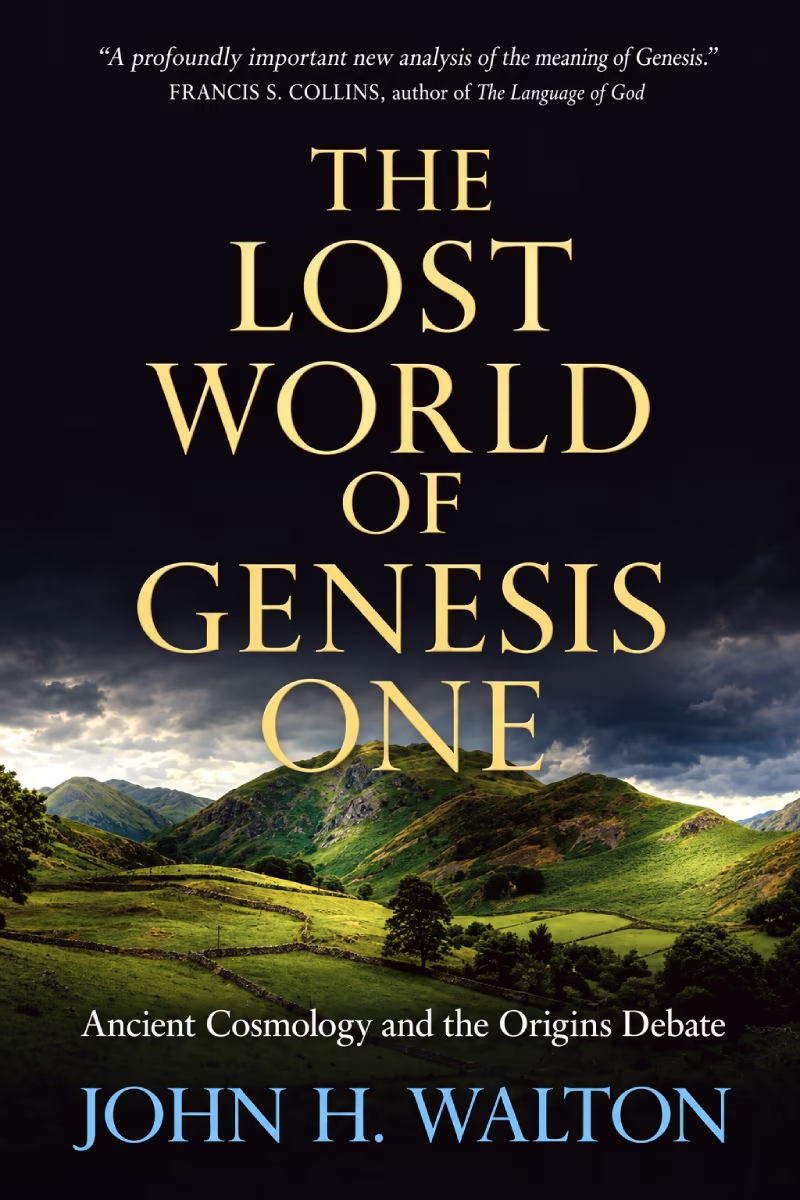
The Lost World of Genesis One: Ancient Cosmology and the Origins Debate
John H. Walton reads Genesis 1 within the ancient Near Eastern world and argues that the seven days concern God ordering the cosmos for function and divine residence rather than describing material manufacture. The book connects this reading to creation theology, scientific origins, intelligent design, and the modern creation-evolution debate.
Available Instantly
About This Book
The Lost World of Genesis One is a sustained study of Genesis 1 that asks what the chapter would have communicated within the ancient Near Eastern conceptual world rather than what modern readers instinctively ask of it. John H. Walton presents his case through a sequence of propositions. His governing claim is that Genesis 1 is ancient cosmology and should be interpreted according to ancient categories of existence, order, function, deity, temple, and rest rather than as if it were written to answer modern scientific questions.
Walton argues that ancient cosmology was strongly function-oriented. In this framework, to “create” is not primarily to manufacture material substance but to bring something into an ordered system by assigning roles and functions. He therefore interprets the opening condition of Genesis 1 as nonfunctional rather than materially nonexistent. Days one through three establish functions, and days four through six install the functionaries that carry them out. The seven-day sequence is then read as the inauguration of an ordered cosmos rather than a chronological account of the material production of all physical things.
A second major strand of the book is the cosmic-temple interpretation. Walton develops the biblical and ancient Near Eastern connection between divine rest and temple residence, arguing that God’s rest on the seventh day is the rest of a ruler taking up residence and beginning to govern. From this, he proposes that the cosmos itself is portrayed as God’s temple and that Genesis 1 describes its inauguration. Divine rest, sacred space, ordered function, God’s rule, and cosmic purpose therefore belong together in his reading.
The book repeatedly returns to the question of material origins. Walton does not argue that God is uninvolved in material creation. Rather, he maintains that Genesis 1 is not addressing the material mechanisms by which the universe came to be. This distinction allows him to separate biblical theology from scientific description. It also drives his discussion of evolution, creationism, intelligent design, and public science education. The conflict, he argues, is not necessarily between Genesis and scientific explanations of origins, but between competing metaphysical claims about whether the universe has purpose and whether God stands behind and sustains it.
Genesis 1 itself is therefore the book’s principal biblical text and receives direct, sustained exposition. The work also treats God as Creator and Sustainer, the meaning of the seven days, the relation between creation and order, and the theological significance of divine purpose. Readers looking for help with questions such as “Does Genesis 1 teach a scientific mechanism of creation?”, “What did the seven days mean to the original audience?”, “What does it mean that God rested?”, or “Can a Christian accept scientific accounts of origins while taking Genesis seriously?” are directly within the book’s intended scope.
The book’s search value lies in the close relationship it develops between biblical interpretation and the modern origins debate. Its central subjects are not merely creation in a broad sense but Genesis 1 as ancient cosmology, functional creation, the cosmic temple, and the distinction between material and functional origins. Intelligent design, evolution, creationism, scientific explanation, and public education appear as implications of the central exegesis rather than as unrelated topics.
For Christian readers, the practical effect is to reframe the question of faith and science. Walton argues that Genesis 1’s theological force is strengthened when the chapter is read in its ancient setting: God orders the cosmos, assigns its functions, takes up residence in it, sustains it, and gives it purpose. The work is therefore both an Old Testament study and a focused theological engagement with how Scripture should and should not be used in modern debates about the origins of the universe.
Book Details

Reading Fit
STUDY LEVEL
Intermediate
STUDY SCOPE
Old Testament, Topical
BOOKS INCLUDED

Edition & Format
PUBLISHED
July 21, 2010
AVAILABLE FORMATS
paperback, kindle, audiobook
LENGTH
193 pages
· 6h 18m audio

Topics Covered
You Might Also Like