

In This Article

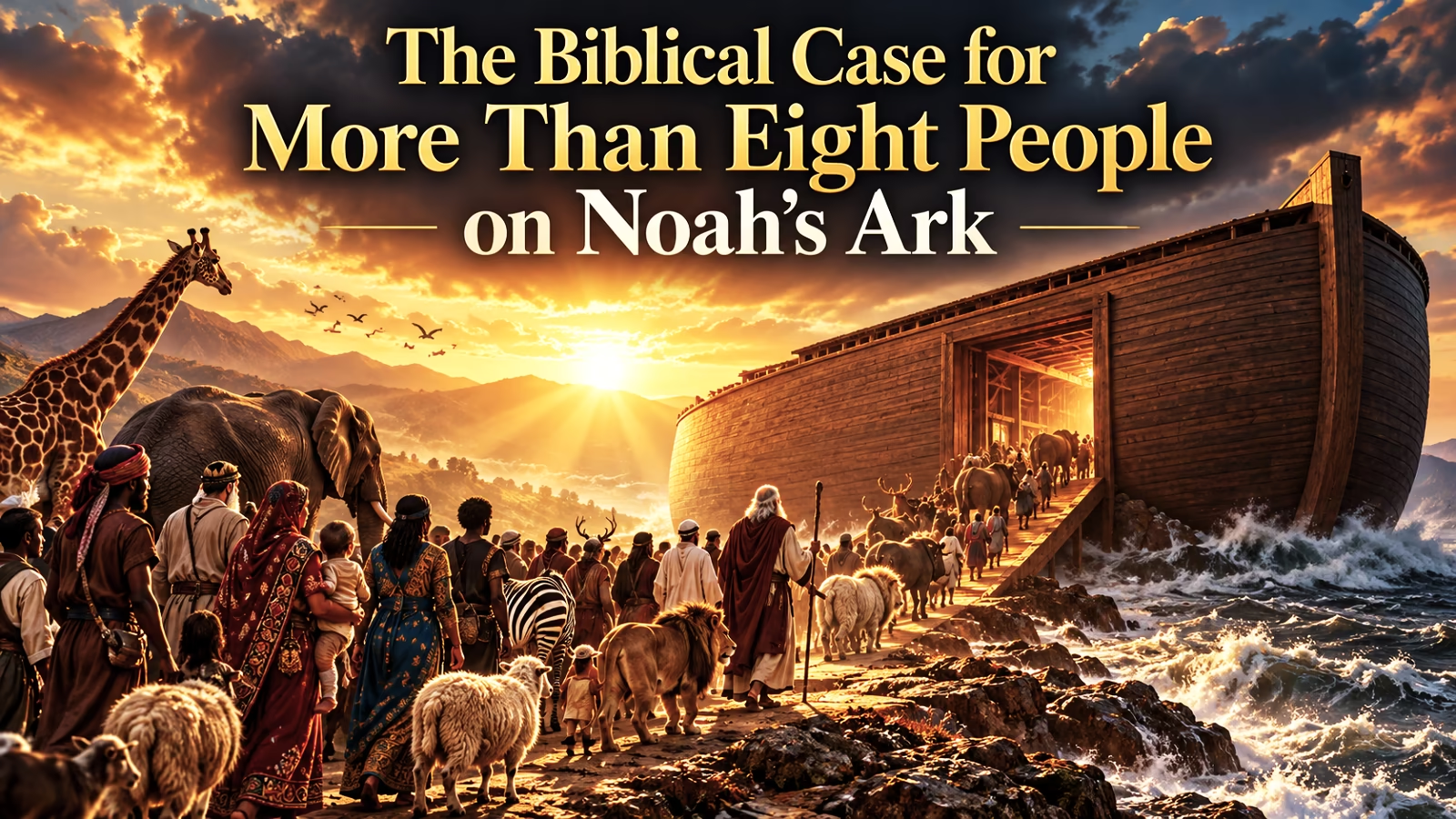
The Biblical Case for More Than Eight People on Noah’s Ark
Most Christians have been taught that only eight human beings were aboard Noah’s Ark: Noah, his wife, his three sons, and their wives. Scripture unquestionably names and follows those eight people because they belong to the Adamic family through which the promised Seed would eventually come.
Genesis, however, had already introduced another human population before Noah was ever born.
Day Six humanity was created by God as the same human kind established in Adam, but Scripture does not derive them biologically from Adam. They were commissioned to multiply and fill the earth, becoming the nations that continue through the biblical story and remain present when New Jerusalem descends.
That creates an unavoidable question at the Flood.
Day Six humanity was living human flesh. The Flood destroyed all living flesh outside the Ark, yet the nations continue afterward.
Genesis itself tells us where they were preserved:
They belonged to the “all flesh” that passed through the Flood aboard the Ark.
The Question Begins Before Day Six
The Ark cannot be understood correctly if we begin with Noah.
We have to begin with the creation week itself.
Genesis 2 reaches back into that week and reveals something Genesis 1 does not describe in the ordinary sequence of the numbered days: the unique formation of Adam.
Before vegetation had appeared, God personally formed Adam from the dust of the ground.
“Then the LORD God formed the man of dust from the ground and breathed into his nostrils the breath of life, and the man became a living creature.”
Genesis 2:7
Genesis 2:5 specifically places this before the plants of the field had sprung up. That places Adam’s formation between Day 2 and the vegetation of Day 3.
Adam therefore cannot be the male created with the female humanity of Day Six.
He is already present.
God then establishes the Garden and places the man whom He had formed within it.
“And the LORD God planted a garden in Eden, in the east, and there he put the man whom he had formed.”
Genesis 2:8
This Garden is far more than beautiful geography.
It functions as God’s earthly governmental center—the place from which His order, life, and purpose are expressed toward the earth. Adam is placed there in direct relationship with God and with the Tree of Life.
The Tree of Life is therefore not incidental scenery.
It points to Christ as Life and establishes a pattern that stretches from Genesis to Revelation. Paradise, God’s dwelling, His government, His chosen man, and the Tree of Life appear together at the beginning and reappear together at the completion of Scripture.
The Garden is thus part of an eternal architecture, not an abandoned experiment.
Genesis begins with Paradise and the Tree of Life.
Revelation ends with Paradise restored in fullness and the Tree of Life standing in New Jerusalem.
Adam Occupies a Unique Position
Adam is the first man.
He is formed directly from the dust, receives the breath of life from God, and is placed within God’s earthly governmental center.
Eve is then formed directly from Adam.
“This at last is bone of my bones and flesh of my flesh.”
Genesis 2:23
Scripture goes out of its way to tell us where Eve’s flesh came from.
That matters.
The relationship between Adam and Eve is biological and explicit. Eve is physically derived from Adam and brought to him as the corresponding woman.
Nothing comparable is ever said about the male and female humanity later created on Day Six.
Day Six Introduces Another Human Population
Genesis 1 later records the creation of humanity on the sixth day.
“So God created man in his own image, in the image of God he created him; male and female he created them.”
Genesis 1:27
The wording is remarkable.
God first speaks of humanity collectively in the singular:
“He created him.”
Then the same humanity is expressed as:
“male and female he created them.”
The singular “him” therefore does not require a solitary individual. Genesis itself uses singular language for humanity collectively and immediately explains that humanity as male and female.
Their commission is also distinct from Adam’s placement within Paradise.
“And God blessed them. And God said to them, ‘Be fruitful and multiply and fill the earth and subdue it.’”
Genesis 1:28
Adam is placed within God’s governmental center.
Day Six humanity is commissioned outward toward the earth.
They are created male and female and commanded to multiply throughout the world.
One Human Kind, but Not One Biological Family
Genesis calls the Day Six population adam—humanity.
They are not another species or another kind of creature. They belong to the same human kind first established in Adam and are likewise made in the image of God.
But Scripture never says they were physically produced from Adam.
It never says they came from Adam’s body.
It never says they came from Adam’s reproductive seed.
It never says they came from Eve’s womb.
That silence is especially important because Scripture was perfectly capable of giving such information when it wished to do so.
It told us exactly where Eve came from.
No comparable biological statement is made concerning Day Six humanity.
Adam is therefore the first and originating man of the human kind. Day Six humanity is later created by God as that same human kind without being Adam’s direct biological family.
They belong to Adam by kind, not by bloodline.
Day Six Humanity Was Created to Become the Nations
The commission given to Day Six humanity explains their continuing place in Scripture.
They were told to multiply and fill the earth.
That is exactly what the nations do.
Unlike the Adamic line, Scripture does not give generation-by-generation genealogies for this wider humanity.
There is a reason.
The Bible is following another physical line for a specific purpose.
It is following the Seed through whom Christ will come.
That line proceeds through:
- Adam
- Seth
- Noah
- Abraham
- Isaac
- Jacob
- Judah
- David
- Jesus Christ
The nations remain present across the earth, but Scripture normally brings them into the narrative when they intersect with God’s movement through the royal line.
The Bible is following the King.
It is not attempting to provide a continuous family history of every nation on earth.
Cain Encounters Humanity Outside Adam’s Immediate Family
Genesis 4 gives the first historical picture of Adam’s family encountering the wider human population.
After Cain murders Abel, he immediately fears the people he expects to encounter outside the presence of God.
“And whoever finds me will kill me.”
Genesis 4:14
God responds by giving Cain a sign so that whoever encounters him will not kill him.
Cain then leaves the presence of the LORD and goes to the land of Nod.
“Then Cain went away from the presence of the LORD and settled in the land of Nod, east of Eden. Cain knew his wife, and she conceived and bore Enoch. When he built a city, he called the name of the city after the name of his son, Enoch.”
Genesis 4:16–17
Cain enters a populated world beyond his immediate household.
He has a wife, establishes a household, and builds a city.
This fits naturally with Genesis 1. Day Six humanity had already been commanded to multiply and fill the earth.
Their existence does not begin with Cain.
Cain encounters humanity God had already created.
Sin Entered the Human Kind Through Adam
Day Six humanity was not part of Adam’s direct biological family, but they belonged to the same human kind.
That distinction explains why Adam’s fall affects them.
Paul does not teach that sin entered humanity through Adam’s biological reproductive seed. He says that sin entered through one man.
“Therefore, just as sin came into the world through one man, and death through sin...”
Romans 5:12
Adam is the first man and representative head of the human kind.
When Adam falls, the human order falls under sin and death with him.
Day Six humanity therefore becomes part of fallen humanity without needing to be physically descended from Adam.
They belong to the same human kind.
Noah Is Traced Directly Back to Adam
Genesis 5 deliberately traces Adam’s physical family down to Noah.
Noah is not introduced as an undefined representative of every human population. He belongs to the specific Adamic genealogy Scripture has been following.
That physical line matters because the promised Seed must continue through it.
After Noah, Scripture will narrow that line still further through Abraham, Isaac, Jacob, Judah, David, and finally Jesus Christ.
Noah’s family therefore occupies a unique place aboard the Ark.
Noah, his wife, his three sons, and their wives form the eight-member household Scripture specifically names and follows.
They carry the Adamic royal line through the Flood.
The Eight Belong to the Traced Royal Family
Peter later refers to these eight people when speaking about the days of Noah.
“A few, that is, eight persons, were brought safely through water.”
1 Peter 3:20
These are the eight people Genesis has specifically identified within Noah’s household.
Their importance is not accidental.
The Bible has already begun tracing the physical line through which Jesus Christ will eventually enter the world.
Noah belongs to Adam.
His sons belong to Adam.
The family Scripture names aboard the Ark therefore belongs to the Adamic bloodline.
Day Six humanity does not.
They belong to the same human kind, but Genesis never places them within Adam’s physical genealogy.
That distinction remains intact at the Flood.
The Flood Returns to Creation Language
The Flood narrative now begins using language that reaches directly back into Genesis 1.
God announces:
“For behold, I will bring a flood of waters upon the earth to destroy all flesh in which is the breath of life under heaven.”
Genesis 6:17
Day Six humanity belongs unquestionably within that description.
They are living human beings.
They are flesh.
They possess the breath of life.
They are made in God’s image.
They therefore cannot be removed from the category God Himself calls “all flesh.”
God Commands the Preservation of “All Flesh”
Immediately after announcing the destruction of all flesh, God tells Noah what must be carried through the judgment.
“And of every living thing of all flesh, you shall bring two of every sort into the ark to keep them alive with you.”
Genesis 6:19
The preservation corresponds to the judgment.
Living flesh is going to die.
Living flesh must therefore be preserved.
Genesis does not redefine the category when the Ark is filled.
Creation Enters the Ark
Genesis 7 describes the living creation entering the vessel.
The text moves through the created order:
- beasts according to their kinds,
- livestock according to their kinds,
- creeping things according to their kinds,
- birds according to their kinds,
- and finally all flesh possessing the breath of life.
“And they went into the ark with Noah, two and two of all flesh in which there was the breath of life.”
Genesis 7:15
Notice that Noah is already the reference point.
The living creation comes into the Ark with Noah.
The next verse then gives one of the most important statements in the Flood narrative.
“And those that entered, male and female of all flesh, went in as God had commanded him. And the LORD shut him in.”
Genesis 7:16
The wording deserves to be read beside Genesis 1:27.
Genesis 1:27 and Genesis 7:16
Genesis 1:27 says:
“In the image of God he created him; male and female he created them.”
Genesis 7:16 says:
“Male and female of all flesh went in as God had commanded him. And the LORD shut him in.”
The verbal relationship is striking.
Genesis 1 has already established a pattern in which singular “him” can represent created humanity collectively, while that humanity is simultaneously expressed as male and female.
Genesis 7 returns to the same vocabulary at precisely the moment the created order passes through judgment.
The animal creation has already been identified according to its kinds.
Noah’s Adamic household has already been individually named.
Then comes the final creation language:
male and female of all flesh.
That category cannot exclude the male and female humanity God created on Day Six.
They are part of “all flesh.”
They possess the breath of life.
They were created male and female.
They therefore belong within the very language Genesis uses to describe what entered the Ark.
Why “Male and Female of All Flesh” Matters
Genesis 7:16 is not merely another statement about animals.
The animals have already been repeatedly identified according to their kinds.
The narrative has moved from:
the named Adamic household
to
the created kinds
to
all flesh possessing the breath of life
and finally to
male and female of all flesh.
That progression mirrors the architecture of creation itself.
God is carrying His created order through judgment.
The wording does not erase Day Six humanity.
It provides the place where they pass through.
Day Six Humanity Could Not Have Survived Outside the Ark
Genesis leaves no surviving population somewhere beyond the Flood waters.
“All flesh died that moved on the earth.”
Genesis 7:21
The next verse makes the scope still clearer.
“Everything on the dry land in whose nostrils was the breath of life died.”
Genesis 7:22
Day Six humanity could not have survived in another location.
If they passed through the Flood, they passed through it aboard the Ark.
There is no other scriptural location for their preservation.
The Nations Cannot Come From Noah’s Bloodline
This is where the distinction established in Genesis 1 and 2 becomes decisive.
Noah’s genealogy reaches directly back to Adam.
If the nations after the Flood originated biologically from Noah’s family, then those nations would also belong biologically to Adam’s family.
Day Six humanity would cease to exist.
The population God created male and female on Day Six would have been completely destroyed, while Noah’s Adamic descendants later took their place.
Scripture records no such replacement.
It records no second creation of humanity after the Flood.
It never says that the identity and function of Day Six humanity were transferred to Noah’s biological descendants.
The nations simply continue.
The Flood Preserves Rather Than Replaces God’s Creation
God does not use the Ark to abolish His original created order.
The Ark carries creation through judgment.
That is why the living creatures are preserved according to the identities established in creation.
The Flood judges the corrupted world without requiring God to begin again with an improvised substitute creation.
The same principle applies to humanity.
The Adamic royal line must survive because Christ will come through it.
Day Six humanity must survive because it belongs to the human creation God established to fill the earth.
Both purposes continue after the Flood.
Nothing in God’s Original Purpose Is Lost
This continuity matters enormously.
God called His original creation very good.
“And God saw everything that he had made, and behold, it was very good.”
Genesis 1:31
The fall corrupted what God made.
The Flood judged that corruption.
But judgment is not the same thing as God surrendering part of His original purpose.
If Day Six humanity vanished permanently at the Flood, then an entire human population deliberately created by God to fill the earth would have been erased from the biblical story.
Something else would then have to replace it.
But Scripture never describes such an improvisation.
Instead, God preserves His creation through judgment and brings His purpose forward toward Christ.
Scripture Continues Following the Royal Line
After the Flood, the Bible does exactly what it had been doing before it.
It follows the Seed.
The narrative moves from Noah toward Abraham.
Then from Abraham to Isaac.
From Isaac to Jacob.
From Jacob to Judah.
From Judah toward David.
And from David toward Jesus Christ.
The nations remain across the earth, but their ordinary genealogies are not the subject of Scripture.
They come into view when they encounter the people through whom God is moving His purpose.
That pattern explains why Noah’s family receives the narrative attention aboard the Ark.
The King is coming through them.
The Nations Continue After the Flood
The nations do not emerge as an entirely new divine creation following Noah.
They continue filling the earth.
Genesis 10 describes peoples, lands, languages, families, and nations spreading across the world.
From that point forward, Scripture assumes a populated earth containing many distinct nations.
The biblical narrative then follows God’s specific movement through the line of Abraham while those nations remain surrounding it.
Their existence continues exactly where the original Day Six commission pointed:
Fill the earth.
God Never Lost Ownership of the Nations
The nations were not outside God’s purpose merely because Scripture did not follow their genealogies.
God created them.
They belong to Him.
When Israel is later separated for God’s specific purpose, the LORD declares:
“For all the earth is mine.”
Exodus 19:5
Israel has a special calling, but the rest of the earth has not ceased belonging to God.
The nations remain His creation.
Their differing role in the biblical narrative does not make them less human or less accountable to their Creator.
Christ Comes Through the Adamic Royal Line
The physical Seed does not arise from the nations.
Christ comes through the genealogy Scripture has painstakingly protected.
The line moves through Adam.
Then Noah.
Then Abraham.
Then Judah.
Then David.
Finally, Jesus Christ enters the world.
This explains why Scripture spends so much time preserving and documenting one physical family while saying comparatively little about enormous populations elsewhere.
God is bringing His Son into the creation.
The genealogy must remain identifiable because the promised Seed must arrive exactly as God declared.
The Cross Reaches the Entire Fallen Human Creation
Once Christ has come, the narrowing of the physical Seed line has accomplished its purpose.
The Son has entered the world.
He dies.
He rises.
He ascends.
Then the gospel goes outward to the nations.
“Go therefore and make disciples of all nations.”
Matthew 28:19
The nations do not suddenly become important because God has invented a new purpose for them.
They were His creation from the beginning.
The cross reaches what the fall had brought under death.
Christ Recovers What God Created
The fall did not cause God to abandon His original design.
Christ comes to recover God’s purpose within the creation that fell.
If Day Six humanity had been annihilated at the Flood, then the nations receiving the gospel would no longer be that original human population.
They would be descendants of Noah’s Adamic family occupying a role once given to someone else.
The original Day Six human creation would remain permanently extinct.
But Scripture does not tell the story of God losing part of His creation and substituting something different.
It tells the story of redemption.
The Nations Are Present in the Age of Grace
After the resurrection and ascension of Christ, the gospel rapidly moves beyond Israel.
The nations receive Christ without needing a new biological genealogy.
They do not become descendants of Abraham, Judah, or David according to the flesh.
They need redemption in Christ.
Their place in the human creation remains what it always was.
What changes is their relationship to God through the finished work of His Son.
The Nations Remain in the Kingdom
The prophets repeatedly describe nations continuing upon the earth under the righteous rule of the Messiah.
Christ rules.
The nations come before Him.
Kings submit to His authority.
Humanity is not collapsed into one indistinguishable biological family.
The nations remain nations under the government of the King.
The distinction visible near the beginning of Genesis therefore continues into the Kingdom.
Revelation Shows the Nations Still Present
The final book of Scripture removes any possibility that the nations were merely a temporary historical category.
John sees an enormous redeemed multitude.
“A great multitude that no one could number, from every nation, from all tribes and peoples and languages.”
Revelation 7:9
Nation.
Tribe.
People.
Language.
The diversity of humanity remains visible within God’s redemptive purpose.
The nations that filled the earth remain part of the story.
New Jerusalem Completes the Architecture of Genesis
Revelation 21 and 22 return us to the architecture established at the beginning.
In Genesis, God establishes Paradise as His earthly governmental center.
The Tree of Life stands there.
The chosen man is placed there.
Humanity fills the surrounding earth.
At the end of Scripture, that architecture reaches perfection.
God’s dwelling stands at the center.
The Tree of Life appears again.
Royal and priestly government is fully established.
And the nations remain upon the earth.
“By its light will the nations walk, and the kings of the earth will bring their glory into it.”
Revelation 21:24
The nations walk in the light of the city.
Their kings bring their glory into it.
They are not erased.
They are not absorbed into an improvised replacement humanity.
They remain nations within God’s completed order.
The Tree of Life Confirms the Continuity
Revelation then returns unmistakably to the beginning.
“The leaves of the tree were for the healing of the nations.”
Revelation 22:2
The Tree of Life that stood within Paradise appears again in the completed dwelling of God.
And the nations are still there.
That detail carries enormous weight.
The same fundamental architecture stands at both ends of Scripture:
- God’s dwelling
- God’s government
- the Tree of Life
- royal humanity
- the nations
The beginning and ending agree.
New Jerusalem Is Completion, Not Improvisation
New Jerusalem is not God repairing a failed plan with whatever remained.
It is the completed perfection of what He purposed from the beginning.
Nothing essential to that original purpose has to be invented later.
What God created is judged where corrupted.
It is preserved according to His purpose.
It is recovered through Christ.
And it is brought to completion under the government of God.
That is why the nations must remain part of the story.
They were present when God established the human order.
They are present when that order reaches perfection.
The Nations Cannot Vanish at the Flood
Put the entire biblical sequence together.
Before the Flood:
- Adam has already been formed and placed within God’s Paradise.
- Day Six humanity exists later as male and female.
- They are the same human kind as Adam.
- They are not identified as Adam’s biological family.
- They are commanded to fill the earth.
- Cain encounters humanity beyond his immediate household.
At the Flood:
- Noah’s Adamic household is specifically named.
- The animal creation enters according to its kinds.
- God judges all living flesh.
- Day Six humanity is living human flesh.
- “All flesh” possessing the breath of life enters.
- “Male and female of all flesh” enter.
- God seals the Ark.
After the Flood:
- the nations continue,
- the gospel reaches the nations,
- the nations remain in the Kingdom,
- and the nations remain in the New Jerusalem order.
There is no point in that sequence where God creates another human population to replace Day Six humanity.
Therefore Day Six humanity cannot disappear at the Flood.
Human Diversity Fits the Original Commission
The remarkable diversity within humanity also fits this biblical architecture.
Human beings are one human kind, yet that kind contains enormous physical diversity across the earth.
Skin tones, facial characteristics, body structures, geographic adaptations, and countless population differences all exist within one human kind.
That diversity does not establish the biblical case.
Genesis does.
But it fits naturally with humanity created from the beginning with the capacity to multiply and inhabit the breadth of the earth.
The nations were not an unexpected development.
Filling the earth was their original commission.
Two Human Lines, One Human Kind
The distinction can be stated clearly without creating two humanities.
The Adamic Royal Line
Adam is the first man and head of the human kind.
He is formed before Day Six and placed within God’s Paradise, the earthly center of divine government.
His biological family is specifically traced through Noah and eventually through Abraham, Judah, David, and Jesus Christ.
This is the line of the promised Seed.
Day Six Humanity
Day Six humanity is created later as the same human kind but is not physically derived from Adam in the text.
They are introduced collectively as humanity, male and female.
They are commanded to multiply and fill the earth and continue throughout Scripture as the nations.
They share the human kind.
They do not share Adam’s traced biological genealogy.
That is why the two lines can remain distinct without becoming two different species or two different kinds of humanity.
The Ark Carries Both Through Judgment
The Ark stands at the center of the continuity.
The Adamic royal family must pass through because Christ will come through that line.
The Day Six nations must pass through because they are living flesh belonging to God’s original human creation and because they continue afterward.
Genesis gives us the category broad enough to contain them:
all flesh in which is the breath of life.
Then Genesis gives the creation-language expression that most directly identifies them:
male and female of all flesh.
The eight named people belong to the family Scripture is tracing.
Day Six humanity belongs within the broader human creation God preserves.
More Than Eight Human Beings Were on the Ark
The complete biblical sequence therefore leads to a clear conclusion.
Noah’s eight-member family was aboard the Ark.
They belonged to Adam’s physical genealogy and carried forward the royal line through which Christ would come.
Day Six humanity did not originate from Noah.
They existed before Noah.
They were not introduced as Adam’s biological descendants.
They were living human flesh.
They possessed the breath of life.
They had been created male and female.
They could not survive outside the Ark.
They were not recreated after the Flood.
And they remain identifiable as the nations throughout the remainder of Scripture and into New Jerusalem.
Therefore they had to pass through the Flood aboard the Ark as part of the “all flesh” God preserved.
The eight named members of Noah’s household were not the totality of humanity aboard the vessel.
They were the specifically tracked royal family.
The Bible Is Following the King
Once this is understood, the Bible’s selective attention makes complete sense.
Scripture never claims to record everything happening among every people on earth.
It follows God’s movement toward Christ.
The nations enter the story when they encounter that movement.
Egypt matters when the royal line enters Egypt.
Canaan matters when Abraham and Israel enter the promised land.
Babylon matters when Judah is carried away.
Rome matters when Christ enters the world and the gospel begins moving through the nations.
The nations are always there.
The narrative follows the King.
From Paradise to New Jerusalem, the Thread Remains Unbroken
Genesis begins with God establishing His earthly governmental center.
Adam is placed there.
The Tree of Life stands there.
Then humanity is created male and female and commissioned to fill the earth.
The fall corrupts the human kind.
The Flood judges the corrupted world while preserving God’s creation.
The Adamic royal line passes through Noah and continues toward Christ.
Day Six humanity passes through the same judgment as part of the male and female of all flesh God preserves.
Christ comes through the royal line.
At the cross, He accomplishes redemption for the fallen human creation.
The gospel then goes to the nations, and God’s children are gathered into Christ.
The marriage of the Lamb has come, and His Bride has made herself ready.
Christ establishes His Kingdom, and the nations remain under His rule.
The Tree of Life appears again as Paradise is restored under the government of Christ.
Finally, New Jerusalem descends.
God’s governmental center is fully manifested.
The Tree of Life remains at the center of God’s completed order, and the nations walk in the light of His dwelling.
Nothing essential has been substituted.
Nothing God purposed in the beginning has simply vanished from the story.
Paradise reaches completion.
The Tree of Life remains.
The Bride remains with the Lamb.
The nations remain.
The beginning and the ending agree.
The eight named members of Noah’s family carried the Seed.
Day Six humanity continued as the nations.
Both passed through the Ark.
And both ultimately stand beneath the victory and authority of Jesus Christ.
The thread never breaks.