
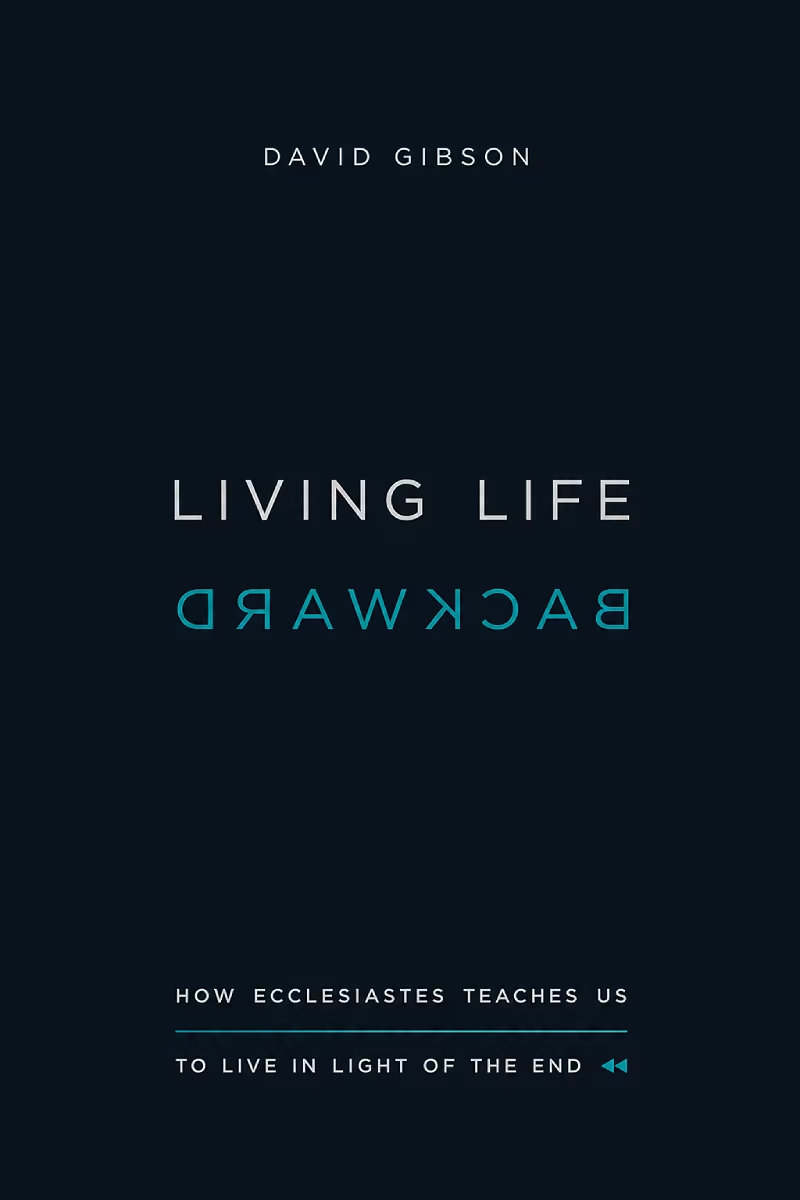
Living Life Backward
Death is the horizon Ecclesiastes uses to teach us how to live. David Gibson shows how accepting life’s brevity, limits, uncertainty, work, pleasures, and lack of control frees us to receive ordinary life as God’s gift and live with wisdom, contentment, generosity, and the fear of God rather than chasing achievements or security that cannot last.
Available Instantly
About This Book
Living Life Backward is David Gibson’s chapter-by-chapter exposition of Ecclesiastes built around one governing reversal: the certainty of death should teach us how to live now. Rather than treating Ecclesiastes as a book of despair or meaninglessness, Gibson reads it as wisdom for people who are finite, unable to control the future, and tempted to build life around achievements that cannot last. The end of life becomes a lens for ordering present priorities, desires, work, pleasure, relationships, and expectations.
Gibson takes Ecclesiastes’ recurring language of “vanity” or hebel seriously as a description of life’s brevity, elusiveness, and inability to yield permanent gain. The Preacher keeps exposing the illusion that human beings can master life, secure the future, or create lasting significance through work, status, possessions, pleasure, or knowledge. Death levels these ambitions because everything “under the sun” is temporary. For Gibson, however, this realism is meant to free the reader rather than produce nihilism.
The positive side of the book is receiving life as God’s gift rather than treating it as a project of gain and control. Food, drink, work, relationships, time, and ordinary pleasures can be enjoyed because they are gifts from God, not because they can guarantee permanence. Gibson repeatedly contrasts worshiping created gifts with receiving them gratefully from the Giver. Contentment grows when a person stops demanding that temporary things provide ultimate security and instead accepts both their goodness and their limits.
Human limitation is therefore a major spiritual lesson. Ecclesiastes teaches that much of life is outside our control: we do not know what tomorrow will bring, cannot determine every outcome of our labor, and cannot escape death. Gibson applies this directly to modern habits of planning, upward mobility, career ambition, and the assumption that every problem can be fixed or managed. Wisdom means recognizing creaturely limits without passivity, working faithfully without pretending work can save us, and making decisions in light of realities we cannot master.
Time and mortality sharpen the book’s ethical force. Ecclesiastes 3 places human life within times and seasons God does not place under human command. Ecclesiastes 7 uses the house of mourning to teach wisdom by confronting the living with their end. Ecclesiastes 9 joins the certainty of death with the command to receive and enjoy the life God gives. The conclusion in Ecclesiastes 12 brings the argument to remembering the Creator and fearing God. Gibson’s “living backward” summarizes this movement: start from the fact that you will die, then work backward into today so that the end reshapes what counts as the good life.
The book therefore addresses practical questions that often sound more contemporary than theological. What should I do when life feels random or out of control? How much of my identity should come from career success? Why do achievement and possessions fail to satisfy for long? How can I enjoy ordinary pleasures without turning them into idols? How should the certainty of death change my priorities? What does contentment look like when I cannot control outcomes? Gibson’s answer is neither withdrawal nor frantic self-improvement. It is a wiser, freer, more generous life before God.
Because the book follows Ecclesiastes rather than merely borrowing its themes, it is also a genuine study of that biblical book. Readers encounter its argument about hebel, time, work, wisdom, pleasure, uncertainty, death, enjoyment, and the fear of God as a connected whole. Living Life Backward is therefore strongest for searches on Ecclesiastes, mortality and death, biblical wisdom, Christian living in light of eternity, human limitations, contentment, work, ambition, time, and receiving life as God’s gift.
Book Details

Reading Fit
STUDY LEVEL
Fundamental, Intermediate
STUDY SCOPE
Individual Book, Old Testament
BOOKS INCLUDED

Edition & Format
PUBLISHED
July 14, 2017
AVAILABLE FORMATS
paperback, kindle, audiobook
LENGTH
178 pages
· 5h 9m audio

Topics Covered
You Might Also Like