
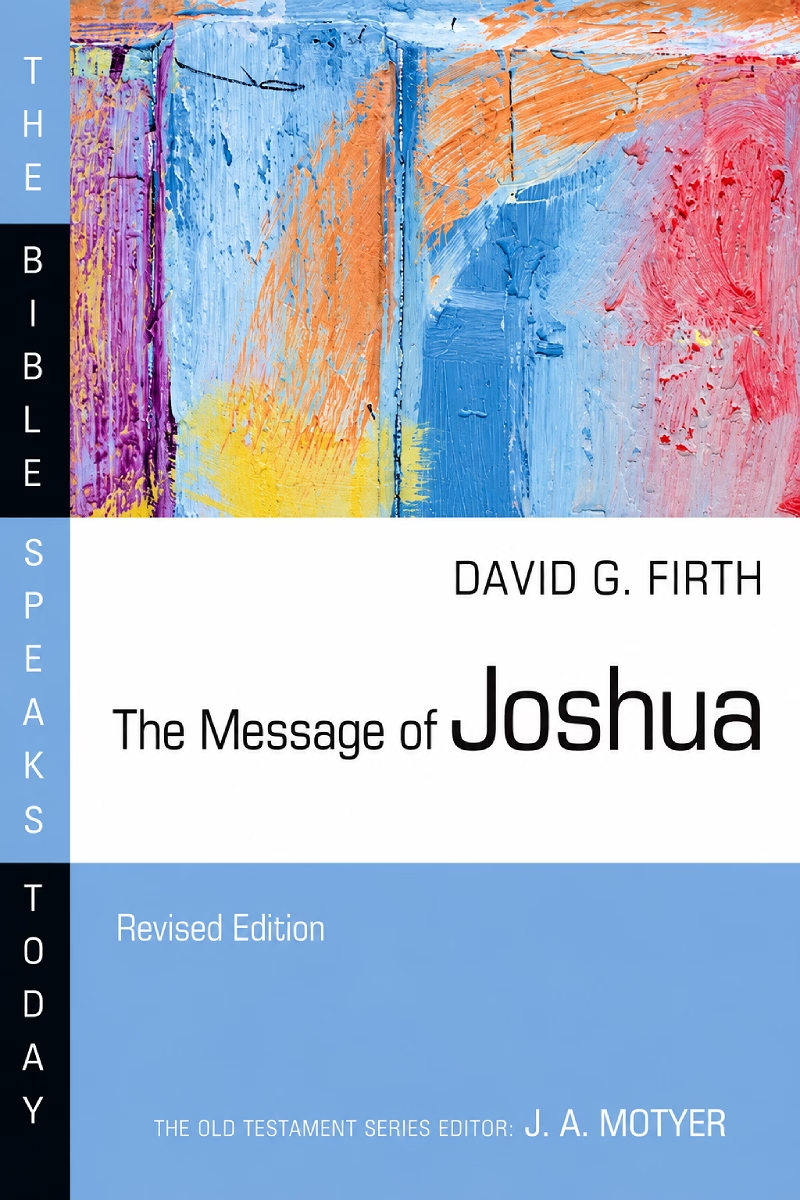
The Message of Joshua
David G. Firth reads Joshua as the story of God’s promise, God’s land, and a people called to faithful participation in his mission. Moving through conquest, allotment, covenant, and renewal, he faces the book’s violence directly while showing how Rahab, Gibeon, Israel’s obedience, and God’s faithfulness reshape questions of belonging, judgment, and promise.
Available Instantly
About This Book
David G. Firth’s The Message of Joshua is a sustained exposition of the whole book of Joshua that reads Israel’s entry into Canaan as part of God’s mission, God’s promise, and God’s claim over the land. Firth addresses the issue that makes Joshua especially difficult for many modern readers—the conquest and its violence—while refusing to let that problem eclipse the book’s larger theological message. His central argument is that the land belongs to Yahweh, not inherently to Canaanites or Israelites, and that Israel receives it as God’s gift within his purpose.
Joshua 1 establishes the controlling relationship between divine promise and human response. God takes the initiative in giving the land and commissioning Joshua, but courage is expressed through faithful obedience to God’s instruction. Firth emphasizes that being “strong and courageous” is not chiefly military bravado; it means allowing life and leadership to be shaped by the Torah. The book repeatedly returns to this relation between God’s faithful action and Israel’s obligation to trust and obey.
The narratives of Rahab in Joshua 2 and the Gibeonites in Joshua 9 are especially important to Firth’s account of who belongs among God’s people. These stories show that the boundaries in Joshua are not reducible to ethnicity. Those who acknowledge Yahweh and align themselves with his purpose can be included, while those who set themselves against him face judgment. Firth therefore interprets Joshua within the larger biblical theme of God’s mission: inclusion and exclusion turn on response to God rather than on racial identity alone.
The crossing of the Jordan in Joshua 3–4, the memorial stones, circumcision and Passover in Joshua 5, and the fall of Jericho in Joshua 5:13–6:27 develop themes of remembrance, consecration, divine initiative, and trust. The defeat at Ai in Joshua 7–8 shows that Israel cannot presume upon God’s presence while tolerating disobedience. Covenant obedience matters because the conquest is not an autonomous national project; it is carried out under God’s command and subject to God’s judgment.
Firth also gives sustained attention to the difficult warfare narratives of Joshua 6–12. He directly engages the moral question of whether the violence of Joshua is inconsistent with the gospel of Jesus Christ. His treatment frames the conquest in terms of Yahweh’s ownership, judgment, and mission rather than as unrestricted human violence. This makes the volume especially relevant to readers troubled by Old Testament warfare or asking how Christians should understand the conquest of Canaan.
The land-allotment chapters in Joshua 13–21 are not treated as disposable lists. They show Israel learning to live within the promise God had made, and they culminate in the affirmation that the Lord had fulfilled what he promised. Cities of refuge, the Levites’ inheritance, and the distribution of territory all contribute to the practical shape of life in the land. Joshua 22 then explores the challenge of maintaining the unity of God’s people across geographical divisions.
The closing chapters intensify the call to covenant faithfulness. Joshua 23 warns Israel against compromise and urges continued loyalty to the Lord. Joshua 24 brings the people to renewed confession and decision, placing God’s prior acts of grace before their response. Firth thus connects promise, obedience, memory, worship, and communal identity.
For contemporary readers, the book answers more than “what happened in the conquest?” It asks who truly belongs to God’s people, why obedience matters when God has already given a promise, how divine judgment and mission relate, how Christians should think about difficult Old Testament violence, and what it means to live faithfully in what God gives. Firth ultimately places Joshua within the forward movement of God’s mission that reaches its fullest focus in Jesus Christ, allowing the ancient narrative to speak to Christian faith without flattening its Old Testament setting.
Book Details

Reading Fit
STUDY LEVEL
Intermediate
STUDY SCOPE
Individual Book, Old Testament
BOOKS INCLUDED

Edition & Format
PUBLISHED
February 15, 2022
AVAILABLE FORMATS
paperback, kindle
LENGTH
241 pages

Topics Covered
You Might Also Like