
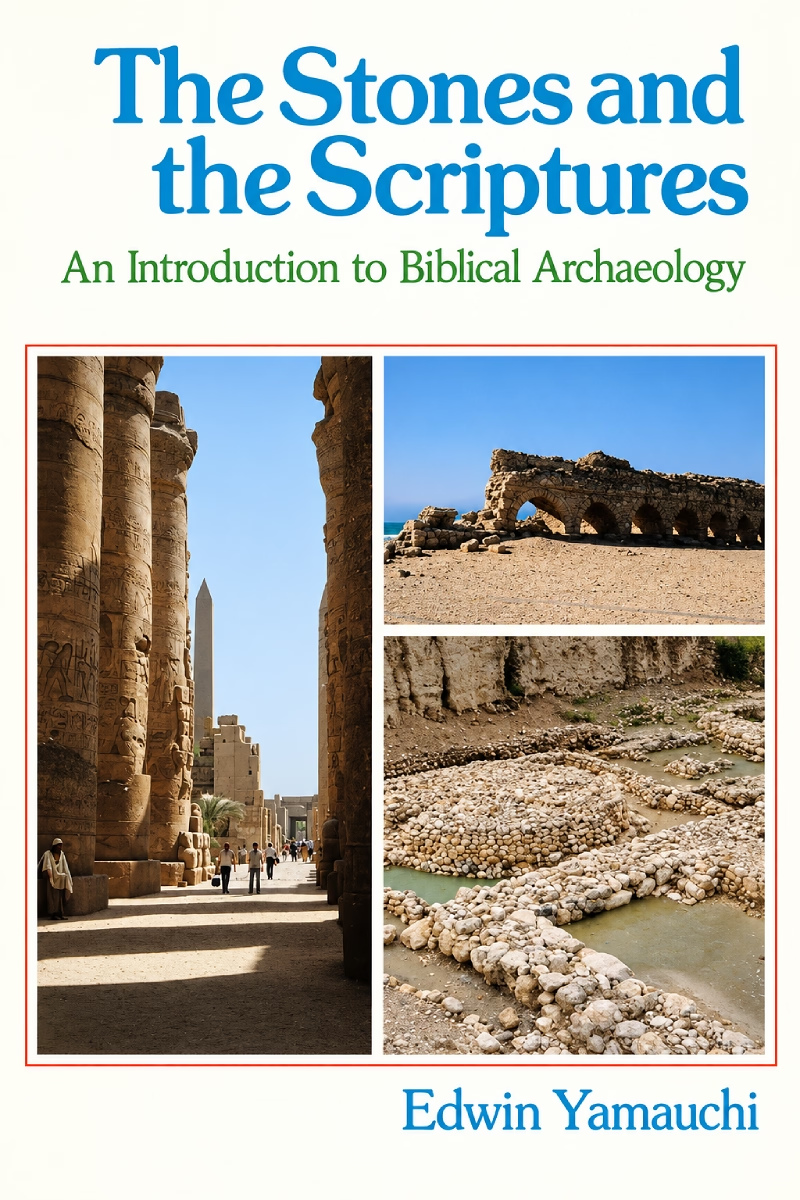
The stones and the Scriptures
Yamauchi surveys what archaeology can and cannot contribute to biblical history. He examines the patriarchal world through Mari, Nuzi, and Alalakh; William Ramsay’s work on Acts and Paul; the Dead Sea Scrolls and Qumran; and the limits of archaeological argument, showing how discoveries illuminate Scripture while requiring careful judgment about evidence and silence.
Available Instantly
About This Book
The Stones and the Scriptures is Edwin M. Yamauchi’s selective study of biblical archaeology and its bearing on the historical claims and cultural setting of Scripture. Rather than presenting a catalog of discoveries, the book organizes its discussion around major case studies from the Old Testament, the New Testament, and the Dead Sea Scrolls, followed by a methodological treatment of what archaeological evidence can and cannot establish. Its governing concern is the relationship between material evidence, ancient texts, historical reconstruction, and the reliability of biblical accounts.
The first major section examines Mari, Nuzi, and Alalakh and the way discoveries from these ancient Near Eastern sites were used to illuminate the Old Testament, especially the patriarchal narratives. Archives and customs from the second millennium BC supplied parallels to social practices known from Genesis, and these discoveries became important in twentieth-century discussions of the historical setting of Abraham and the patriarchs. Yamauchi explains their value while also resisting the assumption that a cultural parallel by itself proves a particular biblical event. This section therefore combines patriarchal archaeology with the broader question of how comparative ancient Near Eastern evidence should be used.
The New Testament section centers on William Ramsay and his encounter with the historical geography of Acts. Ramsay had been influenced by critical approaches associated with the Tübingen school, but sustained work in Asia Minor led him to reassess the historical value of Luke’s geographical and administrative details. Yamauchi uses Ramsay as a case study in the relationship between archaeology, historical geography, Acts, Paul’s travels, and New Testament reliability. The subject is not simply Ramsay’s biography; it is how investigation of real places, routes, titles, and civic settings can test historical claims embedded in a narrative such as Acts.
A third major section turns to Qumran, the Essenes, and the Dead Sea Scrolls. The discoveries near the Dead Sea provide evidence for Jewish life and belief around the time of the New Testament and for the transmission of biblical texts. Yamauchi surveys the Scrolls, the community commonly associated with Qumran, and the significance of the manuscripts for understanding the textual and religious environment of the Bible. This material makes the book relevant to searches concerning the Dead Sea Scrolls, Qumran archaeology, the Essenes, and the preservation and transmission of Old Testament texts.
The final section, concerned with the nature of archaeological evidence, supplies an important methodological control over the earlier examples. Archaeological remains survive unevenly, are interpreted through incomplete data, and often cannot answer the exact historical question a modern reader wishes to ask. Yamauchi distinguishes evidence from inference and warns against treating the absence of surviving evidence as automatic evidence that an event never occurred. This discussion of fragments, gaps, arguments from silence, and the limits of archaeological proof is central to the book’s approach.
Other biblical-historical examples appear in support of these principal case studies. Archaeological questions connected with the Exodus and conquest, the early monarchy, Saul, David, and Solomon, and the historical setting of Jesus and the apostolic period broaden the book’s range without displacing its four major emphases. Across these examples, archaeology is used to reconstruct setting, compare biblical claims with external data, and identify both confirmations and unresolved problems.
The book addresses readers asking whether archaeology proves or disproves the Bible, what Mari and Nuzi contribute to Genesis, why William Ramsay became important in discussions of Acts, what the Dead Sea Scrolls reveal about Scripture, and how much weight should be placed on missing evidence. Its strongest search value lies in biblical archaeology, archaeology and the historical reliability of Scripture, patriarchal archaeology, the archaeology of Acts, Qumran and the Dead Sea Scrolls, and careful interpretation of archaeological evidence.
Book Details

Reading Fit
STUDY LEVEL
Advanced, Intermediate
STUDY SCOPE
New Testament, Old Testament, Topical
BOOKS INCLUDED

Edition & Format
PUBLISHED
January 1, 1973
AVAILABLE FORMATS
paperback, hardcover
LENGTH
190 pages

Topics Covered
You Might Also Like