

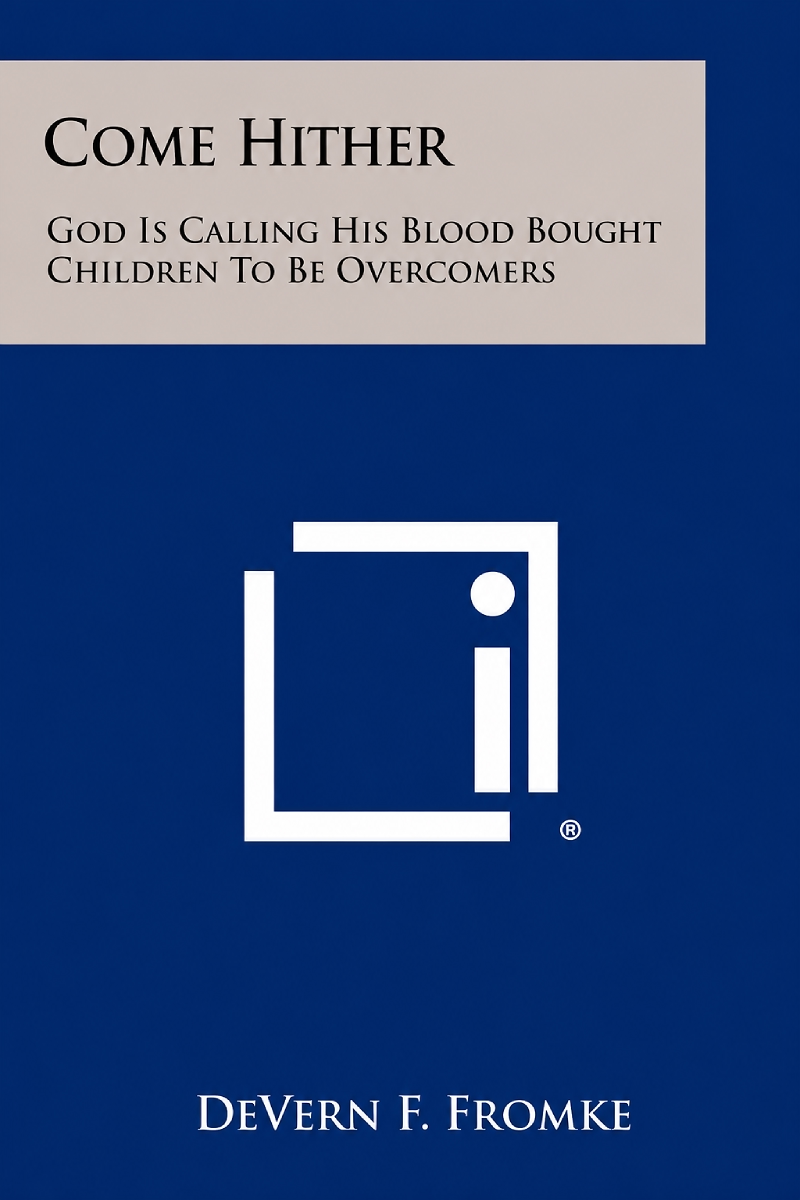
Come Hither
DeVern Fromke calls God’s blood-bought children into the way of the Cross—not merely to seek victory, but to let Christ govern life, service, and motive. Come Hither connects overcoming with identification with Christ, the Holy Spirit’s inward work, obedience, and a God-centered ministry that draws near to the Lord before acting for Him or for others.
Available Instantly
About This Book
Come Hither is DeVern Fromke’s early devotional call to the way of the Cross and to the life of the overcomer. The work arose from the message that marked Fromke’s ministry in the late 1940s: the Cross as the way to victorious Christian living. Its later subtitle, God Is Calling His Blood Bought Children to Be Overcomers, makes clear that the summons is addressed to people who already belong to Christ. The governing question is therefore not how a person earns acceptance with God, but how a redeemed believer actually lives, serves, and overcomes from God’s provision rather than from natural strength.
The Cross of Christ is central in more than a doctrinal sense. Fromke treats the Cross as an inward principle that confronts self-directed life, natural religious energy, personal ambition, and ministry carried on from human resources. In later recollection of this period, he described his discovery of the Cross together with identification with Christ as a decisive change in his life and preaching. The “way of the Cross” means that Christ’s death is not merely something the believer affirms historically; it becomes the pattern by which self-reliance is brought under God’s dealing so that the life of Christ can be expressed.
This gives the book’s language of overcoming its distinctive character. Victory is not presented as a technique for making the natural person stronger. The believer overcomes sin, the world, fear, unbelief, pride, and the claims of self through faith in Jesus Christ and through the Holy Spirit’s working. Christian victory is therefore inseparable from dependence. The Spirit must make the reality of the Cross inwardly effective, and obedience to God replaces action driven by self-will. The book addresses readers frustrated by repeated spiritual defeat, readers trying harder without finding inward victory, and believers who need to understand why the Cross concerns daily Christian living as well as forgiveness.
Come Hither also reaches beyond private victory into the motive and source of Christian service. Fromke later stated explicitly that principles he had learned about ministry “to the Lord” rather than merely ministry “to the house” were written in Come Hither. Using the pattern of Ezekiel 44, he distinguishes activity that meets religious needs from service that first draws near to God, stands before Him, and awaits His will. A person can be busy in good Christian work and still be governed by natural preference, ambition, visible results, or the needs of people rather than by God Himself.
That distinction gives the book important reader-intent value for questions about ministry burnout, fruitless religious activity, and the difference between working for God and serving from communion with God. Fromke’s concern is not to make believers indifferent to people. It is to establish the source and direction of service. Drawing near to the Lord, waiting for His direction, and submitting good intentions to His will protect ministry from presumption and make obedience more important than mere activity or apparent success.
The book’s call to be an overcomer therefore joins several realities that should not be separated. Believers are blood-bought and belong to Christ; the Cross deals with the self-life; identification with Christ relocates confidence from self to Him; the Holy Spirit makes divine reality effective within; faith receives what God has provided; and obedience gives that dependence practical expression. Christian living and Christian service both become questions of source: is the believer acting from natural strength and self-interest, or from Christ under the government of God?
Come Hither is especially relevant to readers asking how to overcome sin and the world, why personal effort so often fails to produce spiritual victory, what it means to take the way of the Cross, how identification with Christ affects daily life, how the Holy Spirit produces inward reality, and how to serve God without allowing ministry itself to replace communion with Him. Fromke’s answer is a summons away from self-generated Christianity toward a Cross-governed, Spirit-dependent, obedient life in which Christ is the believer’s sufficiency and God Himself remains the center.
Book Details

Reading Fit
STUDY LEVEL
Fundamental, Intermediate
STUDY SCOPE
Topical
BOOKS INCLUDED

Edition & Format
PUBLISHED
July 14, 2012
AVAILABLE FORMATS
paperback, hardcover
LENGTH
416 pages

Topics Covered
You Might Also Like