
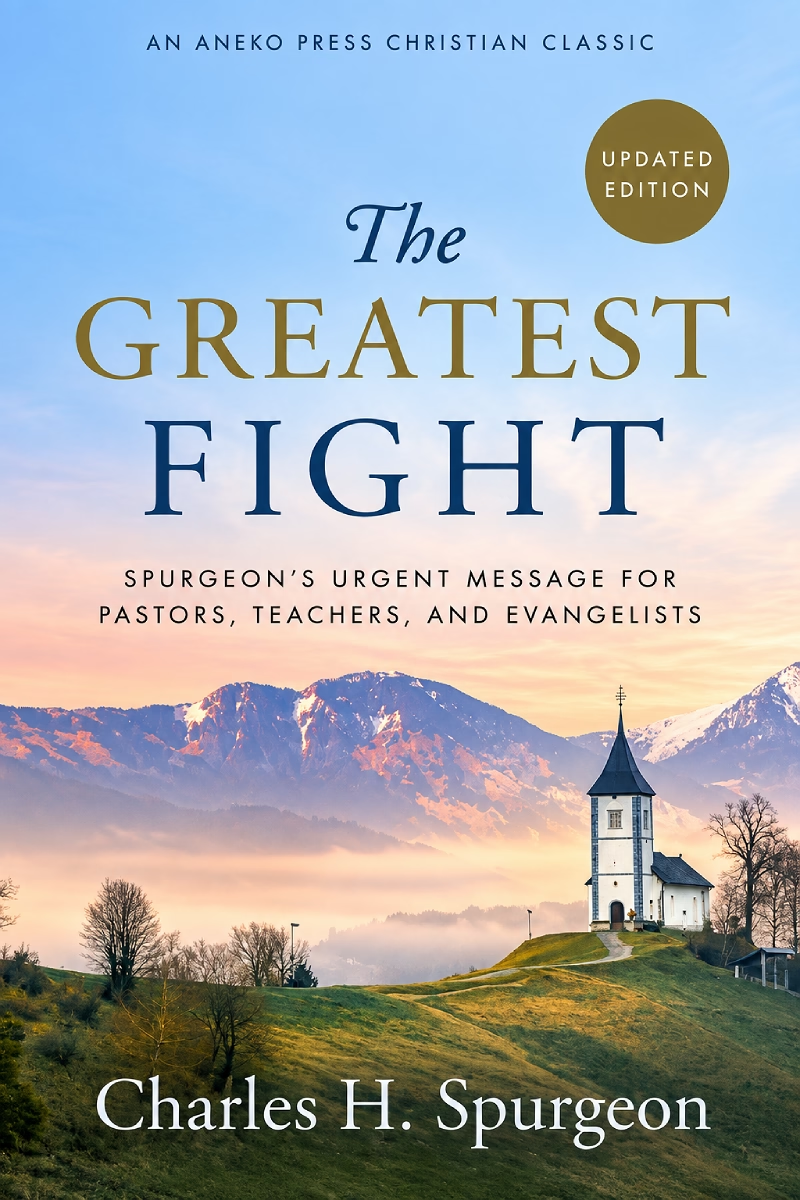
The Greatest Fight
Spurgeon’s final Pastors’ College address calls Christian workers to fight the good fight with three God-given resources: the inspired Scriptures as their armory, the church as their army, and the Holy Spirit as their strength. It is a concentrated appeal for faithful preaching, doctrinal steadfastness, active church service, and practical dependence on the Spirit.
Available Instantly
About This Book
The Greatest Fight is Charles Spurgeon’s final address to the Pastors’ College Conference, delivered in 1891 to ministers and Christian workers under the theme of fighting the good fight of faith. Rather than treating spiritual conflict primarily as a study of demons or occult activity, Spurgeon uses the language of warfare to describe the church’s struggle for “the cause of God and truth,” especially the work of holding, preaching, and living the truth in the face of error and sin. His argument is deliberately organized around three indispensable resources for Christian ministry: the inspired Word as the church’s armory, the church itself as the army, and the Holy Spirit as the strength by which believers serve and overcome.
The largest section, “Our Armoury,” is a sustained defense of Holy Scripture as God’s inspired, authoritative, sufficient, and trustworthy Word. Spurgeon insists that the Bible supplies the minister’s weapons, message, and subjects for preaching. He opposes replacing revelation with human speculation, novelty, or merely attractive speech, and urges preachers to expound the truth God has actually given. The practical question is not simply whether a minister formally affirms inspiration, but whether he relies on Scripture in the actual work of preaching. This makes the book especially relevant to readers asking what should govern Christian ministry, why biblical preaching matters, and how a Christian worker can remain doctrinally faithful when religious opinion changes.
In “Our Army,” Spurgeon turns to the church of the living God. The work is not to be carried on by isolated religious professionals but through the people whom God has called to himself. Ministers are to value, teach, organize, encourage, and lead the church rather than despise ordinary believers or imagine that Christian work belongs only to a clerical class. Evangelistic labor, service, perseverance, and cooperation within the church therefore belong to the book’s practical vision of ministry. Spurgeon’s military imagery emphasizes disciplined service under Christ’s command and confidence that God works through his people.
“Our Strength” identifies the Holy Spirit as the power without whom the best biblical weapons and the largest human organization cannot accomplish spiritual work. Spurgeon calls for a real, practical dependence on the Spirit in preaching, service, growth, endurance, prayer, and the overcoming of sin and opposition. The Spirit is not an ornamental doctrine but the divine power by which Christian workers can be, do, suffer, serve, wrestle, and overcome. This emphasis corrects both self-reliant activism and purely intellectual ministry: truth must be wielded in the Spirit’s power.
The book therefore answers a cluster of closely related questions: What resources has God given for Christian ministry? How should pastors and Christian workers confront error without abandoning biblical truth? What place should the church have in ministry? Why is human ability insufficient for spiritual work? How can a servant of Christ persevere without relying on personal strength? Spurgeon’s answer joins Scripture, the church, and the Holy Spirit in one practical theology of faithful service. The governing appeal is to fight faithfully with God’s Word, among God’s people, and in God’s strength.
Book Details

Reading Fit
STUDY LEVEL
Intermediate
STUDY SCOPE
Topical
BOOKS INCLUDED

Edition & Format
PUBLISHED
March 1, 2018
AVAILABLE FORMATS
paperback, kindle, audiobook
LENGTH
92 pages
· 2h 17m audio

Topics Covered
You Might Also Like