
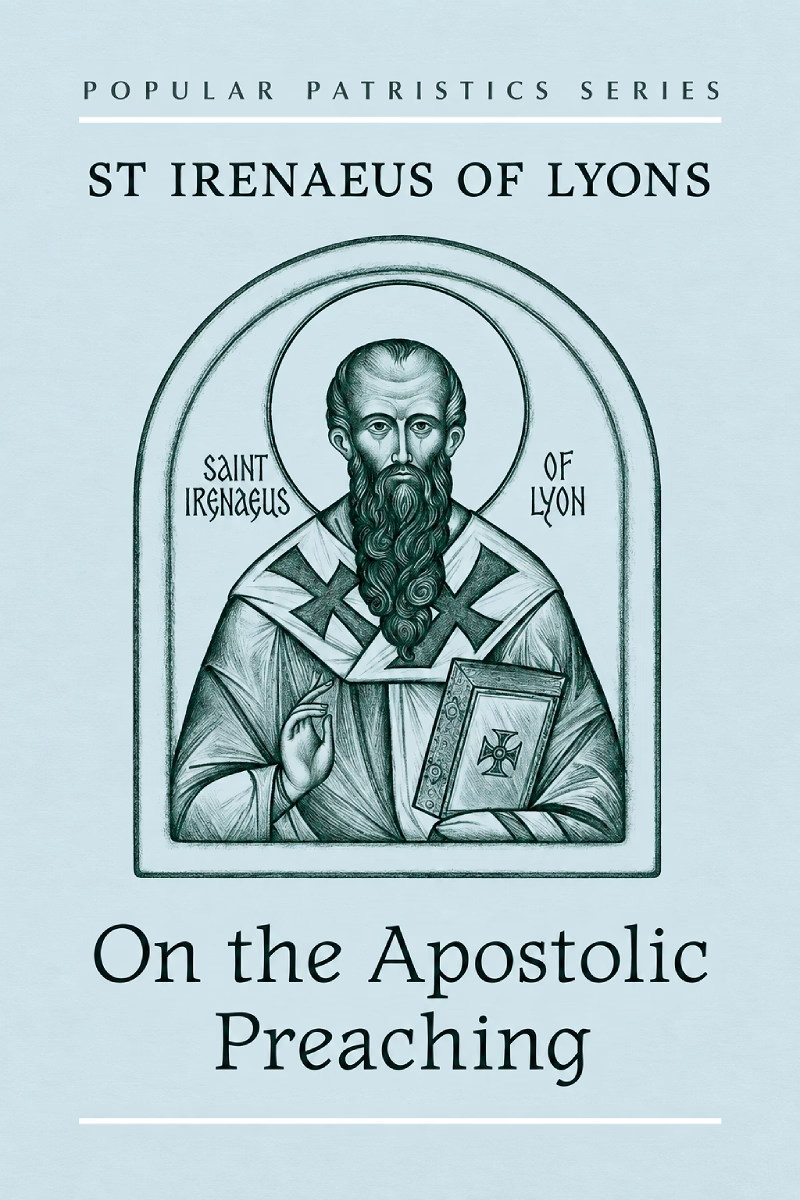
St. Irenaeus of Lyons: On the Apostolic Preaching
Irenaeus gives a compact map of the apostolic faith and then traces it through Scripture, from creation, Adam, the flood, Abraham, and the covenants to Christ’s incarnation, cross, resurrection, and kingdom. Old Testament prophecy and biblical types become a Christ-centered demonstration of one God’s continuous saving purpose from creation to fulfillment.
Available Instantly
About This Book
On the Apostolic Preaching, often called the Demonstration of the Apostolic Preaching, is Irenaeus of Lyons’s concise presentation and biblical demonstration of the Christian rule of faith. Addressed to Marcianus as a “manual of essentials,” it has two closely joined purposes: to summarize the apostolic faith that leads to salvation and to show from Scripture that this faith belongs to one continuous work of God fulfilled in Jesus Christ. The book is therefore both doctrinal and deeply biblical, moving from creation and covenant history into an extended Christ-centered reading of Old Testament prophecy.
Irenaeus begins with the one God and Creator, his Word or Son, and the Holy Spirit. The rule of faith is presented in a triune form: the Father is maker of all things; Jesus Christ the Son of God was manifested in prophecy and became human for salvation; and the Holy Spirit spoke through the prophets and is poured out for the renewal of humanity. Baptism, new birth, eternal life, the incarnation, death, and resurrection of Christ are placed within this framework. The reader is not given isolated doctrines but a connected account of how God creates, reveals, saves, and restores.
The first major movement follows biblical history. Irenaeus recounts the creation of humanity in God’s image, Adam and Eve, Paradise and disobedience, Cain and Abel, the flood, Noah and the covenant, the division of the nations, Abraham and the promises, Israel, Moses, the law, and the inheritance. Genesis is especially important, but the narrative extends through Exodus and Deuteronomy and into Israel’s later history. Irenaeus repeatedly uses biblical events typologically. Adam and Christ are connected through recapitulation; Eve’s disobedience is answered by obedience in the economy of salvation; the tree of disobedience is set in relation to the cross; and patterns within Israel’s history prepare for Christ. These connections present salvation as restoration rather than as a divine plan unrelated to creation.
The second major movement demonstrates Christ from the prophets. Psalms and Isaiah receive recurring and substantial attention, alongside Moses, Jeremiah, Micah, Hosea, Ezekiel, and Zechariah. Irenaeus gathers prophecies concerning Christ’s Davidic identity, birth, suffering, crucifixion, death, resurrection, ascension, reign, and the calling of the Gentiles. The argument is not simply that individual predictions came true. The prophets, covenants, types, and promises form one continuous witness to the Son who was active in God’s purpose before becoming flesh. This gives the work strong biblical-continuity and Bible-prophecy dimensions.
A distinctive doctrine throughout the Demonstration is recapitulation in Christ. The Son becomes truly human to take up humanity’s history, reverse disobedience, abolish death, reveal life, and unite humanity to God. Incarnation, cross, and resurrection therefore belong to the same saving movement. Redemption is bodily and historical, yet also directed toward renewal, eternal life, and the kingdom. The Holy Spirit’s work likewise connects the prophets with the church’s present life, showing continuity between promise and fulfillment.
The book answers foundational questions in unusually concentrated form: What did Irenaeus regard as the core apostolic faith? How do creation, covenant, prophecy, Christ, and salvation belong together? Why did early Christians read the Old Testament as a witness to Christ? How do biblical types and prophecies support the gospel? And how does Christ restore the human story that began with Adam? For readers seeking an early Christian overview of salvation history, Christ in the Old Testament, the rule of faith, or the unity of Scripture, On the Apostolic Preaching provides a compact but theologically demanding synthesis. Its controlling idea is that the Christian proclamation is not an isolated message added to Scripture; it is the fulfillment of the one Creator’s purpose announced beforehand and brought to completion in Jesus Christ.
Book Details

Reading Fit
STUDY LEVEL
Advanced, Intermediate
STUDY SCOPE
Entire Bible, Topical
BOOKS INCLUDED

Edition & Format
PUBLISHED
July 6, 2026
AVAILABLE FORMATS
paperback, kindle, audiobook
LENGTH
121 pages
· 2h 52m audio

Topics Covered
You Might Also Like