
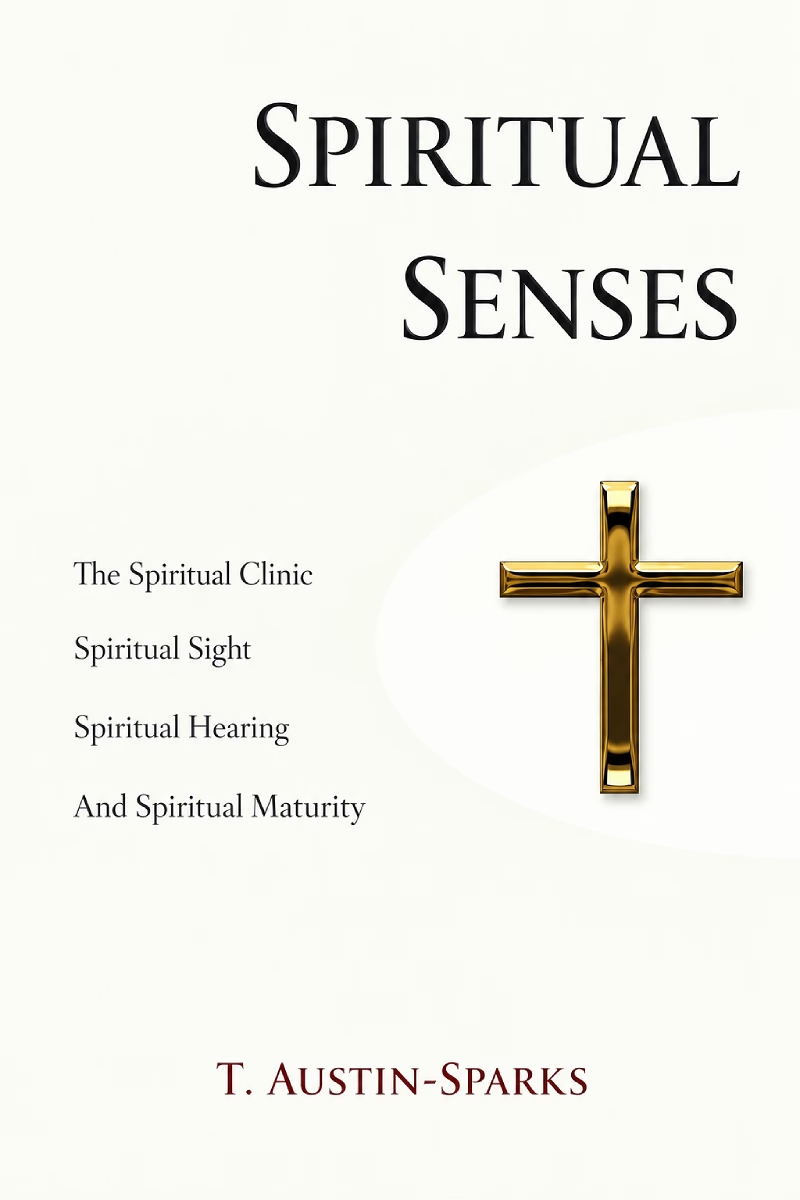
Spiritual Senses: Guided by the Holy Spirit
T. Austin-Sparks explores the inward spiritual senses by which believers see, hear, perceive, and respond to God. Centered on the revelation of Christ within, the book develops spiritual sight, discernment, the Holy Spirit’s work, and growth from natural or merely external religion into exercised spiritual capacity and mature knowledge of Christ.
Available Instantly
About This Book
Spiritual Senses: Guided by the Holy Spirit is a four-part compilation of writings by T. Austin-Sparks centered on inward spiritual knowledge, the revelation of Jesus Christ, and progress toward spiritual maturity. Its governing distinction is between Christianity as an external religious system and Christianity as an inward work of God. Galatians 1:15–16 supplies the language for that distinction: the Christian life is comprehended in God revealing His Son within the believer. The book therefore directs attention away from merely prescribed religious conduct toward spiritual capacity that can perceive, know, and respond to Christ.
The idea of spiritual senses describes inward faculties that correspond, by analogy, to natural seeing, hearing, and perception. These capacities are not presented as stronger natural intelligence or greater religious education. They belong to spiritual life and are developed through the Holy Spirit’s work and the believer’s spiritual exercise. Maturity is connected with having spiritual capacity that has been exercised through experience so that a believer does not remain dependent upon outward forms, secondhand understanding, or the judgments of natural reason.
Spiritual sight forms a substantial line within the compilation. Sparks treats true seeing as a work of divine illumination. Saul of Tarsus is an important example: intense religious zeal did not itself give him spiritual sight. His encounter with Christ exposed the difference between natural religious certainty and inward revelation. The language of blindness, opened eyes, darkness, and light is used to show that spiritual truth may be stated accurately and yet remain unseen until God gives inward sight. The ministry of the Word is therefore dependent upon the Holy Spirit; a speaker can communicate what he has seen, but only the Spirit can open the inward eyes of another person.
This teaching also develops the problem of spiritual blindness among believers. Second Corinthians and John contribute to the contrast between veiled or blinded perception and the light that comes in Christ. Natural faculties, inherited religious ideas, personal interests, and established judgments can become barriers to spiritual seeing when they occupy the place of revelation. Spiritual sight requires an inward adjustment to Christ rather than confidence in zeal, learning, or tradition.
Spiritual perception is closely related to discernment. The believer needs capacity to recognize what is genuinely of God and to distinguish it from what proceeds only from natural life or outward religious appearance. This discernment is not presented as suspicion or analytical cleverness. It grows through the Holy Spirit’s teaching and through spiritual senses that are exercised. The movement from infancy toward maturity therefore involves responsibility, experience, and an increasing inward responsiveness to God.
The compilation also places spiritual development in the context of God’s deeper dealings. Desolateness, limitation, suffering, and experiences in which natural resources fail can become part of the process by which spiritual capacity is enlarged. Sparks does not treat maturity as the accumulation of information. God’s aim is a deeper apprehension of Jesus Christ and a life increasingly governed by what the Holy Spirit has made real inwardly.
Christ remains the object of spiritual revelation throughout this framework. Spiritual sight is not sought as an independent experience, and spiritual senses are not ends in themselves. The Holy Spirit makes Christ known, opens the believer to God’s purpose in His Son, and develops capacity to recognize what corresponds to Him. The result is intended to be mature spiritual understanding, greater responsiveness to God, and a ministry that communicates life rather than merely religious information.
The book addresses questions such as: What are spiritual senses? What does it mean to have spiritual eyes opened? Why can religious zeal exist together with spiritual blindness? How does the Holy Spirit give inward understanding? How does spiritual discernment develop? What is the difference between natural judgment and spiritual perception? Why does maturity require exercised capacity and experience? And how can God use desolateness and limitation to enlarge a believer’s knowledge of Christ?
Book Details

Reading Fit
STUDY LEVEL
Advanced, Intermediate
STUDY SCOPE
Topical
BOOKS INCLUDED

Edition & Format
PUBLISHED
December 13, 2011
AVAILABLE FORMATS
paperback, kindle
LENGTH
235 pages

Topics Covered
You Might Also Like