
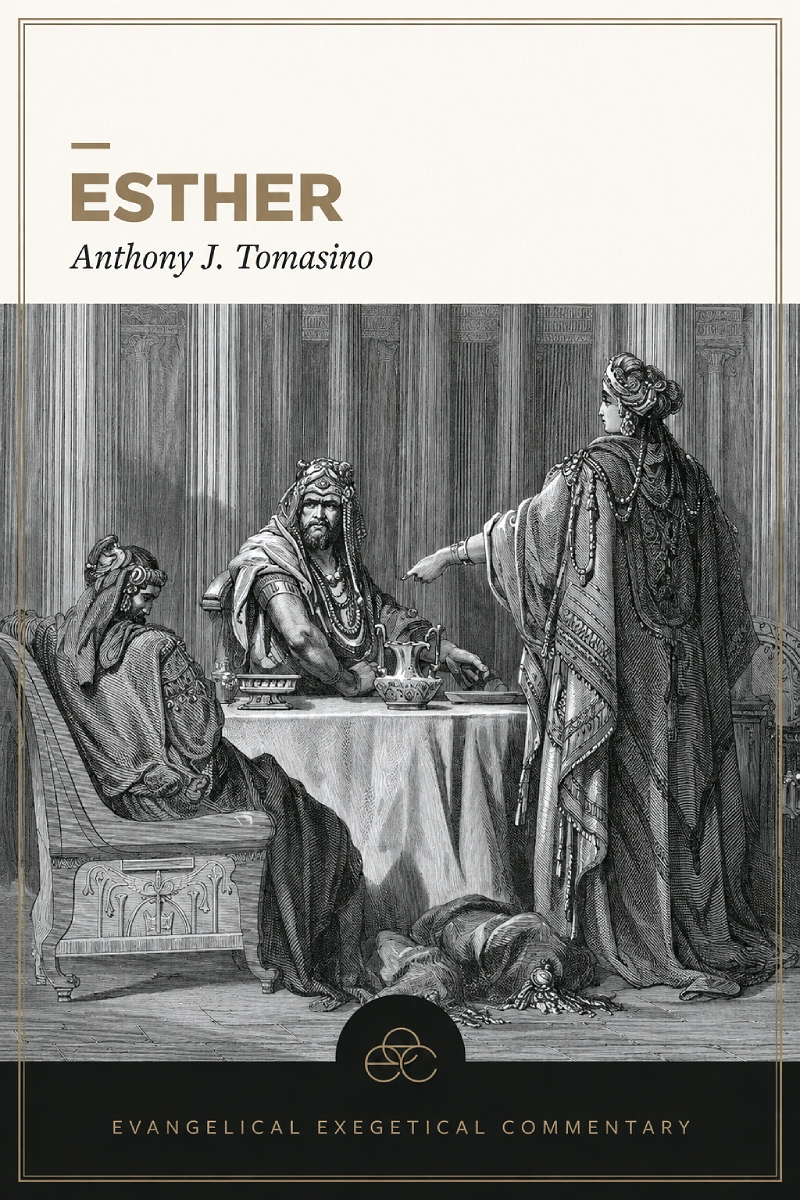
Esther (Evangelical Exegetical Commentary)
Tomasino’s detailed commentary on Esther examines the Hebrew narrative through its Persian setting, literary reversals, feasts, royal power, assertiveness, Purim, and the preservation of the Jewish people. He shows how God’s hidden providence emerges through coincidence and irony even though the book never names God.
Available Instantly
About This Book
Anthony J. Tomasino’s Esther in the Evangelical Exegetical Commentary is a detailed exegetical study of the Hebrew book of Esther that asks what the story is actually communicating beneath its familiar plot. Tomasino pays close attention to the Hebrew text, Persian setting, narrative movement, and recurring literary motifs. Among the themes he develops are feasting, sovereignty, assertiveness, reversal, the preservation of the Jewish people, the origin and significance of Purim, and the striking fact that God is never explicitly mentioned.
The commentary follows Esther as a carefully constructed narrative in which power appears to belong to Persian rulers and officials, yet events repeatedly move in unexpected directions. The royal court is marked by banquets, decrees, status, counsel, and political vulnerability. Vashti’s removal, Esther’s rise, Haman’s advancement, the threat of genocide, Mordecai’s eventual honor, and the reversal of Haman’s plot form a sequence in which apparent security repeatedly collapses. Tomasino treats reversal not merely as a storytelling device but as a major interpretive key to the book.
God’s absence from the wording of Esther becomes one of the commentary’s central theological questions. Tomasino draws attention to coincidences, timing, irony, and reversals that disclose providential direction without explicit divine speech or miracle. The result is a theology of hidden providence: the narrative portrays circumstances in which God may appear absent while events nevertheless move toward the preservation of his people. This gives the commentary strong relevance for readers asking how to recognize God’s care when there is no obvious supernatural intervention.
Esther herself is examined not simply as an idealized heroine but as a person who must act within a dangerous political system. Her decision to approach the king, her use of banquets, and her increasing assertiveness are important to Tomasino’s reading. Mordecai’s role, Haman’s hostility, Xerxes’ dependence on advisers, and the vulnerability of the Jewish population are all interpreted within the power structures of the Persian court. The commentary therefore helps readers understand courage, initiative, influence, and risk without detaching them from the story’s political and communal stakes.
Tomasino also gives major attention to the preservation of the Jews and the establishment of Purim in Esther 9. The deliverance is not treated as an incidental happy ending; it explains why the Jewish community remembers the reversal of threatened destruction through an enduring feast. The motifs of feasting and reversal converge here as mourning is turned to celebration and the threatened people survive.
Because this is an exegetical commentary, Tomasino does more than retell the story. He studies literary details, historical setting, and the movement of the Hebrew narrative in order to clarify how the book communicates. His discussion is especially useful for readers asking: Why does Esther never mention God? What is the theological meaning of the story’s reversals? How does divine providence operate through ordinary events? Why is Purim central to the book? How should Esther’s courage and assertiveness be understood? How does the book portray life for Jews under Persian rule?
The commentary’s governing contribution is to show that Esther’s theology is communicated indirectly. The preservation of the Jewish people, the collapse of Haman’s plan, and the repeated turning of expected outcomes reveal a providence that is hidden rather than absent. Tomasino’s close reading therefore makes Esther a study in God’s unseen action, communal survival, courage under threat, and the literary power of reversal.
Book Details

Reading Fit
STUDY LEVEL
Advanced, Intermediate
STUDY SCOPE
Individual Book, Old Testament
BOOKS INCLUDED

Edition & Format
PUBLISHED
November 2, 2016
AVAILABLE FORMATS
hardcover
LENGTH
416 pages

Topics Covered
You Might Also Like