

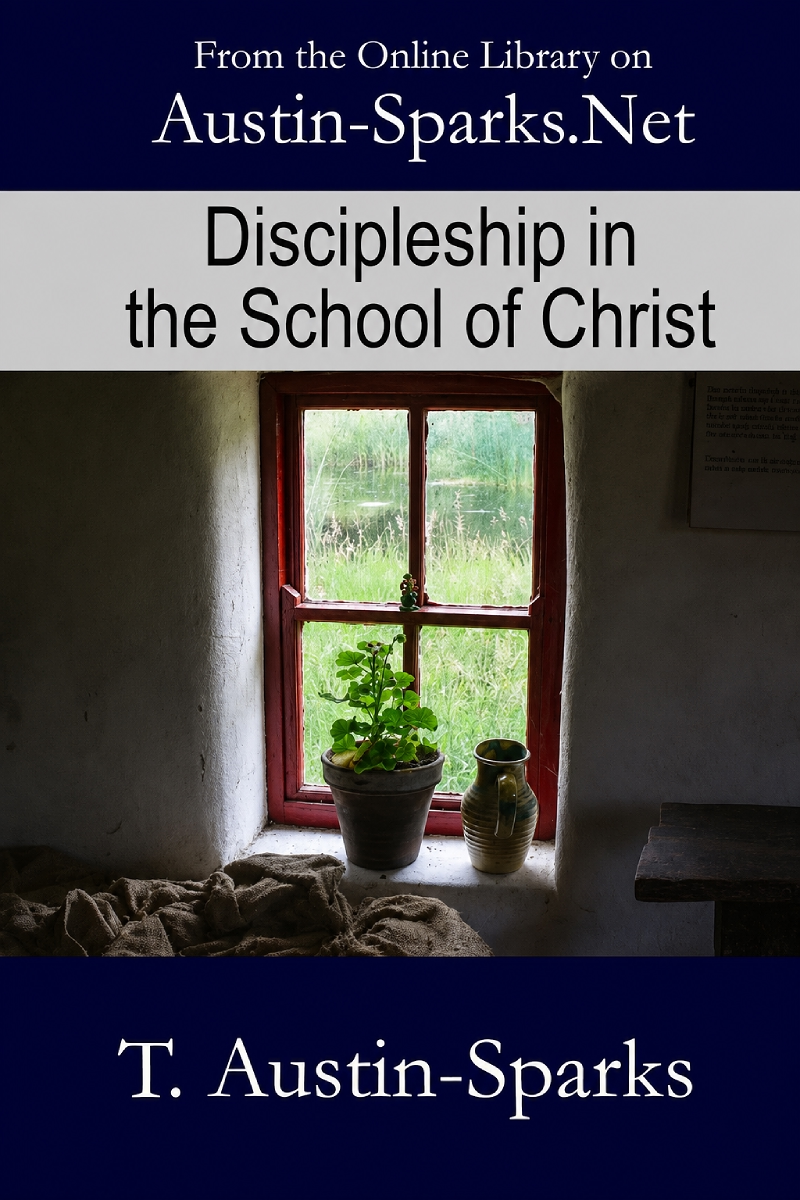
Discipleship in the School of Christ
T. Austin-Sparks presents discipleship as the inward schooling of believers in Jesus Christ Himself. Using the seven signs in John, he traces divine life as new supply, freedom from bondage, sufficiency, triumph over limitation, spiritual sight, and resurrection power, showing how faith grows as disciples learn Christ through experience rather than information alone.
Available Instantly
About This Book
Discipleship in the School of Christ presents Christian discipleship as the lifelong spiritual education of learning Jesus Christ Himself. T. Austin-Sparks begins with Christ’s invitation in Matthew 11:29, “learn from Me,” and distinguishes inward knowledge of Christ from merely accumulating information about Christianity. The disciple is an apprentice whose central occupation is to know the Lord in experience. For Sparks, Christ is not only the Teacher but the content of the lesson: true spiritual education progressively reveals what Christ is, how His life operates, and how believers learn to live from His resources rather than their own.
The Gospel of John supplies the book’s governing biblical framework. Sparks takes John’s seven selected signs as a deliberate course of spiritual instruction concerning the divine or eternal life that is in the Son. John 1:4 and 20:30–31 help establish the central idea: the life Christ gives is not simply endless existence, but God’s own life manifested in the Son and received by faith. This life is supernatural in nature and sufficient for conditions that expose the weakness and limitation of natural human resources.
The signs are treated progressively. At Cana in John 2:1–11, the exhausted supply of wine becomes a setting for new divine provision, showing a life that answers human failure and inadequacy. The healing of the official’s son in John 4:46–54 shows that Christ’s life is not limited by distance or ordinary conditions of time and space. The healing at Bethesda in John 5 develops deliverance from long-standing bondage and from the inability of the natural person to meet divine requirement. Sparks connects this with the practical problem of believers who experience the Christian life mainly as demand and discover that determination alone cannot produce spiritual liberty.
John 6 provides two further lessons. The feeding of the multitude reveals Christ as all-sufficient and inexhaustible when human resources are plainly inadequate. The disciples are trained not to measure the Lord’s possibilities by what they possess naturally. Jesus walking on the sea then presents divine life as triumphant over adverse forces and circumstances that would otherwise overwhelm them. The school of Christ therefore includes situations beyond natural strength because those situations become occasions for learning the sufficiency and ascendancy of Christ.
John 9 develops spiritual sight. The man born blind becomes a picture of the difference between outward religious knowledge and inward illumination. Sparks emphasizes that true discipleship requires eyes opened to perceive Christ spiritually; inherited judgments and religious tradition cannot substitute for personal revelation. This gives the book particular relevance to readers asking how spiritual understanding grows, how believers learn to recognize what God is showing them, and why genuine knowledge of Christ may challenge established human estimates.
The raising of Lazarus in John 11 brings the sequence to its climax. Christ reveals Himself as “the Resurrection and the Life,” and divine life is shown overcoming death in its fullest expression. Sparks reads the preceding signs as successive demonstrations of the same life meeting failure, distance, bondage, insufficiency, hostile conditions, blindness, and finally death. Resurrection life is therefore not only a future doctrine but a present spiritual principle by which believers learn Christ where natural life reaches its limit.
The book also develops Christ’s relationship with the Father as the pattern and source of this life. Jesus lives in conscious union with, dependence upon, and obedience to the Father; believers are brought into participation in the life that is in the Son. The Holy Spirit makes this knowledge inward and experiential rather than merely intellectual. Faith grows through this practical training as disciples encounter circumstances that demand something beyond themselves and discover that the answer is found in Christ.
Sparks’s concern is thoroughly practical. He addresses what discipleship really means, how a Christian learns Christ rather than only Christian doctrine, how eternal life becomes present spiritual experience, why God permits situations that exhaust natural strength, how bondage to sin and death is overcome, how spiritual sight develops, and how believers can live from Christ’s sufficiency in adversity and service. Romans 6 and Galatians 2:20 reinforce the principle that the Christian life proceeds from identification with Christ rather than the independent natural self. The governing burden is that the School of Christ forms disciples who increasingly know Jesus inwardly and express His divine, resurrection life in actual Christian living.
Book Details

Reading Fit
STUDY LEVEL
Fundamental, Intermediate
STUDY SCOPE
New Testament, Topical
BOOKS INCLUDED

Edition & Format
PUBLISHED
November 12, 2013
AVAILABLE FORMATS
paperback, kindle
LENGTH
88 pages

Topics Covered
You Might Also Like