

Church and the Work (3 volume set)
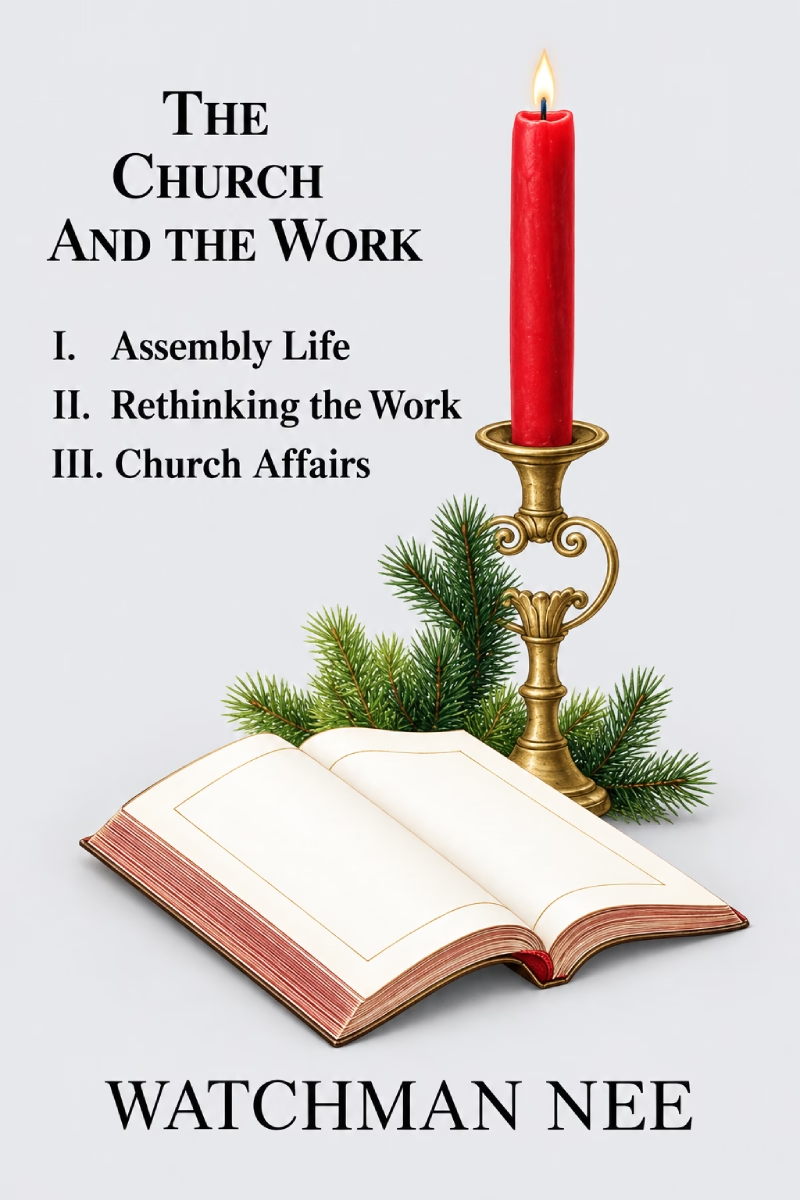
Across three volumes, Watchman Nee gives an unusually detailed treatment of practical church life and the Lord’s work: local assemblies, apostles and workers, elders and deacons, church authority and fellowship, meetings, ministry of the Word, finance, and the relationship between local churches and extra-local work—all under Christ the Head.
Available Instantly
About This Book
The Church and the Work is a three-volume collection devoted to the practical side of the church and the Lord’s work. Watchman Nee’s controlling conviction is that God’s purpose includes the corporate Christ, the Church as the Body of Christ, and that spiritual truth concerning the Body must become concrete in the life of local assemblies. The set therefore moves from the principles of assembly life into detailed questions of workers, apostles, elders, ministry, meetings, fellowship, finance, and the relationship between local churches and extra-local work.
Volume 1, Assembly Life, establishes several foundational features of local church practice. It treats authority in the church and eldership, fellowship among local churches, how believers should meet, and the boundary of a local assembly. The locality of the church is not presented as an administrative convenience but as a practical expression of the one Body in a definite place. Nee is concerned with how believers can meet as the church rather than as a party built around a leader, doctrine, mission, or other ground of division.
Volume 2, Rethinking the Work, develops the extra-local work and its relationship to the churches. It asks who apostles are, how they are sent and move in the work, how churches are founded, how elders are appointed, what constitutes the ground of union and division, how the work and the churches differ while remaining related, how workers should coordinate, and how financial matters should be handled. Acts is a major biblical framework for these questions because it shows apostles preaching the gospel, establishing churches, appointing elders, and moving beyond one locality. Nee repeatedly distinguishes apostolic responsibility in the work from the local government committed to elders within an established assembly.
This distinction makes the set especially useful for readers asking practical questions about church planting and leadership. What is the difference between an apostle or worker and a local elder? Who governs an established local church? How should workers relate to churches they helped establish? How independent should local assemblies be, and how do they preserve spiritual fellowship with other churches? What is the basis of genuine Christian unity, and when does a distinct grouping become a division? Nee treats these not as abstract ecclesiology but as operational questions arising from the work.
Volume 3, Church Affairs, returns to detailed church practice and service. It discusses the order of church offices, elders, deacons, priestly and Levitical ministry, ministers of God’s Word, various kinds of meetings, the local assembly as a center of work, the relation between assembly and work, coordination among workers, apostles and co-workers, finance, and practical questions and answers. First Timothy and Titus contribute to the treatment of elders, deacons, qualifications, and order, while 1 Corinthians—especially the principles of corporate meeting and mutual ministry associated with chapter 14—helps shape the discussion of assembly meetings and functioning.
Underlying the practical instruction is Nee’s theology of the Body. First Corinthians 12:12 identifies the church with the corporate Christ, while Colossians 2:19 emphasizes holding fast the Head so that the Body is supplied and knit together. Ephesians contributes the themes of the one Body, the unity of the Spirit, gifts, ministry, and building up. The Holy Spirit is therefore not peripheral: the work is God’s work, the church is Christ’s Body, and workers and local leaders must recognize spiritual order rather than substitute human organization for divine government.
Because of its breadth and detail, the set addresses readers responsible for local church life, ministry, church planting, or Christian work. It can surface for questions about biblical eldership, apostles and apostolic work, church government, how church meetings function, how local churches relate to one another, the ministry of the Word, deacons, priestly service, financial practice, and the proper relationship between a local assembly and workers serving beyond it. The three volumes are united by one aim: to make the spiritual reality of Christ’s Body practical in the ordered, functioning life of the church and the work.
Book Details

Reading Fit
STUDY LEVEL
Advanced, Intermediate
STUDY SCOPE
Topical
BOOKS INCLUDED

Edition & Format
PUBLISHED
September 1, 1982
AVAILABLE FORMATS
paperback, kindle
LENGTH
798 pages

Topics Covered
You Might Also Like